Wednesday, April 6, 2022

Reporting from Shangri-La: Richard Tregaskis and the Doolittle Raiders

International News Service correspondent Richard Tregaskis had been eager to test his courage in combat when he was sent by the wire service to report on U.S. Navy task forces sailing for missions from Pearl Harbor against the Japanese. He finally got his chance in early April 1942, but he and the other Americans onboard the USS Northampton (CA26) could not know that they were on their way to be a part of an audacious attempt to strike back at the Japanese and gain a measure of revenge for the attack at Pearl Harbor--a mission cloaked in secrecy for a year after its undertaking.

The cruiser was part of Task Force 18, which included ships under the command of Vice Admiral William F. “Bull” Halsey Jr., and they were sailing for a midocean rendezvous with Task Force 16, which included a newly commissioned carrier, the $32 million, approximately 20,000-ton USS Hornet. The Hornet and its escorting ships sailed from San Francisco Bay on April 2. Once the two task forces rendezvoused, the ships set course on a secret assignment to bomb Japan. Instead of its usual complement of Douglas SBD Dauntless dive-bombers, Douglas TBD Devastator torpedo aircraft, and Grumman F4F Wildcat fighters, the Hornet had crammed on its narrow flight deck sixteen twin-engine B-25B Mitchell army bombers of the Seventeenth Bombardment Group under the command of Lieutenant Colonel James H. Doolittle.

The Seventeenth had been the first group to receive the new bombers, named for military aviation pioneer Major General William “Billy” Mitchell and designed and built by North American Aviation, the firm responsible for the development of such successful aircraft as the T-6 Texan trainer and the P-51 Mustang fighter. The bombers and their small, five-men crews (pilot, copilot, bombardier, navigator, and engineer/gunner) had been ordered to hit industrial and military installations—steel factories, gas and chemical plants, and power stations—in Tokyo, Yokohama, Osaka, Kobe, and Nagoya. If they survived their bombing run, the crews were supposed to land at airfields hurriedly being prepared for them in China.

Since the destruction at Pearl Harbor President Franklin D. Roosevelt had been seeking a mission against Japan that would bolster morale in the United States and in other Allied countries. According to Lieutenant General Henry “Hap” Arnold, the head of the U.S. Army Air Forces, the president had insisted that his military commanders “find ways and means of carrying home to Japan proper, in the form of a bombing raid, the real meaning of war.” To meet Roosevelt’s goal, Captain Francis Low, an officer on the staff of Admiral Ernest King, commander in chief of the U.S. Fleet, came up with the idea to use the Hornet as the launching platform for army bombers to raid the Japanese mainland.

Low worked with Captain Donald Duncan, King’s air officer, to develop a plan for the mission, which received approval from both King and Arnold in early 1942. Arnold tasked the mission to Doolittle, who titled the assignment “Special Aviation Project No. 1” and selected the B-25B bomber, with a cruising range of 2,400 miles, as the aircraft best suited to meet the demands of the mission. The plane’s 67-foot wingspan was barely wide enough to be able to take off safely from the carrier’s narrow, 114-foot-wide deck. Although Doolittle realized the Mitchell’s 2,000-pound bomb load could do “only a fraction of the damage the Japanese had inflicted on us at Pearl Harbor,” its main purpose would be psychological, both boosting American morale and causing “confusion in the minds of the Japanese people and sow doubt about the reliability of their leaders.” He also hoped that the shock might nudge the Japanese military to “divert aircraft and equipment from offensive operations to the defense of the home islands.”

Commanded by Captain Marc Mitscher, the Hornet proved that a Mitchell bomber could take off safely from a carrier with two trial flights off Norfolk, Virginia, in early February. The carrier set out in early March for the West Coast to await delivery of the sixteen modified B-25Bs and their crews at the Alameda Naval Air Station on San Francisco Bay. The planes were loaded by a crane onto the carrier on April 1. Mitscher noted that when all the army bombers had been arranged on the Hornet, the last plane in line “hung far out over the stern ramp in a precarious position. The leading plane [to be flown by Doolittle] had 467 feet of clear deck for take-off” from the 824-foot-long flight deck.

The bombers had been modified to better accomplish their mission, but the airmen knew they faced perilous odds as the Hornet sailed off on April 2 to join Halsey’s task force. Second Lieutenant Chase J. Nielsen, navigator on the bomber nicknamed the “Green Hornet,” figured that his crew had a 50-50 chance of taking off from the carrier without crashing. “If we got off, there was a 50-50 chance we’d get shot down over Japan,” Nielsen recalled. “And, if we got that far, there was a 50-50 chance we’d make it to China. And, if we got to China, there was a 50-50 chance we’d be captured. We figured the odds were really stacked against us.”

Having the 134 army pilots and crewmen sharing cabin space engendered plenty of questions about their purpose, with some navy men believing the bombers were meant for delivery to Hawaii or an isolated American base somewhere in the Pacific. The Hornet crew only learned about their destination after the ship had passed beneath the Golden Gate Bridge and was well out to sea.

Lieutenant Commander Oscar Dodson, the Hornet’s communications officer, responsible for all confidential messages, met daily with Mitscher. On April 3 Dodson remembered going to Mitscher’s cabin and seeing the captain seated at his desk holding a document and smiling. “Without a word he passed the papers to me,” Dodson said. “It was a CNO [Chief of Naval Operations] order for HORNET to launch the B-25s for an attack on Tokyo and other nearby cities. He said quietly: ‘As soon as we are well clear of the shore line, I will announce our mission to the ship.’”

Mitscher spoke to the crew on the ship’s bullhorn, announcing the details about their mission. “In the ship there was a moment of stunned silence,” Dodson noted, “followed by wild cheers which rang throughout the ship.” Still thinking of secrecy, Mitscher, Dodson added, cautioned his men to avoid throwing overboard any “identifying material,” including magazines, letters, daily schedules, or the ship’s newspaper.

Tregaskis remained unaware of the Northampton’s destination during the early days of the voyage. He found the ship’s wardroom a comfortable place to relax after they had reached the open sea, as it had leather-upholstered chairs, some dog-eared magazines, and a continuous supply of hot coffee. “It can be had at almost any time of night or day—replacing old-fashioned (and banned) spirits to warm up cold stomachs,” noted Tregaskis. An officer told the correspondent that on the average four-and-a-half cups of coffee was consumed every day by each person on board.

At dinner, Tregaskis tried to get some of his tablemates to conjecture about where they might be headed. There were plenty of guesses, including Australia and the Indian Ocean to relieve the British fleet. Some sailors anticipated a repeat of former raids on the Marshall and Gilbert Islands. “We’re going on a polar expedition to engage the icebergs,” one sailor joked. When questioned by Tregaskis, Captain Chandler would only say: “You know, when you’re on a ship, there’s no use worrying about where you’re going. It just makes the trip seem longer. How good are you at relaxing?”

Accepting the captain’s mild rebuke, Tregaskis decided to spend part of his time looking for the best spot to be during any action to “watch the fireworks,” as well as investigating the pastimes of the more than 1,000 men onboard the Northampton. One place he investigated as a possible perch was on the bridge, which gave him a good view of the ship. A crew member, however, warned Tregaskis that he had to watch out for the number two turret, as during the raid on Wotje it had caught him unawares and knocked him “ass over teakettle.”

An officer pointed out that a newsreel cameraman who had accompanied the cruiser on its previous raids had set up his camera on the derrick forward of the ship’s after mast, which gave him the opportunity to take cover in a nearby room if the going got too tough. “The only disadvantage of this spot, said my informant, was that when the guns went off, great clouds of soot were knocked loose from the stack and covered the area,” Tregaskis remembered.

Discouraged, the correspondent climbed two levels higher to an open, if precarious, platform upon which, at least, he would be clear of the concussion blasts from the big guns and the resulting showers of soot. “Here I consulted a seaman who laughed and said that the thought this would be as good a place as any. ‘But,’ he pointed to the yard arm, ‘you have to watch out for strafing [aircraft]. On the Wotje trip, we had a bullet in there.’”

The men and ships of Task Force 16 had the answer they were waiting for about their mission on April 12, when, northwest of Midway Island, aircrews from the USS Enterprise were sighted by the approaching Hornet. Soon thereafter, Tregaskis heard the “electrifying news” that the now combined group, designated as Task Force 16, had as its mission a bombing strike against Japan. “We’re four months late, but we’ll give it to ’em now,” Tregaskis heard a gunner exclaim as the news reached the Northampton’s crew.

There was another wave of excitement when he trained his binoculars on the Hornet as it moved closer to the cruiser. He could see a high, irregular mass on the carrier’s deck, which marked the presence of “much larger aircraft than the usual carrier planes. As the ship drew nearer, we could make out the double tails, wide wings, and tricycle landing gears of B-25 army bombers.” Tregaskis believed there must have been “exhaustive” tests done in secret to prove the feasibility of launching such a large plane from a carrier. “Our force was told they will approach to a point about 400 miles from Tokyo. There the bombers will take [to] the air, and we will hightail our way home,” Tregaksis said.

Obviously, Tregaskis noted, the bombers could not return to the carrier deck to land, as there was not enough room nor did the aircraft have the necessary arrester hooks that carrier planes possessed to catch the wires stretched across the flight deck. Spruance suggested to Tregaskis about the possibility of the planes landing in China after their mission. “The admiral was not over-optimistic about our chances of getting away unscathed from the expedition,” the correspondent reported. “He spoke of the long range of the Jap patrol aircraft which might spot us; also of the hundreds of small patrol vessels known to operate along the Jap coast. He spoke of the need for lightning withdrawal after we had made our thrust.” At dinner that evening, a marine captain, crossing the fingers on both of his hands, spoke for many of the crew when he exclaimed: “Oh, oh, oh, God, may they [the bombers] get there.”

On April 17, after refueling, the Enterprise, Hornet, and their supporting cruisers, including the Northampton, sped away from the slower destroyers and oilers to make their final dash to the launching point east of Japan for the Doolittle Raid. The bombers, each of which had been equipped with four 500-pound bombs, were set to take off on the afternoon of April 18.

The afternoon before the scheduled launch, Tregaskis noted that the skies had darkened and the seas were rougher. “The other ships were following in close, but they were barely distinguishable in the heavy, driving mist,” he remembered. “It was perfect weather for our raid—for no Japanese ‘eyes’ could be flying on such a day as this. And so we hurried on to make the most of the weather, rising up over the high combers, rolling and pitching, and shivering from one end to the other, but always crowding on full steam.”

That evening on the cruiser, Tregaskis observed no more “nerves” than usual. Officers read books and played cribbage to pass the time, and one aviation officer entertained others by speaking “earnestly on the subject of airplane armament.” Below decks, the sailors and marines, except for those on watch, had turned in for the night. Tregaskis came upon a veteran petty officer standing alone near the edge of the mess hall and asked him where everyone was. “They’re all squared away for the night,” the man told the correspondent, shrugging his shoulders toward the sailors’ sleeping quarters. “These days when they’re not on watch, they’re so tired they turn in.”

Tregaskis awoke at 4:00 a.m. on April 18 not wanting to miss anything, as there was the possibility the army bombers might take off at dawn, but they did not, remaining firmly tied down. He did uncover a rumor—“scuttlebutt” in navy jargon—that at about 3:00 a.m. the Northampton had detected an unknown ship approximately twelve miles away. When the cruiser turned off course, the mystery vessel turned in the same direction and followed until the Northampton’s superior speed dropped the other ship astern.

At about 7:00 a.m., as he was sitting down to breakfast, Tregaskis heard that a scouting plane had spotted an unidentified ship, but quickly avoided it. Later that morning came a report that the cruiser running behind them had sighted a Japanese patrol boat, the No. 23 Nitto Maru, a modified fishing trawler. These small vessels, dubbed “spitkits” by American sailors, were part of Japan’s early warning system. The Nitto Maru had identified the approaching ships as hostile and radioed a warning home—“enemy carriers sighted. Position 650 nautical miles east of Inubo Saki.”

Fighters and dive-bombers from the Enterprise attempted to sink the Japanese boat, but were unsuccessful, so the cruiser Nashville was sent by Halsey to destroy the vessel. “We could see her streaking towards the horizon, where the Japanese ship was only a faint smudge of gray on the horizon,” Tregaskis recalled. “At last, we had met the enemy.”

Although the Nashville was about four miles away from the Northampton when it opened fire, Tregaskis could plainly see the “brilliant flashes” from the cruiser’s six-inch guns. “Clouds of dirty smoke, with a yellowish hue, were rising over the cruiser. And near the horizon we could see tall narrow geysers like a line of white columns, springing into existence,” he observed. “Then the small popping sound of the gunfire came to us from the distance. Sound is slow to travel in such vast spaces. Almost immediately, the bright flashes of a second salvo burst along the cruiser’s deck. And then the bright little sunbursts of color came in rotation, rolling up and down the length of the ship.”

Tregaskis, who called the action an “impersonal introduction to the art of war,” learned that before the Nitto Maru went under, it had charged at the much larger ship, firing its “three-inch deck gun, until it was blown apart.” Mitscher had briefed Doolittle on the encounter with the Japanese picket boat, telling him, “It looks like you’re going to have to be on your way soon. They know we’re here.”

With secrecy compromised and other enemy patrol craft dotting the sea, Halsey decided to proceed with the mission twelve hours ahead of schedule and 150 nautical miles farther away than planned. The admiral sent a message to the Hornet that read: “Launch Planes. To Col. Doolittle and Gallant Crew: Good Luck and God Bless You.” At 8:03 a.m. the crew on the Hornet heard the announcement: “Now hear this! Now hear this! Army pilots, man your planes.”

Because the Northampton had moved into a position to protect the Hornet, Tregaskis had a “marvelous view of the activity on her flight deck. If the demonstration had been arranged for our benefit, we could not have had better ‘seats.’” Sailors and marines busy on the cruiser’s deck snatched seconds from their duties, despite the constant danger of an enemy air raid, to watch what was happening on the carrier, entering into the action “as wholeheartedly as a great football audience,” Tregaskis reported.

The correspondent could see small figures hurrying around on the Hornet’s deck starting the B-25B’s engines. At about 8:20 a.m. the first of the bombers, piloted by the mission’s commander, Doolittle, with Second Lieutenant Richard Cole as his copilot, “waddled forward” to begin its takeoff. At that moment Tregaskis noticed that the wind had increased to “almost gale force” and he could see the Hornet varying its speed to find a moment at which the least pitching would occur in the raging seas. “I could hear the motors now as the bomber inched forward gaining speed,” he remembered. “Soon the craft was airborne, lifting gradually from the deck of the carrier as a great shout rang out on our deck from the sailors and marines who were awaiting this sight for many days.”

Doolittle’s plane staggered into the wind, leveled off, “moving steadily but low, over the waves and gaining speed,” Tregaskis observed. The B-25B eventually swung over the ships in a slow circle, accompanied by “great cheers” from the crew of the Northampton. “Nobody spoke of the great dangers facing this intrepid crew,” Tregaskis recalled.

All the remaining army bombers took off successfully from the Hornet, but some just barely. The fourth bomber in line appeared to almost stall, Tregaskis recalled, and “it hung sluggishly over the sea its nose pointed upward, but the plane fell forward toward the high waves.” The concerned crew on the Northampton groaned in anticipation of a crash and cried “Up, up” as the bomber staggered down a few feet more to almost hit the waves, gained altitude for a moment, and bogged down again. “The plane was sinking, but finally gained speed, power and height, and streaked off into the stormy sky,” Tregaskis reported, adding that a nearby marine commented, “That makes me feel good all over.”

As the bombers continued to streak off the Hornet, the weather worsened and the seas grew even rougher, breaking over the carrier’s bow. “It’s the first time in my life I ever saw that happen; I probably will never see it again,” one of the Northampton’s officers said to Tregaskis. “Waves breaking over the flight deck of a carrier.” Green water also crashed over the cruiser’s bow, with the water reaching as high as the ship’s navigation bridge. “Steel uprights on our midship deck were bent like bows,” Tregaskis noted. “The captain’s coat was soaking wet and our stacks were dripping with salt water.”

During all this, lookouts on the Northampton received a report that Japanese aircraft had been spotted at a range of 30,000 yards, but later learned what they had seen was an American plane. Tregaskis continued to watch as the final B-25B prepared for its take off. “The last plane wobbled down the deck and paused, waiting for a giant swell to pass by,” he noted. “While the bomber paused, a second gigantic wave rolled into the carrier and crashed high over the flight deck. With field glass[es], I could see the spray sweeping through the propellers of the plane.”

The aircraft’s motors, however, did not stall and after a few seconds the bomber moved slowly into the wind, steadied itself, and rose abruptly into the sky. Picking up speed after it was airborne, the B-25, nicknamed “Bat Out of Hell,” made a slow turn over the Northampton and its crew could see the star insignia on its fuselage and the large words “U.S. Army” on the underside of its wings. “I could make out the black silhouetted figure of a gunner in one of the plane’s transparent ‘bubbles’ or turrets,” Tregaskis reported. “I wondered then if this one man—the [only] one whom I had seen as an individual since the planes began to take off—would survive.”

As the correspondent pondered the army crewman’s fate, the Northampton and the Hornet made sharp U-turns and, with the Enterprise and other escorting cruisers, headed for home “at our greatest possible speed,” twenty-five knots (approximately twenty-nine miles per hour). On the Hornet, a relieved ensign, Robert Noone, reflected that after the last bomber had left the carrier there was “a physical let down all over the ship. Everyone was exhausted from the nervous tension of watching them take off. We mentally pushed every plane off the deck.”

Although the Japanese military had intercepted radio traffic that hinted at a possible U.S. fleet attack, they expected any such mission to be launched from closer to land, approximately 200 miles, the expected range of a carrier plane. They had no expectation of being attacked by long-range army bombers. Doolittle’s raiders used their high explosive and incendiary bombs to hit their targets, receiving scattered opposition from antiaircraft batteries and Japanese fighters.

With their fuel exhausted, the bombers, fifteen in all, had to either bail out or crash land in China. The sixteenth, flown by Captain Edward J. York, went off course and had to land near Vladivostok in the Soviet Union. Although treated well, its crew was interned by military authorities, but managed to escape from the country in May 1943. Doolittle, looking at the thousands of pieces of shattered metal that had once been his plane, sat down on a wing at his crash site in China and felt as “dejected as a frog’s posterior. This was my first combat mission. I had planned it from the beginning and led it. I was sure it was my last.”

As he sat there, Doolittle saw his gunner/flight engineer, Staff Sergeant Paul J. Leonard, snap his picture. Trying to cheer up his pilot, Leonard asked him what would happen when they got back to the United States. A dejected Doolittle predicted that he would be court-martialed and sent to prison at Fort Leavenworth. Leonard had a different fate in mind for his commander, telling Doolittle he would be promoted to general and given the Medal of Honor.

Leonard’s prediction came true, but what brought tears to Doolittle’s eyes was his staff sergeant’s comment that when Doolittle was given charge of another airplane, he wanted to serve as his crew chief. “It was the supreme compliment that a mechanic could give a pilot,” Doolittle said. “It meant he was so sure of the skills of the pilot that he would fly anywhere with him under any circumstances.” 

The weather remained overcast and windy as Task Force 16 sped away from Japan’s home waters. An officer confided to Tregaskis that they would probably not have to worry about the Japanese fleet, but still faced danger from patrolling submarines, on the lookout for the Americans. One morning the cruiser tested its guns and the sudden “blasting and banging, without notice, set jittery nerves to jumping,” Tregaskis recalled.

Because the ship’s course had changed sharply during the night, and it seemed to be heading directly for a hostile island base, Tregaskis and others wondered if the task force might be headed for another attack on the enemy. “It was obvious many of the officers wanted to do that,” Tregaskis remembered. One officer told him: “Wild Bill Halsey’s going to hit ’em again before he hauls out of here.” The correspondent, however, could uncover no confirmation for such a plan. He talked to an officer higher up the chain of command, who admitted they knew nothing official but were willing to bet him that the task force was headed “straight home.” Later that day the matter was settled when the ship’s course reverted to its former direction. “And thus more scuttlebutt was laid to rest—as it usually is,” wrote Tregaskis.

During its high-speed run to Pearl Harbor, the Northampton picked up a news report from Los Angeles that quoted Japanese shortwave broadcasts indicating that Tokyo had been bombed by American aircraft. One of the cruiser’s lieutenants reported that the Japanese had claimed they had shot down one of the U.S. planes and gave a purported interview with one of the pilots in which he had confessed that he had been forced to make the flight against his will. “Which gave a good laugh to all of us who had witnessed the unfaltering bravery with which the bombers took off,” Tregaskis wrote. “A good laugh, and a twinge of sadness when we thought some had not come through.”

At lunch, a marine officer had cut through the table chatter with something that was on the minds of several of the crew: “I can’t believe it,” Tregaskis remembered him saying. “Can’t believe what?” he was asked. The marine responded: “I can’t believe that we got over there and back, and sent out our planes, without even a bomb falling on us. It’s impossible.”

Unfortunately for Tregaskis, due to wartime secrecy it took a full year for his articles about the raid to appear in American newspapers.


Friday, March 18, 2022

Soldier and Artist: Harry A. Davis Jr. at War

Situated on the Janiculum Hill, the American Academy in Rome has, since its establishment in 1894, been home to visiting scholars and artists from the United States seeking support and inspiration for their work. During the heady days of Rome’s liberation during World War II, one of the academy’s former students, Harry A. Davis Jr., a sergeant in the U.S. Army, made his way to what had been his art studio at the academy just a few years before.

Davis discovered that everything was just as he had left it, including his paintings and personal effects. He also found that his worst fears about the colleagues he had left behind had not come to pass. Although showing “distinct signs of having suffered from a lack of food,” his friends at the school “were all alive, happy to see Americans again.” With his company bivouacked on the grounds of a nearby estate, the sergeant was able to make several trips to the academy, “each time taking some of my ration of candy, for they had no sweets for several years,” in addition to other supplies.

A graduate of Indianapolis’s John Herron Art School, Davis, from Brownsburg, Indiana, had experienced numerous travails since being honored in 1938 with the multiyear Prix de Rome fellowship for a series of his paintings, including one titled Harvest Dinner, which depicted a large rural family gathered for a meal. The outbreak of another war in Europe had interrupted Davis’s studies and, with his country’s entry into the conflict, he had used his artistic talents to cleverly disguise U.S. military installations and equipment from the enemy through his service with the Eighty-Fourth Engineer Camouflage Battalion. Davis’s arrival in Rome not only brought him back to his student days, but it also altered his wartime career.

Davis was able to wrangle a transfer as a combat artist with the Eighty-Fifth InfantryDivision, working under the supervision of the U.S. Fifth Army’s Historical Section, led by Chester Starr, his friend from his time at the academy. “I was to go along with the Division as they were on the move and while they were at rest, my job was to tell the story, to the best of my ability, of the life of the front-line infantryman, in and out of battle,” Davis recalled. The paintings and drawings produced by Davis and the other combat artists with the Historical Section were later used to help illustrate a nine-volume history of the Fifth Army, and some of his pieces were displayed at the White House.

Upon his return to Indiana at the war’s end, Davis had a successful teaching career as a professor of painting and drawing at Herron for more than thirty years. He also continued to paint, producing more than 500 pieces, many featuring endangered historic buildings in the state. “Most of the work is because I feel a need for it,” Davis said. “Somebody ought to record it. The old landmarks are disappearing so fast.”

Reflecting on his World War II service, he noted that the conflict provided an almost endless amount of material to record, including scenes of violence and bloodshed that he sometimes found hard to stomach. “Torn and crumbling buildings, dead dismembered bodies of soldiers, both our own and the enemies, and rugged and treacherous mountain passes, that were scarred and pitted with shell holes,” Davis wrote in his memoirs about his wartime experiences. He did find time to record on canvas quieter scenes behind the front lines, including American soldiers interacting with Italian families grateful for their liberation. 

Edward Reep, the officer who oversaw the combat artists assigned to the Historical Section, praised Davis for jumping into the thick of the fighting and establishing himself as “a very significant, intrepid member of the unit.” Reep noted that the Hoosier artist involved himself in “gut-level ground warfare” at great personal risk,” and skillfully incorporated soldiers of the Fifth Army as the primary subject matter in his work.

Earning a precarious living as an itinerant minister, Harry Davis Sr. remembered that his namesake, Harry Davis Jr., born on May 21, 1914, possessed an early aptitude for art. “Ever since he was old enough to hold a pencil,” the senior Davis told a reporter, “he has been drawing likenesses of people.” Although local schools offered neither art nor manual training courses, Davis Sr. noted that his son filled their house with “model stage coaches, airplanes, and boats of beautiful craftsmanship which he did just to satisfy the creative urge and to amuse himself.” 

In 1933 the junior Davis entered the Herron School of Art at 1701 North Pennsylvania Street in Indianapolis, supporting his education by winning several scholarships. He began his training at Herron during a time of great changes at the institution under the leadership of the school’s new director, Donald Mattison, a New York artist and teacher. Mattison took on his duties the same year Davis started his studies.

Faced with budget troubles and a declining enrollment, Mattison trimmed the Herron faculty and altered the school’s curriculum so that during their first three years students followed a similar course of study with an emphasis on a firm grounding in drawing, composition, and painting. During their fourth year, students could pick a specialization, including painting, sculpture, commercial art, or teaching. Promising students were able to win scholarships for a fifth year of postgraduate training. “The art school must become the clearinghouse wherein those found unfit for professional work are eliminated,” Mattison observed. “Cold facts, as to proficiency must be recorded and ranked by percentages. Authoritative recognition of the true professional student must exist and adequate instruction must be provided for the deserving students.”

In addition to balancing Herron’s budget, Mattison also inspired his students to aspire to win the art world’s two top honors—the Prix de Rome, which Mattison had won in 1928, and the Charloner Paris Prize. Herron students answered the director’s challenge with gusto. Davis’s 1938 Prix de Rome, which included a stipend and allowance for travel amounting to approximately $1,400 a year, followed one awarded to Clifford Jones in 1937. Sculptor Robert Pippinger captured the prize in 1939, joining Davis at the academy, and Loren Fisher won it in the next year. Davis first learned of his award when fellow Herron students tracked him down while he was relaxing, sunbathing along the Central Canal near Butler University. “I had no expectation of winning,” Davis said to the Indianapolis Star when his prize was announced, “although many people had praised the realism of my picture.”

During his time in Rome, Davis worked on a variety of projects, including a fresco he titled The Sacking of Rome by Alaric, grouping eighteen life-size figures in a setting of an ancient Greek temple. He spent five weeks on the painting, as well as doing drawings and easel paintings in his studio space. Accompanied by other students he also had time to take several trips through Italy, studying the work of old masters in various museums, galleries, palaces, and private homes. “After each period of travel I would go back to the studio and experiment with the technique of old masters,” he remembered. 

Later, Davis did a six-week tour of Greece with another fellow at the academy, Starr, who was studying history. Davis wrote to Mattison that he had grown “tired of going through galleries and seeing art all the time. I wanted to see people and life.” By traveling with Starr, Davis hoped to see “Greece from the point of view of an ancient historian,” and, through his own eyes as a painter, experience the country’s “people, customs, etc.”

Davis also took trips to Turkey, France, and Egypt, a country he particularly enjoyed. “I think people are right when they say it gets under your skin to see this country,” he wrote Mattison in February 1940 about his time in Egypt, which included a stop at the Valley of the Kings on the Nile River’s west bank near Luxor. “I never saw such beauty of workmanship ever.”

In April 1940 Davis learned that the academy had decided to extend his fellowship from two to three years, an offer the Hoosier student accepted. He explained to Mattison that for the past several months he had “found my stride, you might say and now I am painting hard and really am getting someplace. So I’m thinking that I can keep that up next year if I stay then I will be able to have a good deal of work to make a showing.” He and Pippinger had become close, with the sculptor offering Davis “some good constructive criticism” and the two engaging in long, instructive discussions about art. An admirer of Pippinger’s work, Davis noted that the two Herron graduates had “quite a bit in common,” writing Mattison that they were both “interested in accomplishing something and are quite serious about it and we can give one another good suggestions.”

Unfortunately for Davis, the political tensions in Europe had already erupted into war following Nazi Germany’s invasion of Poland in September 1939. By the spring of 1940 the war had made its mark on the academy and its students. “We never know these days what the tomorrows will bring,” Davis explained in a letter to Mattison. “Right now it is hard to concentrate on what you are trying to do and one is almost afraid to start on anything for fear he will not get it finished.” With Nazi Germany’s invasion of France in May 1940, Italian fascist dictator Benito Mussolini, after a period of nonbelligerency, declared war on Great Britain and France on June 10. Joined by Pippinger, Davis left Rome for Naples, where the duo was scheduled to sail home on June 28 aboard the Excalibur, the last American ship out of the Mediterranean.

Davis and Pippinger arrived in Naples a week before their ship left port. While in the city, they witnessed several air raids made by British bombers. They saw Italian women run in the streets and run up to the two foreigners with such questions as, “Why don’t they stop the war?” and “Will America be on our side?” The artists also had to endure some tough questioning from local police, who grew suspicious of them after seeing them sketching, believing they were spies making maps of the Italian defenses. According to Davis, many of the passengers on the Excalibur were employees of oil companies stationed in Egypt and Palestine. “These oil men were bringing their families back to America,” he recalled. “And their families included numerous small children who insisted on getting up at 4 o’clock in the morning. From that time on, their noise added to the discomfort of sleeping in cots placed close together on the floor.”

Upon returning to the United States Davis spent studied art in New York as part of his fellowship before accepting, in 1941, a position as artist-in-residence at Beloit College in Beloit, Wisconsin. With America’s entry into the war following the Japanese attack on the U.S. Fleet at Pearl Harbor in the Hawaiian Islands on December 7, 1941, Davis enlisted on October 10, 1942, receiving his basic training at Camp Livingston in Louisiana. 

Army life proved to be quite different from what he had known as a civilian. Assigned to the Eighty-Fourth Engineer Camouflage Battalion, Davis discovered that not enough soldiers “with ability” could be found to bring the unit to its required strength and, therefore, “men, some of them unable to read and write, and all of them not wanted by other outfits, were used to fill the vacancy.” Davis decided that he might as well “try to get along with these guys and make the best of the situation” as the unit sailed for action overseas in 1943 onboard a flat-bottomed Landing Ship, Tank. “It’s no fun to be headed out where you can see nothing but water clear to the horizon,” he remembered, “and not have the slightest idea what your destination is.”

After a thirty-one-day voyage, the LST carrying the men of the Eighty-Fourth docked at Arzew, a port city in French Morocco near Oran in North Africa. German general Erwin Rommel’s vaunted Afrika Korps was being pushed out of North Africa by American and British troops, so Davis and his unit had some breathing space before seeing action. Its mission was to use concealment and deception to help safeguard American offensive operations, as well as, the U.S. Field Manual outlined, “to surprise, to mislead the enemy, and to prevent him from inflicting damage upon us.”

For its first assignment, the Eighty-Fourth traveled to an airfield in Tunisia (probably Hergla Airfield) to work with the pilots of the Twelfth Bombardment Group to disguise its squadron of North American B-25 Mitchell medium bombers. “Besides camouflaging the planes by the use of broken shapes and flat colors,” Davis noted, “our work was to make their entire layout less conspicuous.” The pilots made sure to caution the men of the Eighty-Fourth to make sure they did not cover up the bomb markings painted on their planes that indicated successful missions flown. When they discovered Davis’s artistic ability, the fliers kept him busy the rest of the time he was at the airfield painting nose art on their bombers, usually scantily-clad women or popular cartoon characters. “The airmen thought that was really fine art, and they were happy, and I think they were given a little more courage by our work for them,” Davis observed.

For the rest of the time the Eighty-Fourth stayed in North Africa, the unit used its skills to work on the equipment carried into battle by the Eighty-Second AirborneDivision in preparation for the unit’s parachute jump for the invasion of Sicily. Davis and the Eighty-Fourth also helped construct decoy installations at points along the coast of North Africa from Oran to Tunis and inland toward the desert “to deceive the enemy as to the movement of our supply line. Along the coast we constructed dummy ships, and inland it was supply depots that we imitated.” The work left Davis exhausted at the end of the day, leaving him too tired to do any of his own work except for a few sketches of the local population and Algeria’s luxuriant green hillsides.

Davis learned in December 1943 that the battalion was supposed to join the U.S. Fifth Army, which had been battling German forces in Italy since September. “I was glad that we would not spend the whole winter in Africa,” Davis recalled, “for I wanted to get to Italy, and to more familiar places, but I didn’t know how I would feel, coming back to a place in which I had some pleasant times, and find utter destruction.”

The journey to Davis’s old haunts proved to be a tortuous one, taking twenty-seven days for a trip that normally should have taken only three or four days. A storm battered the Liberty ship transporting the Eighty-Fourth from Oran to Naples. Tanks and trucks nestled in the cargo ship’s hold broke loose from their restraints and slid “from one side of the ship to the other,” Davis noted, bashing into the sides with such fury that he believed the vessel might sink. 

Finally disembarking at Naples on January 25, 1944, landing on the same pier that he had nearly six years before, Davis heard a rumor that his outfit would be transformed into a combat engineer battalion and sent to the front to build roads. He also discovered that Naples had been enduring nightly bombings by German planes. “The city was teeming with people, tired, dirty, and beaten down, who seemed to be wandering around, without any destination, or purpose,” Davis recalled. “Wounded women and children, many of them with bandaged heads, arms, and limbs, people crippled, and maimed, with eyes that burned of misery and fear, were the kind of sights that first greeted my eyes.”

Luckily for the Eighty-Fourth, the rumor about its transformation into a road-construction crew turned out to be false, and its men were quartered in the ruins of a castle on a hill in a place named Vairano Patenora that overlooked the Volturno River valley. The countryside seemed peaceful during the day when Davis could hear only an occasional shell falling. “But at night, when things let loose, one couldn’t forget there was a war going on,” he noted.

With his new duties as company draftsman taking less of his time, Davis found time to explore his surroundings, occasionally striking up a conversation with Italian laborers and farmers venturing out in the improved spring weather. During one of these trips, he came upon several peasant women working in a field of new wheat—a scene that inspired him to produce a painting titled Tillers of the Grain. Doing the painting provided him “a wonderful relief, a mental rest, an interruption” that greatly improved his morale and reminded him of “Italy’s real self midst chaos.” In a letter home discussing the work, he outlined some of the difficulties he faced in its production, which took three weeks:

I have had to employ a different and almost corresponding unorthodox way of painting. My easel was at times a chair, while again, a tripod arrangement upon which the canvas was hung. At no time was I able to get suitable lighting conditions, working in a tent, sitting on my cot. The canvas for my painting was originally shielding some soldier from the elements, a salvaged shelter half, a half-section of the small pup-tents. It was stretched over a frame made of tent stakes. The sizing and ground to paint upon was white camouflage emulsion. This I used as white pigment, as well, for the oil set that I accumulated did not contain white. Six colors were all that I could gather, with two brushes and a palette knife. I used linseed oil that had been thickened by setting in the sun until it became rich in consistency. Vibrations in the air were strong enough that the canvas quivered like a drum struck with a heavy blow.

In May 1944 the Eighty-Fourth found itself on the move again as American forces raced to break through the Gustav Line and reach Rome, finally liberating the city on June 4, 1944. Davis and his unit moved nearly constantly, staying only a day or two in one spot before moving on to the next, doing a variety of camouflage jobs. “All along the way, familiar places and names of towns would loom up, for along this highway I had been many times, before the war, but now, towns and cities were flattened,” he remembered.

Relieved at finding the academy safe and undamaged, Davis had another pleasant surprise when, during a visit, the academy’s superintendent of grounds told him that another former student, Starr, had visited and left his address behind. The two men met, and although Starr had risen to officer status with the Fifth Army’s Historical Section, and Davis remained an enlisted man, because of their previous friendship “we met, not as a Lt. Col. [lieutenant colonel] and a Sargent [sic], for the military courtesy seemed out of place at such a meeting.” Davis told Starr about his previous work with the Eighty-Fourth, adding that he now wanted a “chance to paint, instead of the designing I had been doing.”

Starr set out to fulfill his friend’s wishes. As he told Davis in a late June 1944 letter, however, he could not secure for him a transfer directly to the Historical Section. Starr explained that each division in the Fifth Army had an artist on its staff, either a commissioned officer or an enlisted man. These soldiers were then placed on detached service with the Historical Section. “This policy insures that the artists work on the most promising subjects, that they are under centralized direction,” Starr wrote, “and that they have full access to all artistic materials in the area of that division, painting the terrain of its major sections, sketching typical members of its units at work in the field, and in general putting in visual form a record of its activities.” 

Once an artist submitted his work, Starr added that the Historical Section sent the art to the U.S. War Department as a permanent part of the division’s history. Some of the pieces were also put on public exhibition. Luckily for Davis, an artist slot was available for both the Eighty-Fifth and Eighty-Eighth Infantry Divisions. In August 1944 Davis received orders to report on detached service to the Eighty-Fifth Division’s headquarters company, reporting there in September in time for its push north of Florence.

Davis viewed his assignment as accompanying the division as it was on the move, engaged in battle, and at rest. The uncertainty of warfare meant that Davis had to make quick sketches under trying conditions. Often, he could not return to the same spot to sketch and, if that was possible, the object or objects in the sketch—either buildings or people—would be altered “or might very well not be there at all.” Just a taste of what life was like for the average infantryman made him thankful that he did have to endure combat for months on end. 

After spending time with the division, Davis returned to the Historical Section to produce his paintings, working under more favorable surroundings and with access to art materials, allowing him to work in pen and ink, watercolor, gauche, and oil. “On our finished work, we were to take as long as we desired,” he remembered, “not having to meet a deadline. The finished work would be photographed, we would receive some prints and the negative for each piece of work, and then our work would become the property of the War Department.”

From October 1944 to April 1945 the Fifth Army had its headquarters in a former tobacco and cigarette factory in Florence. Reep recalled that the factory turned out to be “a pleasant and convenient accommodation, for it was located near the heart of a magnificent city brimming with unrivaled architectural jewels . . . a stone’s throw from the ancient and fabled Pontevecchio,” the ancient stone bridge spanning the Arno River and noted for the shops built along it. Davis had time to explore the city, viewing the old frescos made by Massaceio, Giotto, Benozzo, Gozzoli, and Ghirlandaio, as well as the sculptures of Donatello and Michelangelo. 

For the winter months, Davis's work concentrated on capturing the dugouts and huts infantrymen constructed to give them some shelter from the elements. While GIs of the Eighty-Fifth were out of the line and resting, with five-day passes in hand, Davis produced sketches of them interacting with families, bargaining with local merchants, having their laundry done, and trying to make themselves understood using their rudimentary knowledge of the Italian language.

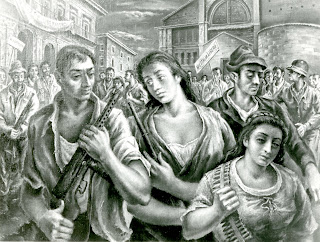
Davis had trouble keeping up with the Eighty-Fifth in the spring of 1945 as the division renewed its drive on Bologna and the Po Valley. Shortly after Bologna had been taken by Allied forces, Davis visited the city and came upon Italian partisans, “little bands of men and women of all ages, equipped with weapons of every description, who fought gallantly to rid their country of Fascism.” Their activities, and the colorful celebration after Bologna’s liberation, inspired him to produce a painting featuring the partisans. By early May, with German troops surrendering by the thousands, Davis worked sketching the captured enemy and their equipment as they were herded into prisoner of war camps “packed to overflowing.”

By May 17 the artists of the Fifth Historical Section had moved their operations to the Palazzo Martinengo Caesaresco, a magnificent palace constructed in the sixteenth century and situated on the shores of Lake Garda. “As I remember those days, it seemed like we were having a vacation,” Davis recalled. Reep noted that after spending a few years in “bedrolls and sleeping bags, army cots and foxholes, insects, worms, dirt, and shellfire, I thought for sure I was in heaven.” The palace provided soft, comfortable beds; maid service; hot and cold running water; and three hot meals a day served in a clean mess hall. The spacious grounds, Reep recalled, also provided plenty of room for such recreational activities as croquet, tennis, softball, and volleyball.

In this serene setting in northern Italy, the artists were able to produce “stirring work,” said Reep, with some “ideas that had burned into their minds during the conflict had been impossible to do justice to while constantly scrambling about and working in crudely erected tents.” Davis had time to work on two oil paintings, spending more time to finish them than he had on his other works. In addition, he noted that the artists had many ideas and sketches that had never been “worked up into paintings, but we had decided that we were going to try to carry our drawings and paintings beyond the stage of sketches.” They had seen plenty of war art that looked as if it had been done in foxholes, but instead had been done in a studio, he noted, “with a lot of quick strokes and spots, to give one the impression of it having been created in the fury of battle. That was not our purpose.” Instead, Davis viewed what he and his fellow combat artists were doing with the eyes of another profession—a historian: “We saw things as they were and we put them down, very much as a Historian would record the events that occurred. Some of my drawings had to be very factual and maybe they are not art but I feel they tell the story.”

Mustered out of the service on November 23, 1945, Davis returned to Indiana, earning a faculty position at Herron, where he remained until his retirement in 1983. A former colleague praised him as knowing how to “get the best out of his students. He wasn’t a soft touch. He wasn’t easy. Art was his life.” In 1948 Davis married Lois Peterson, a fifth-year student at Herron. “We quickly became good friends,” Lois remembered, “but I didn’t take any of his classes. He likes his students neat and dislikes walking into someone’s palette and getting paint on himself. If I had been in his class that might have happened because I’m a messy painter.”

For a time in the 1950s, the couple lived in Brownsburg and Davis, uncertain about his art and the market for it in Indianapolis, decided to supplement his teaching income by building houses. He abandoned that trade, but it left him with a strong understanding of how such structures are put together, using that knowledge to capture on canvas the state’s historic urban architecture, trying to find structures that possessed a wide range of shapes and the correct combination of lightness and darkness.

Davis likened his paintings of buildings to capturing a portrait of a man. “As in the face of a man, the features of a building are enhanced, the forms strengthened and given depth by proper lighting,” he told a reporter. As in the portrait of an older person, the “lines and blemishes that come with age add character to the countenance. Some structures are more handsome than others merely because of the arrangement of shapes, just as in a human face. The weathering of many a storm, and survival against the elements, can add greatly to the fascination of an old building.”

Until his death at age ninety-one on February 9, 2006, Davis and Lois produced art, working out of separate studio spaces in their two-story, shingle home on North Washington Boulevard in Indianapolis’s Warfleigh neighborhood; Davis converted the garage into his workspace, while Lois did her painting for a time in a basement studio, later moving to an upstairs bedroom. “We comment a lot on each other’s work,” noted Lois. “He will tell me what is wrong with my painting or if he looks at it and doesn’t say anything then I know it just isn’t right. He’s very careful about what he says. He will ask me for help and quite often I can pinpoint something and help him too.”

Davis was meticulous about his paintings, taking photographs of the building beforehand and making detailed sketches of the work to come. It took him anywhere from a few days to several weeks to finish a painting. When he finished, he took photographs of the completed work, as well as making sure to keep careful records of where it was exhibited, any prizes it won, and to whom it was sold.

Talking with a reporter about his work, Davis noted that some in the art world believed he underpriced his paintings. “Maybe I do,” Davis agreed, “but a large part of the satisfaction to an artist is not the price, but the knowledge that other people are able to see his work.” He also believed that artists should never retire but must paint “until they are unable to lift a brush, seeing and gathering more and more ideas to include in their work.”   


Saturday, February 19, 2022

“Mail Call”: Robert Sherrod and LST-689

World War II correspondent Robert L. Sherrod could never be certain which of his dispatches from the Pacific would appear in "Time" magazine. Fast-breaking news often relegated feature articles to file drawers or wastepaper baskets—a pity because such pieces brought to life little-known aspects of what it meant to serve overseas. 

One good example is an article Sherrod wrote on the USS LST-689, a tank-landing ship originally laid down in Jeffersonville, Indiana, by the Jeffersonville Boat and Machine Company and which served in the Asian-Pacific Theater during the war. 

This unassuming vessel was actually, in view of Pacific fleet sailors, “the most important ship in the navy,” said Sherrod, because it served as the link with home for thousands of Americans by delivering mail. Whenever a ship entered the Ulithi anchorage (a major staging base for the U.S. Navy), one of LST-689’s small boats scurried over to deliver a load of mail, noted Sherrod. 

When the fleet was out to sea for long periods, LST-689 dispatched mail to it via tankers or destroyers. First-class mail, all of which was brought from the United States by plane, reached within “spitting distance” of the Philippines within six to fifteen days. “The admirals learned long ago,” Sherrod wrote, “that mail is the prime factor in morale and no effort is spared to facilitate delivery.” 

Most of the work done by LST-689’s mail officers, men who had long experience with the U.S. Postal Service in civilian life, involved second-class mail and lower, Sherrod reported, brought to the Pacific by cargo ship, although any vessel could contain mail—at one time a battleship delivered 3,700 sacks. “A single cargo ship has brought as many as 12,000 sacks,” he added. 

Packages from home were the bane of the mail officers’ existence, as they often contained food that spoiled quickly in the tropical heat. “But the first class mail is the all-important item in the life of LST 689,” Sherrod said. The average sea-going sailor received three letters a week, with an Essex-class carrier, Sherrod said, receiving about two bags (1,300 letters) per day. 

On one horrible day, 131 bags of first-class mail designated for a task group were lost at sea. “When the word spread a pall settled over the group and one captain took the mike to tell his men they would soon be back in port where there would be more mail,” he reported

Friday, January 28, 2022

Richard Tregaskis and Superfortress Number 688

The copilot was the first one to notice the problem. Shortly after midnight on June 30, 1945, as the B-29 Superfortress bomber Number 688 reached the initial point on its bomb run, Lieutenant Paul R. Ceman announced: “Number 4 is gone.”

Veteran war correspondent Richard Tregaskis had been with the bright-silver aircraft—the most advanced of its time—and its ten-man crew since it had left its Kansas training base for combat service with the 315th Bombardment Wing on Guam in the Pacific. He and the others jammed together in the cockpit craned their necks to see what might be wrong with the 2,200-horsepower Wright Cyclone engine located on the outboard edge of the right wing. It appeared as if the engine had lost manifold pressure. “Looking out through the driving fog I could see no outward sign that it was out of commission: the big propeller seemed to be turning,” Tregaskis remembered. Still, the cabin floor had begun to vibrate—so much so that the tail gunner had called over the intercom expressing alarm, reporting, “We’re having quite a bit of trouble with vibration.”

The engine trouble occurred at an awkward time on the crew’s approximately 3,000-mile roundtrip mission as one of thirty-six B-29s set to strike the Nippon Oil Company’s refinery at Kudamatsu off the coast of Japan’s Honshu Island. As the bomber closed in on its target, and Tregaskis and the others struggled to don their flak suits and parachutes and put on their oxygen masks, the aircraft was surrounded by “a tight ocean of ‘soup’ and a needle-like torrent of precipitation drummed against the bombardier’s nose window,” Tregaskis reported. Those in the plane’s nose were keeping a sharp lookout for possible ice on the wings when the number four engine suffered what they later learned was a valve problem.

Number 688’s pilot, Captain Bob “Pappy” Hain, a veteran of dangerous missions over Europe in a B-17 Flying Fortress, remained unperturbed despite the glitches on this, only the crew’s second, mission against the Empire of Japan. Hain calmly commented about the vibration: “I don’t feel anything excessive.” The pilot remained confident, Tregaskis later noted, that the plane could reach the oil refinery and make it back to North Field on Guam, if need be, “with three or three and a half” engines.

Hain’s confidence in his plane and crew was rewarded, as the Superfortress made it to the target. “I unclipped my mask from my cumbersome oxygen bottle; it was too clumsy to permit movement and I wanted to see,” Tregaskis wrote. “I half stood up, peering into the fog over the top of the bombardier’s helmet. I saw flashes ahead; a blue flash stabbing through the mist, and next to it, a sudden rosy glow projected on the softness of the fog, to the left. These would be the bomb flashes of the B-29s ahead of us, and perhaps an oil explosion they had caused.”

Finally, the correspondent heard a report over the intercom, “Bombs Away!” As the B-29 plunged out of the fog and reached its top speed to avoid enemy antiaircraft fire and fighter planes sent to track it down, Hain, Tregaskis recalled, had a brief conversation with his precision-instrument operator, Lieutenant John Bond. “How’d it look?” Hain asked. “I think they [the bombs] were pretty close in,” Bond responded.  

Unlike the crew of the Superfortress he flew with, who were rookies in the fight against the Japanese, the Pacific theater of operations was familiar territory to Tregaskis, the veteran of the Doolittle mission, the Battle of Midway, and the invasion of Guadalcanal. What was new for the war correspondent was the publication that was printing his stories. Instead of having his dispatches distributed to U.S. newspapers by the International News Service, Tregaskis’s work appeared regularly in the pages of the SaturdayEvening Post, owned and operated by the Curtis Publishing Company in Philadelphia, Pennsylvania.

The Post had hired Tregaskis to produce a new series, “Road to Tokyo,” promising its subscribers that week by week they would share the dreams, heartaches, and heartbeats of the fighting men responsible for winning final victory over Japan. “Whether in the air, on sea or land he [Tregaskis] will live, eat, sleep, fight and sweat with them to bring you every week . . . the side of war you seldom read about,” the magazine promised in advertisements touting its new feature.

For his part, Tregaskis had been preparing himself physically for the grind of covering combat, walking ten miles and swimming an hour per day in a New York pool. When Post managing editor Robert Fuoss asked him if he really wanted to go to the Pacific, Tregaskis answered: “I don’t want to, but I think I ought to go.” His new situation offered him an opportunity to discover more about the “small personal conflicts which made up the bulk of a soldier’s, sailor’s or airman’s life,” Tregaskis later realized. “Even when he was in action, the dangerous moments were very few; the bulk of a man’s life was concerned with his friends and enemies in his squad or squadron, his likes or dislikes of his superiors, his letters to and from home, his liberties or leaves, the local females he tried to make or decided not to try to make.”

For his “Road to Tokyo” series, Tregaskis not only accompanied a B-29 crew for five missions, but he also flew in combat on a Grumman TBM Avenger torpedo bomber stationed on the USS Ticonderoga and followed General Douglas MacArthur’s military government section to Tokyo at the war’s end. It was not the first time Tregaskis had contributed to the Post, which praised him as “essentially a frontline reporter and one of the best.” The magazine’s February 24, 1945, issue included his detailed piece, titled “House to House and Room to Room,” on the street fighting he had endured in Aachen with soldiers of the First Infantry Division. With victory in Europe obtained by Germany’s surrender to the Allies on May 8, the Post intended to give Tregaskis free rein to report on what it hoped would be “human, intimate” tales of the men battling a nation, Japan, that had once haughtily proclaimed it was “looking forward to dictating peace in the United States in the White House at Washington.”

Tregaskis started his journey in America’s Heartland, at a processing base in Herrington, Kansas, meeting the veterans and rookies of the U.S. Army Air Forces he would fly with on bombing missions against Japan aboard one of the most complex machines ever devised to wage war—Boeing’s B-29 Superfortress, an aircraft with thousands of miles of wires, 50,000 separate parts, and a million rivets holding it all together. U.S. Army Air Forces general Henry A. “Hap” Arnold said that the idea for the long-range, four-engine bomber had been inspired by the early days of the war “when it appeared that England would go down to defeat, and there’d be no place where we might base our planes for future sorties against the Axis powers. Thus a much longer ranged bomber than any we then possessed would be essential to waging a victorious war.”

From the first, when he met the crew of Number 688 preparing to leave its Kansas training base for Mather Field in Sacramento, California, Tregaskis realized flying such a “huge but delicate machine” would be more complex than any other piece of military equipment he had ever encountered. (The B-29 was also the most expensive weapons project developed during the war, even outstripping the cost for the Manhattan Project that produced the atomic bomb.) “Even before starting engines, I found,” the correspondent noted, “the pilot must check on twenty-seven things, including the following: emergency-cabin press release (to let out oxygen from the air-conditioned cabins if something should go wrong with the pressurized machinery); hydraulic pressure, main and emergency; auxiliary power plant (to start engines); turbos (which provide high-altitude power and blow exhaust gases through a cooler to maintain cabin pressure); very-high frequency radio set; emergency landing-gear release for the new-type tricycle landing gear.”

The checklists for the other crew members housed in the plane’s nose were equally extensive, he added, and the details of each man’s responsibilities were honed after months of training. Superfortress Number 688 was also part of a revised series—B-29Bs—that were stripped of all guns (except for the tail position) and sighting equipment to save weight. It also had onboard the advanced AN/APQ Eagle radar unit was ten times more efficient than previous models when it came to bombing navigation, giving its operator a television-like picture of the ground, even through thick fog. “You had to treat the B-29 like a baby, but if you did right by it, it would really perform,” Tregaskis wrote.

Tregaskis had hoped he could join an intact, veteran crew rotating from service in Europe. He learned, however, that air forces officials intended to reshuffle and retrain European crews, and, if he wanted to fly out to the Pacific with a “typical crew, then I would fly by B-29, and that I would find only one or two veterans of the European war in said crew, at the most—perhaps a bombardier or navigator who had flown with the 8th or 9th or 15th [Air Forces], and the rest would be men who had never seen combat before.” Officials saw no reason for using the relatively light-load bombers used in Europe when a B-29 could carry five times as many bombs as a B-17 Flying Fortress or a B-24 Liberator, and carry such a load, the reporter noted, with “very little more gasoline, at greater speed, and with far smaller total ground facilities required for maintenance.”

By luck, Tregaskis drew an experienced pilot, Hain, a native of Hollister, California, and his navigator, Lieutenant Dean Coleman, who both had flown fifty missions together with the Fifteenth Air Force, returning from one raid on Naples with sixty-five holes made by flak peppering their Fortress. Because of his combat record flying missions over Italy, Germany, and Austria, the thirty-year-old Hain, nicknamed “Pappy” by his crew for his advanced age and receding hairline, could have returned to his family’s walnut farm. Asked by the correspondent why he decided to stick his neck out for another tour of duty, Hain said he had felt “kind of foolish, being hale and hearty, getting out now, with all the others gone. . . . And I mean gone for good.” He also pointed out that the opposition in Japan would not match what he had faced in the skies over Europe when it came to enemy fighters and antiaircraft batteries. “It doesn’t seem like there are many Jap fighters, and the flak isn’t going to be the same as with the mediums (medium bombers) in Europe,” Hain told Tregaskis. “We can get up to thirty thousand feet [in a B-29], and the flak isn’t so thick up there.”

Coleman shared Hain’s sense of duty but remained clear-eyed about the chance he took remaining in such a dangerous job. He pointed out to Tregaskis that out of the ninety-seven navigators in his original class, no more than thirty had survived their sorties over Europe; the odds looked grim for surviving the thirty-five missions over Japan that he needed for a ticket home.

It took three weeks for the crew of Number 688 to fly from Kansas to California and on to Hawaii, Kwajalein Atoll in the Marshall Islands, and, finally, reach its home base on Guam in the Mariana Islands. “We could have done better by slow freight,” one of the crew groused to the reporter. For his part, Tregaskis was reminded of an sign he had seen in some of the Air Transport Command terminals he had visited: “If you have plenty of time, travel by air.”

During his long journey, Tregaskis became well acquainted with the aircraft’s officers and enlisted men. “But the crew of 688 is more than an average crew,” he wrote. “It is a sort of microcosm in which one of the great historical facts of this war can be studied: the shift of gigantic military power from one theater of war, where the greatest enemy has been crushed, to the other side of the world, to smash into the ground the third and last of the gangster nations.”

In addition to the European veterans, Hain and Coleman, the crew consisted of Ceman, the young copilot; Bond, the precision-instruments operator; Flight Officer Dominic “Moe” Martelli, the bombardier; Corporal Paul Angelo, radio operator and the self-confessed Don Juan of the outfit; Corporal Clarence Dawson, the hardworking engineer; Corporal Raleigh Marr, the tail gunner; and Corporals Art Manning and Ed Marchalonis, the gunners/observers. Although dedicated and professional, the crew could not help but think about the war finally ending.

As the crew and Tregaskis, dusty and tired, waited for transportation to their barracks after landing at Mather Field, the correspondent said that the “feeling of being in a strange place, and heading for stranger and more forbidding ones,” depressed them all. Ceman put the feeling into words when he said: “It looks like the last lap. I wish we were coming in, instead of going out.” The copilot misread Tregaskis’s sharp look at him as disapproval, and later went up to the reporter, showed him a photograph of his attractive wife, and noted she was the reason why he had said what he said. 

After ten long days of waiting at Mather Field—filled with briefings, paperwork, and postponements—Tregaskis and the crew finally flew on to Hawaii, staying there for four days. As an experienced visitor to the islands from earlier in the war, he had shared with his comrades that the evening air in Hawaii seemed like a “soft kiss on the cheek, that the place was really a land of a million flowers and rainbows, as it said in the song.” Tregaskis praised the view from the Pali mountain pass, the feeling of swimming in the surf at Makapu’u beach, and dining on fresh pineapple and papaya. Unfortunately, Number 688 was a combat crew and had to get to its assignment, Guam, with a minimum of delay, so, Tregaskis noted, they saw “mostly the unpleasant, war-ridden parts of Hawaii on our short stay.”

The bomber crew made sure to visit the post exchange to stock up on such essential items as shaving cream, soap, and candy bars, and were able to have lunch at one of the reporter’s favorite haunts, Honolulu’s Pacific Club, with fare far superior to the expected C-rations, pork loaf, and Vienna sausage waiting for them at other bases. They seemed to exist in a “sort of limbo between peace and war,” Tregaskis recalled. By this time, Hain had opened sealed orders giving the name of the island, beyond Kwajalein, where the crew would be based for its missions against the Japanese homeland—Guam, recaptured from the Japanese by the U.S. Marine Corps in August 1944. In addition to housing airfields for the B-29s, the island served as the principal naval base in the Central Pacific west of Pearl Harbor. “All of the crew had learned about it previously, through the grapevine. But it was nice to know officially,” Tregaskis noted.

Once on Guam as part of the 315th Bombardment Wing’s Sixteenth Bomb Group, Fifteenth Bombardment Squadron, Number 688—designated as Crew Number 7 in the squadron—had to undergo additional training, including target study, aircraft and ship identification, instrument calibration, and air-sea rescue operations. Before tackling targets in Japan, they also had to make shakedown missions against enemy-held islands, including Rota, only sixty miles from Guam, and a June 16 mission against the garrison on Truk in the Caroline Islands. 

Tregaskis made an important discovery while on one of these sorties—he found it nearly impossible to see the B-29’s bombs hit from his position in the aircraft. He had to wedge himself into the very point of the plane’s nose, next to the bombardier, with his “forehead pressed against the Plexiglas,” to see an occasional bomb strike far behind the plane. Even the bombardier did well if he could see the explosions made by three or four of his bombs. “The B-29 certainly wasn’t built for sight-seers,” Tregaskis observed.

Along with honing the skills needed to fly such a complex machine, the officers and enlisted men of Number 688 did a considerable amount of manual labor constructing their living quarters set among banyan, bamboo, palm, and breadfruit trees near North Field. Tregaskis lent a hand as the officers conducted some “moonlight requisitioning” of wooden boards for the floors of their tents in which they slept before their metal Quonset huts were ready to occupy. The group’s enterprising mess officer, Second Lieutenant Herbert R. Davis, had cultivated friendships with naval personnel and the Seabees, resulting in a dining hall that surpassed many of the same facilities Tregaskis had patronized at stateside airbases. With refrigeration available, Davis could offer roast beef, pork, and, on occasion, even steak. The special service officer also proved to be up to his job, offering recorded music over the speaker system at mealtimes and showing movies on a hillside open-air screen every night.

Camp construction progressed so quickly that personnel could “watch the Quonset huts rising and taking shape as days, even as hours passed,” Tregaskis wrote. An exchange of gifts helped procure materials outside the usual channels—a practice that became so widely known that Tregaskis heard some claim that if “you knew where to go on this island, you could receive the friendly gift of a Quonset hut, complete, in exchange for the friendly gift of eight quarts of whiskey.”

What Post readers did not learn from Tregaskis’s reports were some of the more dramatic personal conflicts the crew of Number 688 had to face with one another and especially with their superior officers in the group and squadron. Reflecting on his time with the aviators, Tregaskis said there existed a “slight feeling of jealousy” between Hain and Ceman. The young copilot believed that the veteran flyer did not trust him to make takeoffs and landings, and believed he was a better pilot. The two men were united, however, by difficulty with the squadron leader, Lieutenant Colonel Richard W. Kline, a West Point graduate who was known as “The Grommet,” because while other flyboys wore their caps without grommets, “giving them a shapeless, rakish contour,” said Tregaskis, Kline kept his intact to comply with regulations.

The correspondent recalled that some also resented Kline’s insistence that those under his command stand muster at eight in the morning following twenty-four-hour missions against Japan, even though they did not have to fly that day. Hain believed that Kline and other noncombat veteran officers were too strict about enforcing petty regulations, what World War II veteran and scholar Paul Fussell termed “chickenshit,” which he described as “behavior that makes military life worse than it need be: petty harassment of the weak by the strong; open scrimmage for power and authority and prestige; sadism thinly disguised as necessary discipline; a constant ‘paying off of old scores’; and insistence on the letter rather than the spirit of ordinances.” For Kline’s part, noted Tregaskis, the commander believed that Hain and his supporters were “sloppy and didn’t pay enough attention to discipline.”

These petty differences faded under the rigors of combat. For its first mission over Japan, Number 688 and other members of the Sixteenth Bomb Group were ordered to strike the Utsube River Oil Refinery near Yokkaichi on the evening of June 26–27. The mission was part of an effort by the American heavy bombers to cripple the Japanese petroleum industry, reducing the supplies of gasoline and lubricating oil to the enemy’s air force. The morning of the mission, Ceman, who was in good spirits, visited Tregaskis and expressed frustration that some officers thought they might not return. “If they think they’re going to die, why did they come over in the first place?” the copilot wondered.

At the briefing, the wing’s commanding officer, General Frank A. Armstrong Jr., a veteran of the bombing campaign in Europe, told his men that they might have an easy trip or it could turn out to be “a stinker.” Whatever happened, Armstrong said the crews had to have determination—“some call it guts. We don’t turn back, whatever we suffer. We will make history tonight.” Another officer warned them that the B-29s had the potential of facing 140 enemy fighters in the area, but they had one advantage, as they would be reaching the target on the heels of a daylight raid that had included approximately 400 bombers.

Tregaskis and the crew of Number 688 reached their aircraft at 3:45 p.m., about an hour and a half before the scheduled takeoff. They had plenty of preflight work, including having Martelli, the bombardier, pull the pins on the bombs to leave them free for release. “While Moe sweated over the job amidst the rows of fat, brown, ugly projectiles in the big bomb bay, the others were occupied with equally important tasks,” the correspondent wrote. While the crew set to work, a jeep pulled up to deliver two large metal boxes. “They would provide hot food, an experiment being tried out on two planes of our group,” Tregaskis noted. The dinner menu included meatloaf, boiled potatoes, and canned carrots and peas. “We were one of the lucky planes—the rest had sandwiches,” he wrote.

Climbing aboard, the reporter took his place between Bond and Angelo in the plane’s nose. Peering out of the plexiglass window, Tregaskis could see ahead of them the “long silver shapes of the 29’s moving across the horizon, where the taxiway turned into the runway. Their tails, like the sails of sloops on the rim of the sea, inspired the reflection that we were a long way from the Larchmont [New York] regatta.” 

As Number 688, weighing sixty-six tons with its bombload and gasoline, rolled down the runway for takeoff, Hain spotted in the distance a B-29 coming in for a landing on a field a few miles away. “Back from the daylight raid,” the pilot said to Tregaskis. As the bomber leveled off, the crew listened to a radio news summary relayed from San Francisco to the nearby island of Saipan, with the announcer noting: “Our air attack on Japan continues with increased fury.” Tregaskis thought that to the radio broadcaster the B-29 the reporter flew on was part of “a big war machine pouring death on Japan with continued ferocity. But here in the nose of No. 688 we were only six human beings passing a few hours of time before tonight’s test. The fury of the attack, if any, would be concentrated in a few fleeting minutes over the target.”

Early in the mission, the crew kept themselves busy with, of all things, paperwork. Tregaskis watched as Ceman made notations on his weather report, which had to be filled out every hour with information about position, altitude, winds, and airspeed. “Looking around me in the nose,” he reported, “I saw that almost everybody was occupied with some sort of form, all of them complicated.” Although Hain had no form to worry about, he had plenty to do, including monitoring the plane’s gas consumption and ensuring that the American installation on Iwo Jima knew of his aircraft’s approach, as the machinery that ordinarily produced the necessary identification signals from the plane was out of order.

Although on a mission that, if successful, would produce mayhem and destruction, Tregaskis was mesmerized by the sky’s beauty. He could see the universe divided into level halves—under them “the deep purple of the terrestrial half, the level, dark undercast over which we were cruising; and above us, the lighter, indigo half of the upper sky.” The bomber operated smoothly, feeling as steady, he recalled, as “if we were standing still. The engines were lulling us with their almost synchronous beat—a gentle rhum-rhum-m-m-rhum-m-bar-rum.”

When the B-29 reached the Nanpo Shoto group of islands, approximately 500 miles from the coast of Japan, the crew and Tregaskis began the tedious routine of putting on what he called the “impediments of air combat,” which included flak suits, parachutes, and oxygen masks (the crew could not pressurize its compartments in the high altitude because the plane’s camera hatch was open to film the bombing). Tregaskis gave up wearing protective clothing to guard against any flak that might penetrate the plane, as he did not have enough room for the flak suit, parachute, oxygen tube, and himself in the cramped space he occupied. With the lights extinguished, Tregaskis could see in the gloom that Hain, Ceman, and Martelli appeared as “huge apelike shapes, not at all human. Their faces were transformed into muzzles by the rubber masks, and their flak suits gave them the hunched magnitude of gorillas.”

The correspondent’s thoughts were interrupted by the harsh sound of an alarm bell warning about ice forming on the wings. Ceman used a signal lamp to see if there was any ice forming on the wings or propellers, but the fog was too thick. Hain remained unperturbed, noting that if the plane maintained its speed, they should be alright. Using the Eagle radar, Bond guided the B-29 in over the target for a successful release of its bombload. “From below came a burst of orange fire that lit up the sky around and overhead—a fiery corona that hovered, then faded,” Tregaskis reported. “And in the same moment the aircraft bounced sharply under our feet. I heard a sudden rattling sound; possibly hail, possibly antiaircraft fire.”

Once safely out to sea, the crew talked with one another about what they had observed while over the enemy refinery and took turns sleeping to overcome the exhaustion of their long, more than fourteen-hour mission. While Bond took over navigating, Coleman slumped over his charts, his glasses on his nose, mouth open, and snoring, Tregaskis noted, while Hain, with his red baseball cap pulled down over his eyes, also nodded off. The correspondent slept for a time, waking up to see the sun and hearing music from the radio station on Saipan. “Then we were turning into the sun,” Tregaskis recalled. “We came in sharply, leveled out and swept smoothly down the runway, landing with hardly a jolt.” Coleman noted that the veteran Hain had made a “very good landing for an old man after fourteen hours.”

As the bomber crew hauled their gear out of their aircraft, the ground crew found a hole from flak in Number 688’s rear bomb-bay door; it was the only plane in the group to be hit by enemy fire. Before he collapsed into his bunk at his quarters, exhausted from his experience, Tregaskis took time to compliment Hain for his intelligence, judgment, and luck—qualities that certainly helped to ensure a successful first mission for Number 688. Hain noted that he did not believe it was luck, but the grace of God, noting, seriously but not solemnly, “I think He kind of keeps an eye on us.” 

All the crew slept until dinnertime, and returned for more rest after they ate, pausing only long enough to shower and wash their dirty flying suits by hand. Tregaskis discovered that a mission on a B-29 was “a thick sandwich to chew, a twenty-four-hour slab of time, from briefing to landing, with plenty of work and worry all the way, but only a thin slice of excitement or fear in the center.”

As the B-29s pounded Japanese cities and industrial sites from bases on Guam, Tinian, and Saipan, naval aircraft from the U.S. Navy’s Fast Carrier Task Force 38, under the command of Admiral John S. McCain Sr., ranged up and down the enemy’s coast bombing and strafing any military target they could find in preparation for Operation Downfall, the invasion of Japan. From just fifteen miles offshore, battleships bombarded enemy factories at Kamaishi on the coast of Honshu Island. “However much propaganda a Japanese civilian will swallow,” Admiral William “Bull” Halsey Jr. noted, “it must have been hard for him to digest the news that certain American warships had been sunk when he had just watch[ed] them blast his job from under him.”

During the third and fourth bombing missions Tregaskis made with Number 688, he heard radio broadcasts describing the naval activity off the Japanese coast. Also, at the briefings before their missions, the heavy bomber crews learned that they could expect little enemy fighter opposition because the American navy had been knocking out Japanese planes on the ground. Tregaskis very much wanted to observe the carrier action, so he wrangled a spot on one of the big Essex-class carriers, the USS Ticonderoga, which had been launched in February 1944.

As he prepared to leave Guam, Tregaskis felt pangs of nostalgia for the time he had spent with Hain and his crew. While flying with them on their third mission, he jotted down in his notebook: “I’m fond of these guys—know all of them, now. It’s going to be tough not to know how they are making out.” 

At least Tregaskis was able to stay long enough to see the crew settle well into its tour of duty, including seeing the enlisted men promoted to sergeant; learn that Bond’s wife had given birth to a baby boy in Akron, Ohio; and share the pride that the crew had been cited for the air medal, signaling successful participation in five combat missions. He had faith, which was born out, that Crew Seven could take care of themselves and their aircraft. (The men of Number 688 completed eleven missions before the war’s end in the Pacific in August 1945.)

Friday, December 3, 2021

Richard Tregaskis at War

Sprawled alone in the broken shell of what once had been a house in Aachen, Germany, in the fall of 1944, Richard Tregaskis, an accredited war correspondent for the International News Service, could hear from his temporary sanctuary the “ripping sounds” of an enemy machine gun firing at advancing American troops in a nearby rubble-filled street.

Tregaskis was no stranger to combat at this point in his career and had always been eager to be close to where American forces were fighting, becoming an embedded reporter long before the term came into use. “The lure of the front is like an opiate,” he had once mused while stuck behind the lines at headquarters and forced to write about politics instead of battle. “After abstinence and the tedium of workaday life, its attraction becomes more and more insistent.”

For nearly seven weeks in the summer of 1942, Tregaskis also had a front-row seat to one of the turning points of the war in the Pacific—the Battle of Guadalcanal. Tregaskis was one of two civilian reporters (the other was Bob Miller of United Press) who landed with the marines and stayed with them to cover their attempt to capture and hold the island, codenamed Cactus but simply called the Canal by those who fought there, against fierce attacks from the land, air, and sea by the Japanese.

In his dispatches to INS clients, newspapers owned by the William Randolph Hearst chain, Tregaskis captured what it was like to live and fight on a “pesthole that reeked of death, struggle, and disease.” He later turned the jottings from his battered notebooks into the best-selling book Guadalcanal Diary (Random House, 1943)—a work that awakened those on the home front to the long struggle ahead to achieve victory. Tregaskis related his sometimes-terrifying experiences to his readers simply and poignantly, using a day-by-day diary format to report what he had witnessed and the often-matter-of-fact stories of combat told to him by enlisted men and their officers.

The Harvard-educated reporter from Elizabeth, New Jersey, had accomplished all of this while dealing with what once had been a fatal illness—diabetes—a condition he kept secret from everyone but his doctor and family. For his first combat assignment in the Pacific, Tregaskis carried with him a case (100 tins) of sardines because he could not handle the high-carbohydrate fare served by navy cooks on his ship, as well as a handbook (Diabetic Manual—for the Doctor and Patient) about the disease from an early pioneer in the field. Afraid at being found out, Tregaskis even forged an inscription in camouflaged handwriting in the handbook reading, “To my friend Richard Tregaskis, best wishes from Doctor Elliott P. Joslin.” If the item were questioned by anyone, Tregaskis believed he could “demonstrate that Dr. Joslin was a friend and I carried his book only for sentimental reasons.”

Standing approximately six-feet, five-inches tall, Tregaskis had been warned by many friends before going into action that the Japanese, if they did not kill him, would capture him and use him as an observation post, but he left Guadalcanal relatively unscathed physically except for bouts with gastroenteritis and malaria. Even he considered himself to be an unlikely type to be a war correspondent, due to his height, thin frame, and glasses. 

After his adventures in the Pacific, Tregaskis moved to the European theater, accompanying American and British forces during the invasion of Sicily, staying on the Mediterranean island until it was secured. His willingness to go where the action was impressed one soldier, who told the correspondent, “How you guys go ahead and stick out your necks when you don’t have to—well, it just beats hell out of me!” Tregaskis had a simple response: “But we certainly do have to—that’s our job.”

Tregaskis’s luck ran out during his next assignment, accompanying Allied forces for the invasion of Italy. On November 22, 1943, after observing U.S. Rangers battling Germans on Mount Corno near Cassino, Italy, Tregaskis was returning to headquarters to write his story when a German shell landed near him. Shrapnel struck and pierced his helmet, lodging in his brain and causing partial paralysis that robbed him for a time of his power to speak, read, and write. “They carried me out with a hole in my skull the size of a soup spoon and bone and steel fragments embedded two inches deep in my brain,” he recalled. “I worked my way toward the States through six Army and Navy hospitals. Finally, a tantalum [metal] plate was put in my head at Walter Reed Hospital in Washington—and I went back to the fighting front.”

A recovered Tregaskis caught up with Americans forces in the summer of 1944 after their successful breakout from the Normandy beachhead. He noticed, however, a change in his attitude after his wounding. “I was aware of a new and dreadful sensitivity to the dangers of war—an acute, nervous state that made the sounds of incoming shells or enemy machine-gun fire crushing and unbearable.” His nerves continued to be “shaky” as he made his way across France, Belgium, Holland, and into Nazi Germany. Tregaskis decided to put himself to the test by participating in the battle for Aachen alongside a frontline unit—a company with the Twenty-Sixth Infantry Regiment (known as the Blue Spaders), First Infantry Division (the “Big Red One”). If he survived he knew he would be equipped with a new set of nerves, and “probably a good story, too.”

As Tregaskis cautiously made his way through Aachen’s rubble-filled streets to join the second squad of the first platoon with whom he would be staying, he felt “waves of terrible apprehension” washing over his body. He was now more aware than ever that the “worst could happen to me, that I could be a statistic in the casualty list and not someone else.” Because of what he had suffered on Mount Corno, Tregaskis knew what being wounded meant to a person—the “long sessions of jolting pain, the horrible hours of not knowing whether you would ever recover, the contemplation of ways to kill yourself if you became no more than a vegetable.”

Before he participated in any military operation, Tregaskis always took some time to prepare himself for the coming ordeal, including calculating his odds for survival. He usually remained confident that the “worst could not happen to me; that chance would stay on my side.” What he witnessed in Aachen, however, almost overwhelmed him, describing what he saw as “a blur of terror, a living nightmare: running down streets; faces full of dirt as shells screamed in and you hit the rubble which was the earth; the shock of the cracking bullets that were coming too close (close ones don’t whine as they do on TV—if they’re dangerous, they crack); the knowing that an unseen enemy rifleman or machine gunner is trying to kill you; the breathless hunt for him among the ruins; the silencing of him, usually with grenades or artillery; the horror on men’s faces at the moment you know well—when you have been hit; and the dreadful ignorance of whether or not you are going to die.”

The madness of combat might have overwhelmed Tregaskis if it had not been for one man—Captain Ozell Smoot. The officer from Oklahoma City, Oklahoma, always seemed to appear when his soldiers needed a steadying hand. Darting into the street “while the firing was still going on all around,” said Tregaskis, “he would stop to talk to the platoon leader as calmly as if we were on maneuvers. He would make sure our wounded were carried out and reached ambulances. And he would spot snipers and Kraut artillery and observation posts with a cool eye and call artillery or mortars down on them.”

When one of his officers was hit by a sniper’s bullet and seriously wounded, Smoot raced up to his comrade to offer “the tender uprintable things that one brave man will say to another,” Tregeaskis reported. Smoot cut the wounded man’s clothes away from the gaping wound and fed him sulfa pills while bawling out directions to bring up a medic and a stretcher team to take the fallen soldier away. At the same time, Smoot never let his attention waver from his duties as commander. “He’d say, with great tenderness, that the wounded man would be all right; that the jeep would be coming any minute now,” Tregaskis wrote. “And then he’d wheel and bark an order, and lard that order with hair-curling cuss words.”

In addition to serving as an example for his men, Smoot helped calm to the anxious reporter’s shaken spirits, as Tregaskis suffered from what he described as “Purple Heart syndrome.” Almost every soldier, he noted, naturally assumed that he would be safe while under fire and that “the wounds will happen to anybody else but him, that he is not a statistic, and that somehow some unquestioned magic will keep him safe, no matter how bad the casualties get or how scared he is.” When the nearly worst happened, and the soldier was wounded, shock and pain followed. “And very often,” said Tregaskis, “if he is not given to powerful flights of imagination, if he is not the imaginative type, more a man of deeds than thought, the shock can get very profound. The idea is burned in letters of fire in his brain: I can get hurt too.”

Tregaskis, while huddled in a hole in the ground in Aachen, suffered from his own brand of “Purple Heart syndrome.” He could hear a fusillade of small-arms fire coming at him like a cascade. “It seemed closer; it seemed to be moving in my direction.” The sound stopped for a moment and, at that instant, Smoot skidded into the broken bricks that formed Tregaskis’s sanctuary. The commander grinned at Tregaskis and mentioned in an offhand manner that it had been a “rough day.” 

Reading Tregaskis’s face, or perhaps having heard from members of his platoon that the correspondent had “been running much too scared,” Smoot quietly related: “I got it myself a couple of times. I came in with the Division at North Africa.” In another lull in the fighting, Smoot added, without looking at the reporter as he talked: “It took me a while to figure it out. Your chances aren’t any worse after you’ve been hit once. It just seems like it. It takes more guts because you know what can happen.”

Just seconds after he finished his talk, Smoot left the safety of Tregaskis’s hole and ran down the street toward his men, but his words had made a difference to the shaken reporter, who recalled that the “fighting seemed less dreadful, and I knew I had gained a new grip on myself.” The commander had restored to Tregaskis the toughness he would need—a “new kind of toughness, the seasoned kind of inner strength that comes after battle scars.” Both Tregaskis and Smoot emerged from Aachen physically unscathed. The reporter was lucky enough to be able to return to the United States for some needed rest before an assignment for the Saturday Evening Post to follow the crew of a B-29 Superfortress bomber making its way overseas for service in the Pacific against targets in Japan.

As he prepared to report on the final push against the Japanese in the Pacific, Tregaskis lost touch with Smoot. Not until the war was over did he learn about the officer’s fate—Smoot had been killed in combat on November 17, 1944, about a month after he and Tregaskis had parted company in Aachen. The officer had been one of the approximately 33,000 American casualties of the tough winter fighting in the HürtgenForest. “He died a soldier’s death,” Tregaskis noted of Smoot, “leading his troops in battle, taking the chances he had to with his usual calm competence. He died facing the ultimate danger, respected and loved by his men.”

Tregaskis had often pondered why he, and others, risked their lives to report on the war. Good correspondents, like other people of action, were generally unwilling to make themselves heroes, he said, but most “will admit that they take chances in war zones for the same reason the mountain climber gave when asked why he wanted to scale [Mount] Everest: ‘Because it is there.’” Although Associated Press reporter Hal Boyle joked that all one needed to be a war correspondent was “a strong stomach, a weak mind, and plenty of endurance,” he and his colleagues were aware of the dangers they faced.

Casualty rates for reporters during the war matched that of the American military, with 2.2 percent of reporters killed and 6.8 percent wounded, while the figures for the armed forces was 2.5 percent killed and 4.5 percent wounded. Despite the deaths and disabilities that went hand in hand with war, there was another facet, Tregaskis said, that drew people “whatever their personal persuasion or sex: the instant elimination of personal ambition in favor of unselfish sacrifice to a great cause. Never mind that the fact that the cause is the destruction of an enemy and the expenditure of resources—including life and health—to destroy something the foe considers highly valuable.” Still, he acknowledged, “War can be as exciting as anything in life.”