Monday, May 15, 2023

No Place to Go: John Bartlow Martin and James Hickman

For millions of veterans following the end of World War II, their return home resembled what they had gone through upon their induction into military service—long waiting in long lines. On Friday, February 16, 1946, after filling out the necessary paperwork at an army separation center at Camp Ulysses S. Grant, located on the outskirts of Rockford, Illinois, John Bartlow Martin, who in civilian life had been a freelance writer for a variety of true-crime and national magazines, achieved what he had been seeking for many months—discharge from the U.S. Army. He took a train to Chicago and by 8:00 p.m. had made it to his home in Winnetka, where he hugged his wife Fran and daughter Cindy.

Martin had trouble readjusting to life as a civilian. Harried by the army and its regimented ways, he had longed for “the old comfortable things” of his former life but discovered that they began to weigh on him after a time. He admitted to a friend that it was going to take him several months to recover his bearings. Writing a story about a private detective, William V. Pennington of San Francisco, Martin found that he was “a lot less facile and more awkward than I used to be—and facility was never a strong point of mine, writing always did come hard. It comes like molasses now.” He had also lost a bit of his confidence, realizing it would be some time before he could say to an editor: “The legwork will take 6 days, 3 days to write, 2 days to revise, two in the mail—you can have the [manu]script in 13 days from now.”

Luckily, before leaving for stateside service during the war, Martin had developed a solid relationship with Frederick Lewis Allen and the staff at Harper’s magazine. Although it had a small circulation (109,787 in 1940) and offered its contributors paltry fees (usually $250 for articles) in comparison to other magazines, Harper’s reached a vital audience, what one of its editors described as “the intelligent minority” of opinion makers in the United States, “the thinking, cultured reader who seeks both entertainment and an enlarged and broadened point of view.” Allen, who had taken over as Harper’s editor in October 1941, said the magazine under his watch intended to print within its pages “the exciting, the creative, the lustily energetic, the freshly amusing, the newly beautiful, the illuminating, the profound.”

Martin’s post–World War II work for the magazine often examined crime and the individuals caught in its vortex. Crimes, Martin learned, did not happen by blind chance—something caused them. “Sometimes the matrix is social, sometimes psychological, most often both,” he said. “Writing about an individual criminal case, then, offers also an opportunity to write about a whole society. Crime in context.”  
 
His pieces in Harper’s included examining the murder of Don Mellett, a crusading newspaper editor in Canton, Ohio, who had been uncovering corruption among the city’s police and politicians (“Murder of a Journalist”), and the killing of Toledo, Peoria, and Western Railroad president George P. McNear, whose armed strikebreakers had shot dead a union member on the picket lines during a strike (“The McNear Murder”). Martin’s Harper’s story on McNear’s still-unsolved murder had been reprinted in Reader’s Digest, and the editor who handled it for the magazine, Paul Palmer, had been intrigued enough by it to suggest that Martin should explore a recent mine disaster in Centralia, Illinois. The resulting Harper’s article in March 1948, “The Blast in Centralia No. 5,” made Martin’s reputation, with writer Marc Rose, in a 1952 issue of The Quill, the magazine of the Society of Professional Journalists, calling the Centralia story “one of the most magnificent examples of magazine journalism” he had ever seen.

A piece Martin did for Harper’s just five months after his Centralia investigation proved to be just as powerful and moving as his exploration of the mine disaster, and it opened the nation’s eyes to racial segregation in a Northern city years before the civil rights movement and the U.S. Supreme Court’s 1954 Brown vs. Board of Education decision striking down separate public schools for white and African American schoolchildren. “I wanted to do not an article, crammed with demographers’ statistics,” said Martin, “but, rather, a story about a man.”

As he explained, Martin tried to avoid doing what he called “articles,” preferring instead to think of them as “stories.” The difference to him was that an article was “about a subject while a story is about a person.” He tried to find a broad subject area to write about and then find a specific person “to whom something has happened, so that the piece will have a narrative story line. There has to be drama.” Although such a piece might never have the same penetrating quality as truly great fiction, Martin said it could have “more penetration . . . than any ‘article’ or second-rate fiction.”

The person he found for his Harper’s story was James Hickman, an African American who had moved from the Deep South to Chicago in 1945 seeking a better life for himself and his family. Instead, Hickman ran headlong into tragedy with a fellow African American, his landlord, David Coleman, whom he shot and killed after a suspicious fire burned to death four of Hickman’s children in their tiny apartment at 1733 West Washburne Avenue.

To prepare for his Harper’s story, Martin read Swedish economist Gunnar Myrdal’s classic 1944 study of race relations, An American Dilemma: The Negro Problem and Modern Democracy, which Myrdal described as “not a study of the Negroes but of the American society from the viewpoint of the most disadvantaged group.” Martin conducted extensive interviews with Hickman and his wife, as well as with Coleman’s relatives. “I simply told the story of Hickman’s and the landlord’s lives,” said Martin, “and their world—the world below.” Martin visited the slum neighborhood where the Hickman family lived, making notes and gathering atmosphere for his story by walking the same streets they had walked.

Hickman had been born on January 19, 1907, “in the country,” as he put it, near Louisville, Mississippi, the son of sharecroppers raising corn and cotton. At the age of sixteen he married a neighbor girl, Annie Davis, and when their first child, Arlen, was born, Hickman, a deeply religious man, had vowed to God: “I was the head of this family and had to make a support for them. I was guardian to see for them as long as the days I should live on the land.” Trying to raise a family that eventually included nine children on the paltry wages sharecropping afforded, Hickman looked to the North for the opportunities, including education, denied to African Americans in the South.

Staying with an older daughter who had married and lived in Chicago, Hickman found a job with International Harvester’s Wisconsin Steel plant near the Indiana border, receiving $1.25 an hour for guiding the burning steel as it rolled off the hotbed. “On the farm I’d be charged for a lot of things, I couldn’t see what it was for,” he said of his experiences as a sharecropper. “In the factory work it [his wages] come to my hand.” He marveled at the size of the country’s second largest city, as well as seeing whites and blacks riding together in buses and his fellow African Americans working in banks and post offices.

Life in a northern city provided its own hardships for Hickman, particularly when it came to finding decent and affordable housing for his family. By the mid-1940s approximately 80 percent of Chicago’s residential housing was covered by racially restrictive covenants that excluded blacks from buying or renting property in white neighborhoods. The city’s African American population of 400,000 squeezed into a seven-square-mile area, called the “Black Belt” by Martin in his article, located on the south side from Twenty-second Street (Cermak Road today) to Sixty-second Street between Wentworth and Cottage Grove Avenues. European immigrants who prospered in their new homeland could scatter throughout the city, noted Martin, disappearing and blending into the general population. “‘Disappearing’—how can a black man disappear?” he asked. “He is not wanted. He is condemned to inhabit the areas nobody else wants.”

Landlords in the black ghetto, African American and white alike, did all they could to maximize their profits as the demand for already scarce housing rose during and after World War II. They divided apartments into smaller and smaller units, often called “kitchenettes,” and charged outlandish rents for the tiny spaces they provided their tenants. “In this artificially restricted market, people of means bid high for hovels; rentals skyrocket; landlords gouge,” Martin said. Hickman also had trouble finding a place to live because many landlords did not want to rent to someone with children.

Unfamiliar with Chicago, Hickman sometimes wandered into white neighborhoods seeking a place to rent. He experienced little trouble, as people guided him to areas where African Americans were allowed to live. “I was born in a country where there’s nothin’ but white folks,” Hickman told Martin, “and I knowed how to talk and carry myself and they treated me mighty fine.” After a year of painstaking effort, Hickman finally found a home for his family at a four-story brick tenement owned by Coleman, who had also come to Chicago from Mississippi, worked hard to improve his station in life, and thought of himself as a businessman.

Hickman, his wife, and six of their children huddled together in a small room in the building’s attic that measured about fourteen feet by twenty-one feet in size. “There was no electricity; they used a kerosene lamp,” wrote Martin. “There was no gas; they used a stove and heater burning kerosene. There was one window. There was no water; they had to go down to the third floor to use the toilet or to get water for washing and cooking.” Hickman later told people he had never lived so poorly in Mississippi as he and his family had to live while in Chicago. Coleman had hinted to Hickman that a larger apartment might soon open up for his family on the second floor, but it never materialized, and Hickman, tired of the runaround and wanting back the $100 down payment he had paid Coleman, tried, but failed, to have his landlord arrested.

To increase his rental income from the property, which he needed to meet his own late payments on the building, Coleman had sent a contractor to 1733 Washburne to divide the existing apartments into the more lucrative kitchenettes, but the tenants had resisted, saying it would take a court order to evict them. A defiant Coleman had threatened: “I am the owner, I don’t have to go to Court to do that, I will get everybody out of here when I want to if it takes fire.”

Coleman’s dire threat came true on the evening of January 16, 1947. Hickman had gone to his job at the steel mill at 9:00 p.m., leaving his wife to help their children with their homework. The family went to bed at about 10:00 p.m.; an hour and a half later Annie woke up after hearing the “paper popping” on the ceiling—a fire. As flames raged throughout the attic space, Charles, the Hickman’s nineteen-year-old son, escaped down the stairs, and Willis, the oldest son, and Annie barely managed to escape the fire by going out the window and falling to the ground below, escaping with only minor injuries. Unfortunately, four Hickman children—Leslie, fourteen; Elzena, nine; Sylvester, seven; and Velvena, four—were killed in what a Chicago fire chief called a “holocaust” of flames.

Told at work that there had been trouble at home, Hickman returned at about 7:30 a.m. the following morning, only to be greeted by another tenant, who told him: “Mr. Hickman, I hate to tell you this, four of your children is burnt to death.” The news devastated Hickman, who fell to the ground and had to be carried into the building’s basement. “Mr. Hickman looked pretty bad, like he was losing his mind,” a neighbor said to Martin. Hickman kept thinking about the threat Coleman had made to burn down the building if the tenants failed to clear out. A coroner’s jury, however, failed to deliver any indictments for arson.

Convinced that Coleman had been responsible for the fire, and that justice had failed him, Hickman became bitter, sitting alone and having conversations with his dead children. “Paper was made to burn, coal and rags,” he said again and again. “Not people. People wasn’t made to burn.” Taking a .32-caliber pistol he owned with him, he took a streetcar and bus to Coleman’s residence, found the landlord reading a newspaper while sitting in a Buick taxicab owned by Coleman’s half-brother, engaged in a brief conversation with him, and shot Coleman several times. “I had put a heavy load down and a big weight fell off of me and I felt light,” recalled Hickman, who took a streetcar home and confessed what he had done to his wife. The Homicide Squad arrested him that afternoon and he confessed his crime to them. After Coleman died three days later, authorities indicted Hickman for the landlord’s first-degree murder.

Interviews of Hickman by two local newspapers, the Chicago Daily Defender, the city’s leading African American newspaper, and the Chicago Daily Tribune, caught the attention of an organizer for the Socialist Workers Party, Mike Bartell, who found a lawyer to defend Hickman, M. J. Myer, a local labor and civil rights attorney. Two other attorneys—Leon Despres and William H. Temple—joined Myer in the case and they formed a Hickman defense committee to raise money to defend him in court and to educate the public about the horrible conditions in which African Americans lived in Chicago. Groups involved included the American Federation of Labor, the Independent Voters of Illinois, and the Committee on Racial Equality. “Many such groups degenerate into luncheons and resolutions,” Martin observed. “Hickman’s defenders worked hard, effectively, fast, and according to plan.” The committee held rallies, collected donations from jars set out in African American businesses, and sought help from other like-minded organizations.

During his trial, Hickman spoke eloquently and almost biblically, noted Martin, about what had happened to his children. When asked by his lawyer to describe his feelings between the fire and the shooting, Hickman responded: “I had two sons and two daughters who would some day be great men and women, some day they would have been married, some day they would have been fathers or mothers of children; these children would have children and then these children would have children and another generation of Hickmans could raise up and enjoy peace.”

The defendant’s first trial resulted in a hung jury, with six men and one woman voting for acquittal and five women for conviction. Thanks to pressure brought on Chicago’s political establishment by the defense committee, and people from all over the country, however, an agreement was reached with Assistant State Attorney Samuel L. Freedman and, on December 16, 1947, a judge found Hickman guilty of manslaughter and placed him on probation for two years; he was home in plenty of time to celebrate Christmas with the surviving members of his family. “We really felt good when it was over,” Willoughby Abner, an African American labor leader who had been involved in organizing assistance for Hickman, told Martin. “It shows everything isn’t in vain, isn’t all injustice, people will rally, it shows what can be done.” The Hickman family found new accommodations in a housing project near the airport and intended to stay in Chicago. “I like Chicago,” said Annie Hickman. “I used to like it very much when I had my children.”

Martin failed to share Abner’s optimism, pointing out that both Hickman and Coleman had been victims of Chicago’s segregated system of housing—a system that showed no signs of changing. “The North has failed the Negro no less than the South, there is no place in this country for a black man to go,” Martin wrote, calling Chicago’s postwar housing record a total failure. “The housing problem is bad everywhere in America, in no major city is it worse than in Chicago, and Negroes are at the bottom of the heap because we put them there and keep them there.” The more African Americans who moved to the city for a supposedly better life, the more they would be met with fierce white resistance—new restrictive covenants, Molotov cocktails and rocks thrown at their homes in white areas, and political speeches promising “racial purity.”

A year after the fire, Martin returned to 1733 West Washburne Avenue and found the building where the Hickman children had died deserted, its windows boarded up and charred, black timbers poking up to the sky. Martin came across an elderly black man tending a fire behind the abandoned building. The old man told him that he had heard rumors of the building’s owner fixing it up and offering it for sale. Asked by Martin if anyone would ever again live in such a place, the man laughed and said people would “be lined up here putting in their application. People got no place to go.”


Monday, March 6, 2023

Eliza Blaker and the Free Kindergarten Movement

When he took over as minister for the Plymouth Church in Indianapolis in 1877, Reverent Oscar Carleton McCulloch noticed that churchgoers in the capital city “had not much hand in relieving the poor.” He soon set out to change that, rejuvenating the Indianapolis Benevolent Society and creating the Charity Organization Society to aid those he called the “worthy” distressed.

In the summer of 1881, after investigating the condition of children whose families were being helped by the Benevolent Society, McCulloch called on five influential women in the community to attempt to help underprivileged children improve their lives. That summer a trial free kindergarten program was started to assist underprivileged youngsters in the corridor of School Number 12 at West and McCarty streets. Pleased with its success, the women organized the Indianapolis Free Kindergarten and Children’s Aid Society.

Indianapolis’s free kindergarten movement, which began in that school corridor, grew by leaps and bounds until, by the mid 1910s, it included as many as sixty schools. These schools were dedicated to providing “education and moral training of the children of the poor between the ages of three and eight years.” The accomplishments of the Indianapolis free kindergartens, which became a model for the rest of the country, were achieved through the untiring efforts of the daughter of a Philadelphia seamstress and Quaker Civil War veteran, Eliza A. Blaker. She watched over the education of thousands of Indianapolis youngsters as superintendent for the free kindergartens and trained numerous teachers by starting the Kindergarten Normal Training School, known to those in the community as “Mrs. Blaker’s College.”

The woman who inspired such devotion that following her death alumnae and faculty of the Kindergarten Normal Training School formed the Eliza A. Blaker Club was born in Philadelphia on March 5, 1854, the eldest of three children raised by Jacob and Mary Jane (Core) Cooper. In 1876 at the Philadelphia Centennial Exposition, Cooper became familiar with a system of education that became her life’s work: kindergartens. One of the Exposition’s most popular features was a demonstration kindergarten taught by Ruth Burritt of Boston. “There I found what I had been groping for,” said Eliza.

The idea for kindergartens originated in Germany in the 1830s through the work of Friedrich Froebel. Using a child’s love of play as its base, Froebel’s system attempted to “give the children employment in agreement with their whole nature, to strengthen their bodies, to exercise their senses, to engage their wakening mind, and through their senses to make them acquainted with nature and their fellow creatures.”

For it to succeed, Froebel believed that his kindergarten idea needed to have the support of what he described as “intellectually active women”: a definition that fit the young Eliza. Fascinated by what she saw at the exposition, she enrolled in the new Centennial Training School for Kindergartners, operated by Burritt’s through the auspices of the Friends’ Society of Philadelphia. After graduating from the school, Eliza found a job at Philadelphia’s Vine Street Kindergarten. Before assuming her new responsibilities, however, she took time out to become the wife of a former childhood playmate of hers, Louis J. Blaker.

In 1882 officials from the Hadley Roberts Academy, a private school in Indianapolis located on Meridian and Vermont streets (the present-day site of the Indianapolis Athletic Club), hired Eliza Blaker to start a kindergarten class for children of the community’s well-to-do families. Shortly after moving to Indianapolis, however, Blaker left the academy and accepted an offer from the Indianapolis Free Kindergarten Society to direct the group’s efforts to aid underprivileged children. Blaker helped to open a new kindergarten adjacent to the Friendly Inn, a charitable home established by McCulloch on West Market Street.

Seeing the “sad and old faces” and “vacant, far away expressions” of the countless underprivileged youths who flocked to the free kindergartens inspired Blaker to provide for them a “miniature world in which the little one is happy, is harmoniously developed and learns to think and act as a reasonable being endowed with a high destiny.”

This high purpose, however, had to be achieved with limited financial resources. The benches the children sat on at the first free kindergarten on Market Street consisted of bundles of kindling chopped by indigent men to earn their room and board at the Friendly Inn. When teachers could not find enough paper for students, Blaker sent them out to seek donations of materials from Washington Street merchants. Even before they could start attending the schools, many children had to be given shoes and clothes by the Children’s Aid Society. Some kindergartens served breakfast to their charges and all offered free lunches.

Blaker outlined her philosophy of teaching in numerous speeches over the years to local clubs and organizations, and in yearly reports from her superintendent’s office. She described the role of the kindergarten as providing a wholesome environment in which students were free to form the proper habits needed for their future schooling and life. Such an institution, said Blaker, also gave poorer students the “opportunity to get a fair start in life; in fact, to feed the soul and, where necessary, to feed and clothe the physical body. To sum the divisions of this aim—it [the kindergarten] is character-forming.” Students spent three hours each morning in the classroom engaged in activities under the guidance of trained teachers.

To further the work of the free kindergarten, Blaker realized from the beginning that it was crucial to have available trained kindergarten teachers. Preschool students, she maintained, had to be under the guidance of a well-trained teacher, one who combined the talents of “a gardener, a mother, a nurse, an elder sister, [and] a wise play-fellow. She must be a psychologist, a woman of good education, [and] of definite training for her work.” In 1882 Blaker opened in her own home a training school for kindergarten teachers called the Kindergarten Normal Training School, which became the Teachers College of Indianapolis in 1905.

Despite early hardships, Blaker had faith in the school. “There have been times when I knew not where the money was to come from, but it came, because by the middle of the month I began to ‘dig in’ and work to get it,” she said. Through hard work and “the guidance of a Higher Power than I,” Blaker soon had students flocking to her side. From an enrollment of twelve students in 1883, the school’s population grew over the next decade to 344 pupils. Graduates of the program had gone on to start kindergartens in other Hoosier cities, including Evansville, Lafayette, Bloomington, as well as in such states as Tennessee, Michigan, Ohio, and Pennsylvania.

Shortly before her death on December 4, 1926, Blaker worked out an arrangement between the Teacher’s College and Butler University whereby students at each institution who wished training in a particular field—elementary education at the Teacher's College and secondary education at Butler—had the opportunity to do so and receive course credit. “Mrs. Blaker’s School” continued to produce teachers until 1930, when control passed to Butler. The free kindergartens had a longer life, continuing to ease the way for Indianapolis youngsters until 1952, when they were incorporated into the Indianapolis school system.

During her forty-four years in the capital city, Blaker oversaw the education of thousands of youngsters and provided training for thousands of preschool teachers. Her devotion to education resulted in her receiving an honorary doctorate from Hanover College in 1917. Even after her death, Blaker continued to be honored for her work, with the Eliza Blaker Club, members of whom were all graduates of her school, establishing a room in her honor at Butler University in 1943 (today located in the Rare Books and Special Collections room at Butler’s Irwin Library) and the Indianapolis school system naming a school for Blaker in 1958. Blaker, however, always refused to let such tributes go to her head. “The cause,” she said, “is greater than the individual.”
 

Thursday, March 2, 2023

The GI and the General: Charles H. Kuhl and George S. Patton

When Private Charles H. Kuhl of the Twenty-Sixth Infantry Regiment, First Infantry Division, checked himself into an aid station in Sicily, doctors believed he suffered from “psychoneurosis anxiety state, moderately severe (soldier has been twice before in hospital within ten days). He can’t take it at the front, evidently. He is repeatedly returned.” 

Doctors transferred the combat-stressed soldier to the Fifteenth Evacuation Hospital near Nicosia for further evaluation. “I never did like war or being overseas,” Kuhl, a Mishawaka, Indiana, native told an interviewer years after the war. “I never could get used to it.” Even as a civilian, he could remember the awful screams of wounded on the Normandy beaches and the shells streaming overhead. 

Admitted on August 3, 1943, Kuhl, who had been serving in the army for eight months, had the misfortune of being at the hospital the same day that the commander of the Seventh Army in Sicily, Lieutenant General
George S. Patton, decided to visit. The general had already earned fame for his leadership in North Africa, invigorating dispirited U.S. troops and defeating the vaunted German Tenth Panzer Division at the Battle of El Guettar in Tunisia. One of the officers who served under him, Lucian Truscott, described Patton as “perhaps the most colorful, but certainly the most outstanding battle leader of World War II.”
 
Others, however, were disgusted by Patton’s combative personality. Beloved columnist Ernie Pyle “hated Patton’s guts,” remembered Pyle’s friend and fellow correspondent Don Whitehead of the Associated Press. According to Whitehead, the officer’s “bluster, show and complete disregard for the dignity of the individual was the direct antithesis of Ernie’s gentle character.” Soldier-journalist for the Star and Stripes newspaper Andy Rooney, best known for his 60 Minutes commentaries, also loathed Patton “and everything about the way he was. It was because we had so few soldiers like him that we won the war.” While soldiers in the Seventh Army were justifiably proud of their battle record under Patton, they bristled at his strict discipline and hunger for glory. “He likes to be called Blood and Guts Patton—his guts and our blood,” a soldier told war correspondent Quentin Reynolds of Collier’s magazine.
 
While battling German and Italian troops as part of Operation Husky in Sicily, Patton had repeatedly urged his troops forward, advising them to never “take counsel of your fears. The enemy is more worried than you are.” He desperately hoped to beat the British Eighth Army under General Bernard Montgomery to the critical city of Messina. “This is a horse race in which the prestige of the US Army is at stake,” Patton wrote one of his officers. “We must take Messina before the British.” When one of the American armored columns had to halt its advance because some balky Sicilian mules blocked the way on a one-way bridge, Patton handled the problem by taking out his revolver, shooting the mules and having soldiers throw the carcasses and the cart they were pulling off the bridge. He wrote in a letter to his wife Beatrice that he had also struck the mules’ owner with his walking stick, breaking it in the process, adding, “Human rights are being exalted over victory.”
 
A few days before visiting the Fifteenth, Patton had been informed by a major in the First Division that the front lines had been thinned out, not only because of casualties caused by enemy fire but also due to “a very large number of ‘malingerers’ at the hospitals, feigning illness in order to avoid combat duty.” According to Colonel F. Y. Leaver, the Fifteenth’s commanding officer, Patton came into a tent full of wounded GIs and made sure to praise each of them, either shaking their hands or patting their heads and thanking them for what they had done in the war. Patton’s mood changed drastically when he encountered Kuhl, sitting on a stool fully clothed and appearing to have no visible injuries. Upon questioning by Patton, the private tried to explain about his nervous condition, finally noting, “I guess I can’t take it.” An officer accompanying Patton remembered hearing Kuhl comment that he “wasn’t hurt, he was nervous, and added that he had been to the front three times but couldn’t stay there.”
 
Enraged by what he heard, Patton responded by smacking Kuhl in the face and roughly removing him from the tent—a court-martial offense under army regulations. “I gave him the devil,” Patton wrote in his diary, “slapped his face with my gloves and kicked him out of the tent. Companies should deal with such men and if they shirk their duty they should be tried with cowardice and shot.” Patton later added: “One sometimes slaps a baby to bring it to.” Kuhl ended up being shipped to North Africa to undergo treatment as doctors had diagnosed him as being afflicted with chronic dysentery and malaria, maladies that had plagued Allied forces on the island. On August 5 Patton issued a directive to his command that read:
 
“It has come to my attention that a very small number of soldiers are going to the hospital on the pretext that they are nervously incapable of combat. Such men are cowards and bring discredit on the army and disgrace to their comrades, whom they heartlessly leave to endure the dangers of battle while they, themselves, use the hospital as a means of escape. You will take measures to see that such cases are not sent to the hospital but dealt with in their units. Those who are not willing to fight will be tried by court-martial for cowardice in the face of the enemy.”
 
The incident involving the Hoosier soldier might have been enough on its own to endanger Patton’s military career, but he made matters worse a week later when he visited the Ninety-Third Evacuation Hospital near Sant’Agata di Militello and encountered Private Paul G. Bennett of C Battery, Seventeenth Field Artillery Regiment. Although Bennett, a North Carolina native, showed signs of nervousness and confusion, he had repeatedly told doctors he did not want to be evacuated, asking instead to be returned to his unit. 

Coming upon the shivering Bennett, who had seen his buddy wounded in action, Patton heard him complain about his nerves and the constant shelling at the front. The general repeated his performance with Kuhl, slapping the enlisted man and threatening him: “You’re going back to the front lines and you may get shot and killed, but you’re going to fight. If you don’t, I’ll stand you up against a wall and have a firing squad kill you on purpose. In fact, I ought to shoot you myself, you goddamned whimpering coward.” Patton even started to make good on his threat with the pistol he carried until Colonel Donald E. Currier, the hospital’s commander, and other medical personnel stopped him. After a week’s rest, Bennett returned to the front, pleading with authorities not to tell his wife what had happened. Patton had no regrets about his actions, telling his staff, “I may have saved his soul, if he had one.”
 
Although correspondents covering the Seventh Army uncovered details about the slapping incidents, and medical officers issued scathing reports decrying Patton’s actions as incalculably harmful “upon the wellbeing of patients, upon the professional morals of hospital staffs and upon the relationship of patients to physicians,” no dispatches about the general’s behavior reached the American public for three months. On November 21 broadcaster and newspaper columnist Drew Pearson, on his fifteen-minute national radio program, broke the news about Patton slapping a soldier—an action Pearson incorrectly predicted would sideline the general from any important command for the rest of the war.
 
The story quickly blew up, embroiling all of those involved, especially Patton and Kuhl. Even years after the war ended, and Patton’s untimely death in a car accident at the age of sixty in 1945, the matter continued to dog the mild-mannered Kuhl as he reestablished his civilian life in Mishawaka after seeing additional combat in France. “I think it should be forgotten and dead,” he told a reporter in 1970 upon the release of the film Patton, which included one scene of the general berating and slapping a crying soldier. “I’ve been trying to keep it quiet and I wish sometimes that everyone in the world would too. The whole experience is still nerve-wracking.”
 
Before enlisting in the army on December 11, 1942, Kuhl had worked for a floor- covering business in South Bend. He received his basic training at Camp Wheeler in Georgia, with additional service at Camp Shenango in Pennsylvania. Sent overseas by the army on Mother’s Day 1943, Kuhl joined the First Division in June. He was one of more than 150,000 American, British, and Canadian forces involved in the amphibious landings on the island of Sicily in early July, battling Axis troops.

Accompanying members of the First Division engaged in close combat with the enemy in the hilly, rocky countryside, correspondent Richard Tregaskis of the International News Service remembered that the conditions at the front were so tough that the vaunted American Jeeps could not get through to deliver rations and ammunition. After an intense shelling, Tregaskis observed a GI stumbling with his “head bowed, arms dangling like an ape’s, short legs swaying and slipping like rubber things as the little figures stumbled down the side of the mountain.” His comrades grabbed the man by his arms and helped him sit. “The strain of the fighting on this knoll had been too great for one man on this day,” Tregaskis reported. Lamenting the casualties his unit had endured, a sergeant told the veteran correspondent: “If we keep on like this, we won’t have any platoon leaders left.”

During the Sicilian campaign Kuhl had been admitted three times to Company C, First Medical Battalion, for exhaustion, eventually receiving a dose of amytal sodium to help calm his nerves. His experience with Patton at the evacuation hospital did not help his fragile condition, as the general not only slapped him across the face with his gloves but also shouted at the private: “You can’t stay in here with these brave, wounded Americans.” Patton went as far as to grab Kuhl by the collar and drag him out of the tent, finishing off by kicking him in the rear with his cavalry boots. According to a report about the incident from Lieutenant Colonel Perrin H. Long of the Medical Corps, after being kicked out of the tent Kuhl had been picked up by a corpsman and taken to another ward. “There he was found to have a temperature of 102.2 degrees F and he gave a history of chronic diarrhea for about one month, having at times as high as ten or twelve stools a day,” Long wrote. “The next day his fever continued and a blood smear was found to be positive for malarial parasites. The final disposition diagnosis was chronic dysentery and malaria.”

 
Details of the slapping episodes had reached not only fighting men in Sicily and North Africa but also reporters covering the Seventh Army, with some, including Demaree Bess of the Saturday Evening Post and Merrill “Red” Mueller of the NBC network, investigating the incidents by interviewing witnesses at the hospitals. A delegation of correspondents—Bess, Mueller, and Reynolds—flew to Algiers, Algeria, in North Africa to discuss the situation with Patton’s superior and commander of Allied forces in the region, General Dwight D. Eisenhower. The general already knew about his subordinate’s belligerent conduct, as he had received a detailed report from Long on August 16. With the fighting on Sicily about to end with an Allied victory, and busy with planning for the invasion of Italy, Eisenhower wanted to save Patton for “service in the great battles still facing us in Europe, yet I had to devise ways and means to minimize the harm that would certainly come from his impulsive action and to assure myself that it would not be repeated.”
 
Instead of sending Patton home in disgrace, Eisenhower wrote him “a sharp letter of reprimand,” warning him that the conduct he had displayed at the hospitals “will not be tolerated in this theater no matter who the offender may be.” Provided that the reports he had received about the incidents were true, Eisenhower told Patton to make an apology “or other such personal amends to the individuals concerned as may be within your power.” No letter he had been called upon to write in his long military career, said Eisenhower, had “caused him the mental anguish” of the one he had to write Patton, “not only because of my long and deep personal friendship for you but because of my admiration for your military qualities.” Patton did apologize to those involved, but privately believed that he had been justified in doing what he did “because one cannot permit skulking to exist. It is just like any communicable disease.” He admitted, however, that his actions had been wrong, and he would make “what amends I can. I regret the incident as I hate to make Ike mad when it is my earnest study to please him . . . I feel very low.”
 
Remembering what had happened between him and Patton, Kuhl theorized that the general, who apologized and shook hands with him on August 23, might well have been “battle fatigued. He seemed about halfway nuts at the time.” Charles Daly, a CBS correspondent who had investigated the incidents, also believed that Patton had gone “temporarily crazy.” According to Eisenhower, he would have understood if Patton’s assault had been at the front with a combat platoon. “It would merely have been an incident of battle—no one would have even noted it, except with the passing thought that here was a leader who would not tolerate shirking,” Eisenhower wrote in his memoirs. But to abuse an enlisted man in a hospital, he added, was “nothing less than brutal, except as it was explained by the highly emotional state in which Patton himself then existed.” 

Patton may also have been driven by his combat experience in World War I. One of his friends suffered from what was then known as shell shock, a condition called battle fatigue or exhaustion in World War II and today commonly known as Post-traumatic stress disorder. Patton’s friend and the doctors who treated him later shared their belief that if “he had been roughly checked at the time of his first misbehavior, he would have been restored to a normal state,” Patton recalled.
 
By 1943 army psychiatrists had abandoned what Patton had been told by medical personnel in the previous conflict. Instead, they stressed treating the exhaustion of soldiers who suffered a mental breakdown in battle—an important point considering a study found that out of the 75 percent of the men in a rifle company expected to be wounded in action, 18 percent were put out of action due to combat fatigue. As historian John C. McManus discussed in his work on American soldiers in World War II, combat exhaustion “almost always occurred not because a man was psychologically unfit but because he was physically or mentally exhausted. This exhaustion had lowered his resistance to stress the same way it would to disease.” If given time away from the front, fed good food, and offered plenty of rest, most combat-exhaustion cases would recover and rejoin their units. “It was found that the farther behind the lines battle fatigue cases were shipped,” McManus noted, “and the longer they were held out of combat, the less inclined they were to ever function effectively again.”
 
Correspondents Reynolds, Mueller, and Bess Meeting met with Eisenhower at his headquarters at the Hotel Saint George in Algiers, outlining what witnesses had told them about Patton’s outbursts. Reynolds remembered that when he telephoned Captain Harry C. Butcher, naval aide to Eisenhower, for an appointment, Butcher immediately knew the meeting’s purpose. “The general hasn’t slept for two nights, worrying about it,” Reynolds remembered Butcher saying about Patton’s actions. Reynolds let the military men know that Patton was not universally loved by GIs, stating that “at least 50,000” of them would be happy to shoot the general “if they had the slightest chance.” Despite this, Bess told Eisenhower that he and Mueller had discussed what might happen if they reported the story. They had concluded, he said, they were “Americans first and correspondents second. Every mother would figure her son is next.”
 
Although there were approximately sixty correspondents in Algiers and Sicily, the story, for a time, remained untold, until Pearson’s dramatic broadcast. Eisenhower later insisted that he had told the newsmen to use “their own judgment” on whether to print the story, and his staff and Patton had been told that “under no circumstances was there to be any effort to suppress the story.” Ed Kennedy of the Associated Press did point out that while military censors had not “specifically ruled” about dispatching articles about the uproar, the army had “made it plain that it looked with disfavor on seeing the news of the incident in print.”
 
Pearson’s report unleashed a flood of news stories, including reports in Indiana. Kuhl’s father, Herman F., a casket maker and a German-born naturalized American citizen, shared with the South Bend Tribune an August 4 letter from his hospitalized son in which the Hoosier soldier had written that Patton had “slapped my face yesterday and kicked me in the pants and cussed me. This [his letter] probably won’t go through. But I don’t know. But just forget about it in your letters.” 

Other letters from Kuhl informed his family, including his wife, Luretta, who worked at the Studebaker automobile plant in South Bend, that the general had apologized to him in person and had told him that he had acted in haste. Later, the sixty-six-year-old Herman indicated to Tribune reporters that he and his family held no grudge against Patton. “If he is a good man, as they say, let’s keep him,” Herman said. “We need good men. I’m willing to leave the case rest as is and drop the whole thing and get on with the war. He [Patton] was good enough to apologize.” Herman went on to say that his family had made the letter from his son public not to spite Patton, “otherwise we would have made it public long ago. As it was, we kept silent about the whole affair until the report of the incident was made in the newspapers. Then we felt we could inform The South Bend Tribune of the letter we had from our son.”
 
By the end of November Kuhl had been sent to an army replacement center in England, where he expressed surprise about the attention the slapping incident had received from the press. According to an article from Joseph Azrael, a special correspondent for the Baltimore News-Post and the International News Service, officials at the center had issued an order prohibiting anyone from talking to newspapermen. The order also directed that “any reporters appearing at the camp [should] be taken to the battalion commander.” One soldier at the center did describe to Azrael what he had seen when Patton apologized to members of the First Division:
 
“The division was assembled on a hillside between Palma and Licatta [Sicily]. Gen. Patton arrived and we were told to sit down. Patton spoke from a platform equipped with amplifiers. It was the same place and platform on which Bob Hope had performed for a week. Patton spoke for almost half an hour. He complimented us on our work and talked in general terms about army discipline. Toward the end, Patton said: “Many of you men have heard me curse you occasionally and get angry with you. But for every time I cursed a soldier there were hundreds of times when I’ve given you praise. And as for getting angry, I’m trying to get results and when things aren’t done right I’m likely to lose my temper. That’s the way I am.”
 
Although Reynolds believed that Eisenhower had managed a difficult situation “as well as a commander could hope to handle it,” Pearson’s report created an uproar. General Walter Bedell Smith, Eisenhower’s chief of staff and a Hoosier, issued a statement that Patton had not been reprimanded for his actions. Although the statement was technically correct, as no such mark had been made on the general’s official army record, Eisenhower himself called the statement “factually wrong,” and recalled that a reporter had called him after the conference to complain about what he called “the shabby treatment of the press.” Eisenhower admitted that he and Smith had learned a valuable lesson: “In dealing with them [reporters] we plainly had to be right the first time.” Smith apologized to correspondents for what he called his “tongue-in-cheek” communique. Some of the reporters who had sat on the story paid a price for their inaction, with Kennedy noting that his AP superiors chastised him for “not having informed the home office on the situation” before Pearson’s scoop.

Patton played no role in Operation Avalanche, the Allied landings near the port of Salerno, Italy, on September 9, 1943, led by General Mark Clark. Patton remained without a combat command for eleven months, serving as a decoy in part to fool German officials, who were always fearful of the general’s battle expertise. Following the D-Day landings on June 6, 1944, the Allies were bogged down in the tough Normandy countryside. Patton swung back into action as commander of the Third Army, whose men during nine months and eight days of campaigning in Europe liberated or captured 12,000 cities, towns, and villages and killed 47,500 enemy soldiers, wounded 115,700, and captured approximately 1.3 million. Even Joseph Stalin, leader of the Soviet Union, was impressed, noting that his “Red Army could not have conceived and certainly could not have executed” what Patton’s soldiers had accomplished.
 
Discharged from the army on September 27, 1944, Kuhl returned to Mishawaka and found a job with the South Bend Carpet and Window Shade Company. He had to quit the firm due to his nerves, eventually finding work as a janitor at Bendix. The stress he endured during the war, Kuhl believed, might have been responsible for a heart attack he suffered in 1953 after years of what had been good health. Most of his fellow workers at Bendix had been unaware of the slapping incident until the release of the hit Patton movie in 1970 and a subsequent appearance Kuhl made on the David Frost television show. “I’m not a glory hunter,” he told reporters, “and I’ve been hesitating about giving out information to keep this thing alive but there are so many, too many, who have been after me.”
 
Kuhl died on January 31, 1971, and was buried in Mishawaka’s Fairview Cemetery. Asked for a comment about the general who had shamed him following Patton’s death in 1945, Kuhl had been magnanimous. “General Patton was a very good leader for his country,” he said. “It was with deep regret that I heard of his passing.”

Thursday, February 2, 2023

The Commando and the Reporter: On the Road to Messina

The Jeep crept through what seemed to be deserted streets on the outskirts of Messina, the last great prize sought by American and British troops on the island of Sicily as a successful conclusion to Operation Husky in mid-August 1943. The three men in the vehicle—Lieutenant Colonel J. M. “Mad Jack” Churchill, commander of the British Number Two Commando outfit and a distant relative of Prime Minister Winston Churchill; the colonel’s driver, Trooper Bill Holmes; and American war correspondent Richard Tregaskis—had broken away from the main body of the Fourth Armored Brigade headed toward Messina.

Churchill had urged speed upon his driver, eager to reach the city and round up its mayor. “Be nice if we could sort of capture the city,” he had said, with enthusiasm, to Tregaskis. The reporter did not share the commando’s eagerness, telling him instead that it might be wise to show more concern for any mines or snipers left behind by the retreating German and Italian forces; after all, they were fully a half-hour ahead of the bulk of the British forces. Tregaski’s advice did not appear to disturb Churchill, who merely told Holmes to slow down a bit; he did, however, pick up a submachine gun that had been lying on the vehicle’s floor, ignoring, for the time, the sword and bagpipes he had stored in the rear.

Just hours before his drive with Churchill, Tregaskis at Cape D’Ali, part of an amphibious landing with Second Commando and the Fourth Armored Brigade, had stood on a cliff outside the town of Scaletta, located a few miles south of Messina, entranced by the sight of Italy appearing before him across the Strait of Messina. Peering through his binoculars, he could make out the white buildings in the town of Reggio and the gray alluvial fan of the Saint Agata River. “It was startling to realize that we were no so close to the mainland of Italy that we could see individual buildings and streets and rivers,” he observed.

Tregaskis’s reverie had been disturbed, however, by a heavy German shelling that had caused the ground to shake and had filled the air with the sizzling sounds of shrapnel “zooming by like hornets on the prowl.” It had made him skeptical, as he drove on with Holmes and Churchill, about tales he had heard that the enemy had abandoned the island to Allied forces.

Although Churchill had at last taken the precaution of putting on his helmet, Tregaskis, as they drove on, continued to feel “very conspicuous, sitting up in the high rear seat, unarmed, and looking into the empty windows of the myriad houses, each window seeming black and mysterious, like the eyesocket of a skull.” One grenade tossed from a house could kill them all, Tregaskis realized. Miraculously, he noted, when they reached the last bridge before Messina, he could see no mines hidden in the pavement, no German shot at them, nor did the bridge explode underneath their wheels.

Tregaskis’s relief only lasted a moment, for after they had crossed the bridge his heart stopped when he spied something moving about in a nearby building, which had been wrecked by heavy shelling. He could see the face of a human form stirring in the darkness, and came to realize it was an old Sicilian woman, her “gums barred in a snarl. It might have been a smile, but there was no mirth in it,” Tregaskis recalled. “Only strange animal sounds, which could not have been words in any language, came from the toothless mouth.” The first live person they had come across in Messina had been “shellshocked into insanity.”

Hoping to beat American general George S. Patton’s troops into the city, British general Bernard Montgomery had authorized an amphibious landing involving approximately 400 members, including a detachment from Number Two Commando, led by Lieutenant Colonel Churchill, as well as men and vehicles from the Fourth Armored Brigade, commanded by Brigadier John Cecil Currie, who was fated to die in combat in Normandy, France. The task force, which included Sherman tanks, Priest tank destroyers, artillery, and engineers, had been tasked with making its landing at Scaletta about ten miles to the south of Messina, cutting off Highway 114 (the actual landings occurred about three to five miles north of the intended beach.)

Tregaskis heard about the operation and received permission to accompany what was codenamed Operation Blackcock along with Evelyn Montague of the Manchester Guardian. The correspondents secured berths on Currie’s command ship, LCT (Landing Craft, Tank) 387, that set off from Catania’s waterfront on August 15. On board, Tregaskis noticed tanks and scout cars jammed together in the ship’s open hold and heard a briefing on the operation from a young lieutenant. Hearing about the plans, one of the soldiers noted that it sounded like “a damn bad show for Jerry. Hope he takes a lenient view of it.” As the sailors tossed off the ship’s bowline and it moved away from the dock, Tregaskis could see Currie waving his cap to the men still on the shore and heard soldiers begin to sing, with enthusiasm, “We’re Shoving Right Off.”  

After catching some sleep while sprawled on the hood of a scout car, Tregaskis awoke at about 2:00 a.m. on August 16 with his “mental alarm clock” telling him he had about an hour left before the landing. The correspondent shared a brief conversation with Currie, who asked him if he had been on one of these landings before. Responding that he had, Tregaskis quoted the officer as cheerfully noting, “Stimulating, isn’t it?” To help pass the time, the correspondent went to the front of the LST and spent a “pleasant hour” talking to three enlisted men manning a scout car that would serve as mobile headquarters when the force landed. The men—named Adlington, Fincham, and Bowles—were happy to chat with the American, and even shared their civilian occupations, with one an automobile salesman, one an office boy in a stock brokerage firm, and one a store clerk.

As his LCT reduced its speed and turned toward shore, Tregaskis witnessed a “terrific explosion,” probably the work of the commandos that had already landed. They proceeded with caution under the guidance of blinking green lights on the beach and grounded itself on the sand. “A small group of Commandos came down the beach, escorting a crowd of Italian prisoners,” Tregaskis noted. “I talked to one of the Commandos, a captain, who told me that there had been only three British casualties in the landings; that the explosion had been caused by a Commando grenade which hit an enemy ammunition lorry on the bridge at the town, killing five or six Germans.” High up on the hillside came another tremendous explosion, scattering rocks along the beach and bellowing smoke over the ship. “It’s the wrong beach,” Currie announced. “Tanks can’t get up there.”

Finally locating the proper beach, located to the south, Tregaskis’s LCT and others came under German fired as they landed and unloaded a column of men and machines from within. Unfortunately for the correspondent, the scout car he rode in came to be stuck deeply into the gravelly sand and had to be pulled free by a nearby tank destroyer, all while under fire. The British mechanized column made its way to the town of Scaletta, where Tregaskis transferred to a scout car driven for the forward observing officer, who directed his vehicle through the town, where Sicilians shouted after them, “Viva Ingleterra!

Eventually proceeding ahead on foot, Tregaskis and the FOO had to dash for cover to avoid incoming shells, careful to avoid the charred remains of a British soldier, as well as several German casualties. Fire from a tank destroyer, augmented by a Sherman tank, quieted the enemy shelling enough for Tregaskis to hitch a ride to the Scaletta railroad station, where Currie had established his headquarters for a time. “Somehow, the Germans had discovered the location of the headquarters, and put a concentration of shells into it,” he reported. “A blond private told us that ‘about twenty’ people had been killed or wounded.” A Priest tank destroyer had taken a hit, and although it did not look seriously damaged, Tregaskis quickly noticed that “the vehicle was spotted with wads of gore and smears of blood.”

Catching up with Currie, Tregaskis learned that reconnaissance parties had been unsuccessful in establishing contact with the main body of the Eighth Army behind them, and the Germans had blown out the coast road in several places. In spite of these difficulties, Currie remained undaunted, telling Tregaskis and Montague: “Our intention is to advance north and capture Messina.”

Churchill led the troops toward their objective, followed by the armored forces, and Currie gave his permission for the journalists to accompany Churchill. A graduate of the Royal Military Academy Sandhurst, Churchill had been battle hardened in the early days of the war, including fierce fighting at the Dunkirk evacuation and a commando raid against the Germans-occupied harbor of Vaagsø in Norway, where he had guided his men ashore by playing “The March of the Cameron Men” on his bagpipes. He also possessed a unique view for modern warriors, believing that any officer “who goes into action without his sword is improperly dressed.”

As he dined on a mess kit containing soup, Churchill looked over Tregaskis and advised him to obtain a British helmet for the mission, as some of his men might mistake him for a German if he wore his American headgear. Unfortunately for Tregaskis, the only British helmet available was a charred one formerly worn by a Tommy who had been burned to death. “The discomfort of wearing it,” he noted, “was preferable to the prospect of being shot by a Commando.”    

For the next several hours, Tregaskis shuttled between the different vehicles in the British caravan headed toward Messina, frequently halted by German shell fire and mines that blocked the roadway until it could be cleared by sappers (military engineers), with Currie even lending a hand removing the rubble. In a broad valley north of the village of Tremestieri the British column came face to face with a giant gap where a bridge once had been. “Our column halted, for the drop to the stream bed was too abrupt to be negotiated,” Tregaskis remembered.

The correspondent saw Churchill looking impatiently at his watch; it was 8:15 in the morning on August 17 and the colonel remained anxious that his troops beat the Americans into Messina. “Going to do a bit of reconnaissance,” he announced, according to Tregaskis, who asked, and received permission to ride along, with the colonel telling him to “Jump aboard” his Jeep.

Although Tregaskis kept worrying that at any moment German snipers would fire upon them or a squad of Nazi infantry would approach them from a side street and capture them, the small band made it safely into Messina. The first few civilians they came across ran away in fear, but, finally, a well-dressed man came upon them and indicated the Germans had left the city that morning; only a few snipers remained. The Sicilian, a doctor, said he was a friend of the mayor’s, and volunteered to guide the trio to him, sitting on the Jeep’s hood as they drove through the city’s battered streets.

Unfortunately, Churchill’s dream of capturing the city was crushed when they came upon an American soldier in the street. “Sure, we been in here two hours,” said the soldier, Sergeant Pet Sumers of Sturgis, South Dakota. “The general took the mayor and the police chief back to headquarters.” Tregaskis noted that there was at least some solace for the “energetic” Churchill, as he learned from the Italian doctor that about 500 Germans had been evacuated from the city’s southern beaches only an hour before Churchill’s Jeep had arrived. “The colonel, with his force of one driver and one correspondent, could not have arrived much sooner without being blown up or captured,” Tregaskis recalled.

Dropping off the doctor, Churchill, Tregaskis, and Holmes drove on through the city, looking for more Americans. They found them near a park, along with an unexpected participant in the celebration—Michael Chinigo, a colleague’s of Tregaskis from the International News Service who had been covering the American Third Infantry Division and served as an intermediary in the city’s surrender.

Chinigo had walked ten miles to Messina, part of an original five-man patrol that also came upon more Americans trying to reach the city before the British. “At 6:10 a.m. we crossed the city limits and met the pathetic scene of a semi-dead city, with rubble-littered streets, gaping holes in the buildings and the razed harbor,” Chinigo noted in his dispatch about Messina’s surrender. Twenty minutes later, the patrol had found the Italian military command headquarters, which also had within the city’s civilian officials. “Both groups agreed on unconditional surrender,” he reported.

The piazza at the center of the city became the place where the Allied forces mingled. After talking with Chinigo, Tregaskis heard the roar and clattering of Currie’s Sherman tanks arriving on the scene. “Commandos, smiling and shouting, sprawled over the exteriors of the tanks, and the little parade was made festive with many-colored flowers thrown by Sicilians,” Tregaskis recalled. “Some of the dirty-faced soldiers clutched huge bunches of grapes.”

At about the same time that Currie had dismounted from his tank, an American staff car drove up bearing Patton, who got out and shook hands with Currie. “We got in about ten,” Currie told the American general. “It was a jolly good race. I congratulate you.” Although Patton later believed that Currie had been “quite sore that we had got there first,” the British general, in a message sent after the Sicily campaign ended, seemed pleased with what his men had accomplished, writing, “We were a scratch force drawn from all quarters of the army, yet everyone worked together. The dash and determination shown by all ranks was beyond praise.”

Unfortunately for the Allied forces, while they had been preoccupied with the plaudits that would come for taking Messina, the Germans and Italians had been able to evacuate more than 100,000 troops and 10,000 vehicles to the Italian mainland in an operation codenamed Lehrgang (Instruction Course).  

Capturing Messina also did not translate into an immediate halt in the fighting. Wandering about the battered city, Tregaskis could hear the booming of Allied artillery firing from somewhere in Messina. Looking out over the wrecks of boats in the waterfront and across the Straits of Messina, he witnessed “spouts of shellfire leaping from the water and into the sand on the shore of Italy. Some of the shells were falling into the buildings of the mainland. We had reached the gateway to the European continent.”

The enemy did not remain silent; they returned fire, and Tregaskis, who had been mediating about the closeness of Europe, was reminded “how dangerous that closeness could be.” Shells started landing close by, and the correspondent headed for a nearby British scout car. As the vehicle’s driver frantically attempted to start its engine, Tregaskis managed to jump onto its running board as it sped away. He soon realized he had seen the car before—it was the car manned by the enlisted men he had met on the LST—Adlington, Fincham, and Bowles, who drove the correspondent to safety as two more shells exploded on the waterfront.

Thursday, December 22, 2022

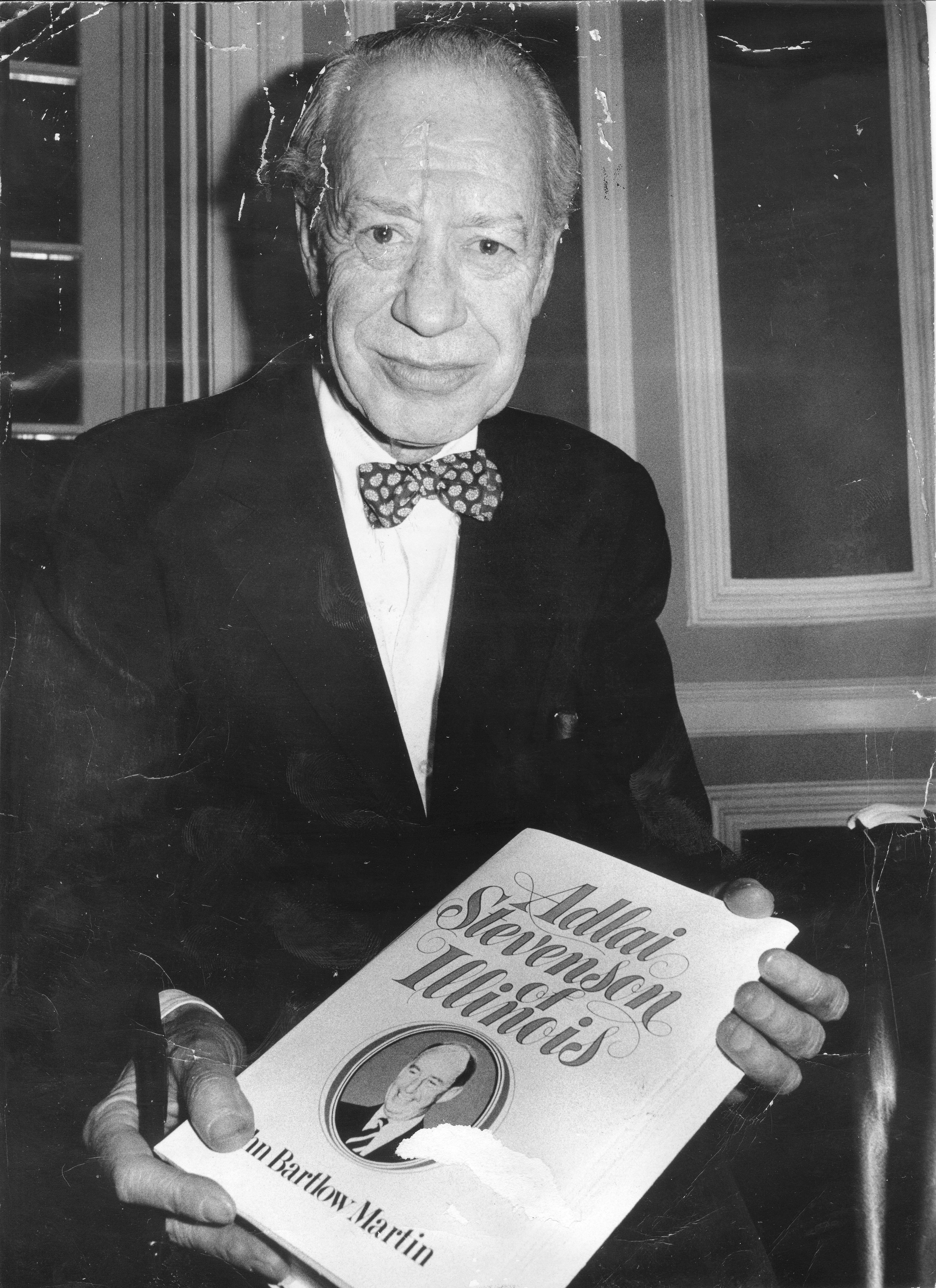
The Biographer and the Governor: John Bartlow Martin and Adlai Stevenson

On July 14, 1965, Adlai Stevenson II, two-time Democratic presidential candidate and diplomat, was in London following a speech in Geneva, Switzerland. During his stay, Stevenson had met with British prime minister Harold Wilson and visited friends. That day after lunch he and Marietta Peabody Tree, his confidante and lover, went for a walk in Grosvenor Square near the U.S. Embassy as he wanted to show her the house he had lived in with his family while working on the UN Preparatory Commission following World War II. The house, however, had been torn down and replaced with a modern building, which caused Stevenson to sigh and comment, “That makes me feel old.”

The duo walked on toward Hyde Park, but Stevenson asked Tree to slow down before uttering his final words, “I am going to faint.” He fell over backward, hitting his head on the pavement, unconscious. Although passerbys, including a heart doctor, tried to help, and an ambulance arrived to take him to the hospital, Stevenson died, the victim of a massive heart attack.

The news about Stevenson’s death reached John Bartlow Martin, who had worked as a speechwriter in his 1952 and 1956 presidential campaigns, while he and his family were vacationing in Michigan’s Upper Peninsula. That night he and his wife, Fran, took a train to Chicago, where they spent time in Adlai Stevenson III’s office working with Newton Minow and others on funeral arrangements before taking a flight to Washington, DC, to attend a service for Stevenson at the National Cathedral. There, offering his condolences to Martin on the loss of his friend, President Lyndon B. Johnson said of Stevenson, “He showed us the way.” Flying back on the presidential plane taking Stevenson’s body home to Illinois, Martin fell into a conversation with his friend and fellow Stevenson speechwriter Arthur Schlesinger Jr., who told Martin he should write a biography on the two-time Democratic presidential candidate.

At first, the Stevenson family turned to another person close to their father, Walter Johnson, a longtime University of Chicago history professor, as its choice to write the definitive Stevenson biography. Johnson certainly had the knowledge to accomplish the task, as he had been national cochairman for the movement to draft Stevenson as the Democratic presidential candidate in 1952 and became a close friend of the former governor.

Instead of tackling a biography, however, Johnson decided to serve as editor of a collection of Stevenson’s letters, writings, and speeches. “I felt it was time to get the solid material out,” Johnson later said. “When I began I was thinking of two or three volumes. But there was so much good material, and it soon became evident that it would require several more volumes.” The Papers of Adlai Stevenson, published from 1972 to 1979 by Little, Brown and Company, grew to eight volumes under Johnson’s editorship, assisted by Carol Evans, Stevenson’s secretary for many years.
 
According to Martin, Adlai III, a few months after his father’s death, had sought his advice about the biography, asking him if any writer the family selected might be willing to share royalties to help support the establishment of a Stevenson Institute. “I told him that I myself had never split royalties but that in these circumstances, to help the institute and because of my feelings for his father, I probably would,” Martin recalled. He suggested names of several writers as possibilities, but none of them panned out, and after a time Adlai III asked Martin to take on the project. “I’ve always been a fact writer and I’ve always written about people. These two elements come together better in biography than in any other form,” Martin noted.
 
In October 1965 Martin wrote Ivan Von Auw Jr., one of his agents, along with Dorothy Olding, at Harold Ober Associates, that he had been in talks about the biography with Adlai III and Minow. “They’re for me, and so are most others, but I think two important people [Martin did not name them] are not; and while Adlai and Minow seem to be all but certain that I will be anointed, I’m somewhat less so.”
 
Fran had counseled her husband to reject the assignment, as she considered doing the Stevenson biography as “going back,” and she wanted him not to “relive the past but to move forward.” She added that to do a proper biography on Stevenson’s life would take a long time and the family might prove to be difficult. Fran’s reservations had some validity in the end, but Martin decided to forge ahead and with the biography on someone he considered to be “an extraordinarily appealing civilized human being.” Martin also realized that he had always been a fact writer and written about people, and those two elements “come together better in biography than in any other form.”
 
Doubleday and Company, the publisher of Martin’s Overtaken by Events, which highlighted his time as U.S. ambassador to the Dominican Republic, agreed to back the project, offering financial support of approximately $200,000, with a due date for the book of January 2, 1969. Martin approved splitting his royalties with Stevenson’s sons, and gave Adlai III, acting for the family, the right to review the manuscript before publication. They also established a procedure to follow if they could not reach agreement on suggested changes, with the issue going for binding arbitration to Carl McGowan, a federal judge and Stevenson’s former chief of staff, or, if McGowan was unavailable, to Minow, Stevenson’s former law partner.
 
The legal precautions were spelled out ahead of time to avoid the problems William Manchester had experienced with Jacqueline Kennedy and Robert Kennedy in writing about John Kennedy’s assassination in The Death of a President, eventually published in 1967 after long, tense negotiations and a lawsuit prompted by Jacqueline Kennedy. Martin later said he did not like the idea of the book being Stevenson’s “official” biography, as the word conveyed the “idea that the [Stevenson] family controlled the manuscript, and therefore the book cannot be trusted entirely. That’s not the situation."

 
Martin started his work on the Stevenson biography in December 1965. For a few months, he and his family rented and lived in Stevenson’s farm in Libertyville, Illinois, where Martin had visited him often during his lifetime, finding the place to be “light and airy, filled with sunshine, cheering.” Martin kept expecting to see Stevenson’s “dumpy figure waddling up the sloping field from the Des Plaines River, picking up dead tree branches as he came; to enter through the sun porch, blue eyes wide, cross the living room and, looking slightly perplexed, hesitate by the fireplace; then, grumbling about ‘this appalling task,’ go into his study to work on a speech.”
 
With the assistances of his old friend, Francis Nipp, who worked for a time as his research assistant, Martin catalogued Stevenson’s library and discovered that it contained reference books, bound copies of Stevenson’s speeches, family histories, and numerous items on Abraham Lincoln and Illinois. “He was a man of Illinois, always; even after he belonged to the world,” Martin said of Stevenson, “Illinois history, the Illinois prairies, and above all these seventy acres held him.” Scattered about Stevenson’s office were a bust of President Kennedy, “gorgeous” pictures of a cruise Stevenson had taken on a private yacht during his United Nation years, an autographed picture of President Johnson, a collection of plaster donkeys (the Democratic Party’s symbol), and mementos of Stevenson’s travels around the world. “Under his desk blotter was a scrap of paper containing in his handwriting a notation that Artie, his Dalmatian, was buried by a tree outside his study window,” Martin recalled.
 
The biographer found that his subject had been “a string saver; he almost never threw anything away.” On the wall of the basement stairs Martin saw a lithograph from the 1892 presidential campaign, when Stevenson’s namesake had been elected vice president as the running mate of Grover Cleveland, plus one from 1900 when the elder Stevenson lost with Democratic presidential candidate William Jennings Bryan. The basement also included an old filing cabinet with one drawer stuck tight. “I finally pried it open—and found Stevenson’s daily appointment books covering his entire four years as Governor,” remembered Martin.
 
In addition to the items he uncovered at Stevenson’s home, Martin explored materials at the Illinois State Historical Library in Springfield; the State Department in Washington, living for a time in a rented house in Georgetown; the U.S. Mission to the UN in New York; and Princeton University, where Stevenson had graduated in 1922. Martin also received a grant from the Rockefeller Foundation to work on the book while staying with Fran and his son Fred at the foundation’s Villa Serbelloni on Lake Como in Italy. Fran brought with her seventeen footlockers crammed full of items on Stevenson.
 
During his search of what Martin called Stevenson’s “enormous” archive, he found not only the longhand first drafts of the presidential candidate’s famous speeches, old love letters, campaign contribution lists, and income tax returns, but such minutiae as ticket stubs to Princeton football games and old dance programs. 

Martin and Nipp copied several hundred thousand pages of Stevenson’s papers, placing the copies into looseleaf binders, each containing upwards of two hundred pages. They numbered the binders and gave each one a special symbol designating whether it contained correspondence, speeches, or other material. “We indexed the copies, making an average of perhaps a thousand 5-by-8-inch cards on each of the sixty-five years of his life, and arranged them chronologically,” said Martin, who used the cards to write the rough draft, as they guided him to material in the binders. “I write from the actual documents,” he noted. Martin acknowledged that there was “a certain amount of accountancy to this type of research,” but it was the way he worked. “It’s clumsy, it’s awkward, it’s slow—it takes a lot of time—but you don’t make many mistakes this way,” he noted. “And that’s the whole purpose.”
 
To fill in any gaps in the information, Martin interviewed, in all, nearly two hundred people involved in Stevenson’s life, dictating his interview notes and indexing them in binders as well. The interviews included some he did in the summer of 1966 in Bloomington, Illinois, with Stevenson’s family and friends. These were especially important because Martin believed nobody could understand Stevenson unless they understood the town where he grew up. “It was there that I discovered that Stevenson’s childhood, far from the happy time usually pictured, had been a horror,” said Martin, including a tragedy in which Stevenson accidentally killed a young friend with a rifle.
 
In the fall of 1966 Martin and his family moved to Princeton, New Jersey, and it was there that he realized the “generous” royalty advance, which he had invested “for my future,” and research grant he had received from Doubleday would not be enough to finish the book (Martin had originally estimated it would take him three years to write; it ended up taking a decade to accomplish).
 
Looking for supplementary income (he estimated it would cost him $30,000 more in research funds to complete the Stevenson biography), Martin thought of writing once again for the national magazine market, writing Olding that he did not mind borrowing “more money from the bank to carry expenses if there seems a good chance of writing pieces that will sell for enough to repay the loans and keep me going.” Martin, however, had the good fortune to receive a one-year appointment as a visiting professor in public affairs at the Woodrow Wilson School of Public and International Affairs at Princeton. “After that, Arthur Schlesinger had me appointed visiting professor at the Graduate Center of the City University of New York, where he himself now taught,” said Martin. He commuted to CUNY from Princeton to teach his seminar, which dealt with the limits of American power in foreign policy.
 
When he began his work on the book, Martin expected it should take him three years to finish. It took him far longer than that because of the great volume of material he had uncovered about Stevenson. “I have to say that I came away from the whole exercise admiring him more than I had when I began,” Martin said of his subject. “I always knew he had political courage—I was with him when he attacked [U.S. Senator Joseph] McCarthy and President [Dwight] Eisenhower wouldn’t,” said Martin. “But I didn’t know how miserable, how horrible his private life had been. I learned he also had private courage.”
 
Stevenson had to deal with a sometimes traumatic childhood, “a foolish father, a pretentious and suffocating mother, a domineering older sister, a disastrous marriage, and, despite all the friends and comings and goings, an essentially lonely life,” Martin said. His subject never complained about these hardships, assuming, Martin noted, that a person’s private life was supposed to be torture.
 
On June 5, 1970, Martin, who averaged writing fifty pages a day, finally finished the rough draft of his manuscript, which ran more than 16,000 pages and contained some two and a half million words. “I write a long, awkward—and lousy—rough draft,” Martin noted. “It’s simply an attempt to get facts down in some order.” For the next year and a half, he spent his time in cutting and rewriting the manuscript into a semifinal draft of approximately 3,200 pages, or nearly a million words.
 
Martin spent another three years clearing the manuscript with people he had promised to show it to in return for their cooperation (among them George Ball, Arthur Schlesinger Jr., Theodore White, Jane Dick, and Newton Minow), and obtaining clearances for quotations from letters other people had written to Stevenson, including such important figures in his life as Jacob Avery, Agnes Meyer, Carl McGowan, Dore Schary, Wilson Wyatt, Louis Kohn, John Kenneth Galbraith, and many others.

 
Although some biographers paraphrase letters written to their subject in an attempt to avoid the trouble of seeking permissions, Martin wanted to include verbatim quotes from the letters, especially those from Stevenson’s female admirers, in order “to preserve the flavor of their friendships.” 

Final approval also had to be obtained through negotiations with Stevenson’s eldest son, Adlai III—meetings that included Minow as potential arbiter, and sometimes included Martin’s editors from Doubleday, Samuel S. Vaughan and Ken McCormick. There were times when Martin lost his patience and wondered if he was in danger of writing a book by committee. “If we make this Stevenson book so that it pleases everybody,” Martin wrote his agent Dorothy Olding, “we will not have a book worth reading.”
 
The storm passed, however, and Martin believed he had endured the troubles for a good cause. “He [Adlai III] raised numerous objections, but we never were forced to arbitration,” Martin said. Most of the younger Stevenson’s protests involved the book’s explorations of his father’s relations with his female friends, some ill-timed statements Stevenson had uttered about Jews, and his feelings about African Americans. “I must say I thought young Adlai behaved well; I am not sure I would want to read a candid biography of my own father,” Martin said. “In any case, he did not gut the book, nor did I falsify it.”
 
When he wrote the rough draft, Martin had, he confessed, been too keenly aware of his status as a Stevenson partisan, and, consequently, to be objective, “had been hypercritical of him,” focusing too much attention on his subject’s flaws and weaknesses. This caused a reader of one of the drafts to tell Vaughan that he believed the author did not like his subject. Adlai III’s critical comments and suggestions for changes, which were adopted in the final draft, helped to restore balance to the book, Martin said. It had not always been possible to unravel all the complexities of Stevenson’s life in writing the biography of this “sometimes ambiguous man,” but Martin believed he had answered all the important questions.
 
The manuscript for the Stevenson biography proved to be too long to publish in one book, so Doubleday released the book in two volumes: Adlai Stevenson of Illinois (1976), covering his life from birth to his first presidential campaign in 1952, and Adlai Stevenson and the World (1977), exploring Stevenson’s career after the 1952 campaign up until his death in 1965 and published just twenty-five years after Martin had first met him; together the books became known as The Life of Adlai Stevenson.
 
No stranger to biography, Schlesinger praised the books as “superb” and complimented his former speechwriting partner for his ability to combine “affection, insight, and objectivity” into what he regarded as “one of the greatest American political biographies of the [twentieth] century.” Taken in full, the more than 1,600 pages produced by Martin represented, noted Jeff Broadwater, a subsequent Stevenson biographer, one of the “most impressive pieces of detective work in the history of American biography,” an opinion, with some reservations about the books’ relentless amount of detail, that was shared by many other reviewers. 

As John Kenneth Galbraith noted in his review of the first volume in the New York Times Book Review, Martin had been able to organize the vast amount of material on Stevenson into “a far more coherent and interesting story than anyone would think possible. Some writers take many words to say little; John Bartlow Martin takes many words, but fewer than would be supposed, to say everything.” There was no malice or meanness of thought in the book, and Galbraith said that Martin never allowed his friendship with Stevenson to affect his narrative.
 
Although not always flattering to a man Martin unabashedly considered to be one of his heroes, the books represented an honest and unflinching look at one of the leading U.S. politicians and statesmen of the twentieth century. The striking and rigorously documented biography demonstrated to all who read it that Stevenson’s polished speeches, his candor, and his forthrightness had worked together to elevate the tone of America’s politics, according to a review in Time magazine. “He [Stevenson] set a standard that later presidential aspirants have yet to match,” the reviewer for Time concluded. Martin’s former hometown newspaper, the Indianapolis Star, gave him the highest compliment a biographer could receive when its reviewer noted, “After reading Martin’s book, one can say with some degree of satisfaction that he knows Adlai Stevenson—knows him, in fact, about as well as he could have been known as a living person.”
 
Martin had started work on the Stevenson biography while still in his fifties—a time, he said, when a person is expected to earn his highest income and do his most important work. He spent this vital period of his life immersed in writing about Stevenson, and never had any regrets about his decision. “I’ve heard it said that some writers who spend so long on a biography become bored with their subject, or, worse, come to resent him for taking so much of their lives to write his,” said Martin. “Luckily I escaped both infections.”
 
After the dissatisfaction he had experienced while working as a speechwriter for George McGovern’s 1972 presidential campaign, Martin had been inspired in writing his book by the pleasant memories of his days with Stevenson during the Illinois governor’s 1952 run for the presidency, marked as it was by “a sort of ebullience, a freshness, a verve” not seen since in politics. Stevenson took politics “out of the gutter,” Martin said, and believed it to be “a high calling, and that showed through in the way he handled himself as a politican. I think that was the thing that attracted all of us to him in the first place.”
 
Martin’s experience with the Stevenson biography had its setbacks. Both volumes were “widely and favorably reviewed,” but sales were only modest, Martin noted. He also shared Fran’s disappointment that neither volume won a Pulitzer Prize or a National Book Award. Martin came to believe that if he had written the biography fast and it had been published in one volume shortly after Stevenson’s death, it probably would have become a best-seller and won at least one major honor. “On the other hand,” Martin said, “it would have been a very different book.”
 
The enormous amount of documentation he uncovered contributed to the biography’s length, but it did not overwhelm him, Martin said. He always tried to remember that he, alone, had complete access to all of Stevenson’s papers and he owed an obligation to history to provide a complete view of the former governor’s life. “Adlai Stevenson was one of the most important figures in my life,” Martin said. “In life, he gave me a great deal, and I like to think I helped him.”