Monday, August 28, 2023

". . . the glories of peace": Richard Tregaskis in Japan

The Douglas C-54 Skymaster transport plane emblazoned with a white star along its sliver fuselage and “Bataan” printed on its nose glided in for a landing at Atsugi Airfield near Yokohama, Japan, on the afternoon of August 30, 1945. With his trademark corncob pipe clenched between his teeth and clad in aviator sunglasses, General Douglas MacArthur climbed down a ramp wheeled up to the plane.

As MacArthur ambled down the steps, the general was serenaded by a band and cheers from paratroopers from the Eleventh Airborne Division, the soldiers who had secured the airfield formerly held by Japanese kamikaze pilots determined to give their lives for their emperor. President Harry Truman had recently appointed MacArthur as Supreme Commander for the Allied Powers, giving him the job of overseeing the occupation of the conquered country and directing him to “exercise your authority as you deem proper to carry out your mission.”

Shaking hands with General Robert Eichelberger, head of the Eighth Army, MacArthur, as newspapermen and photographers (some American and many Japanese) swarmed around him, commented: “Well, Bob, it’s been a long road from Melbourne to Tokyo, but as they say in the movies, this is the payoff.” MacArthur also took time to compliment the band’s performance, telling its leader that it had been “about the sweetest music I’ve ever heard.”

As MacArthur and his party, all unarmed at the general’s orders, pushed on from the airfield to Yokohama in a motorcade along a road lined with thousands of Japanese soldiers providing security, more transport planes landed at Atsugi. One passenger, Richard Tregaskis, who had followed members of the Military Government Section from Manila in the Philippines to a muddy base in Okinawa and now on to Japan itself on behalf of the Saturday Evening Post, had trouble believing what was happening. “The nonchalance of this peaceful invasion seemed astounding,” Tregaskis wrote. “I’d been flying with the B-29’s on bombing runs, and on Admiral [William “Bull”] Halsey’s torpedo planes, too recently to realize that the war was over, that all this could happen here.”

Although one of the passengers on Tregaskis's plane jokingly objected that he wanted to return to the United States, most were absorbed in sightseeing, sitting in “awed silence, now, straining to see everything,” Tregaskis reported. As someone pointed out something on the ground to a man sitting next to him, others were quick to try to rush to see what it was. Tregaskis compared it to a “mass nerve response like the craning of necks at a football game or automobile race, when something exciting is happening.”
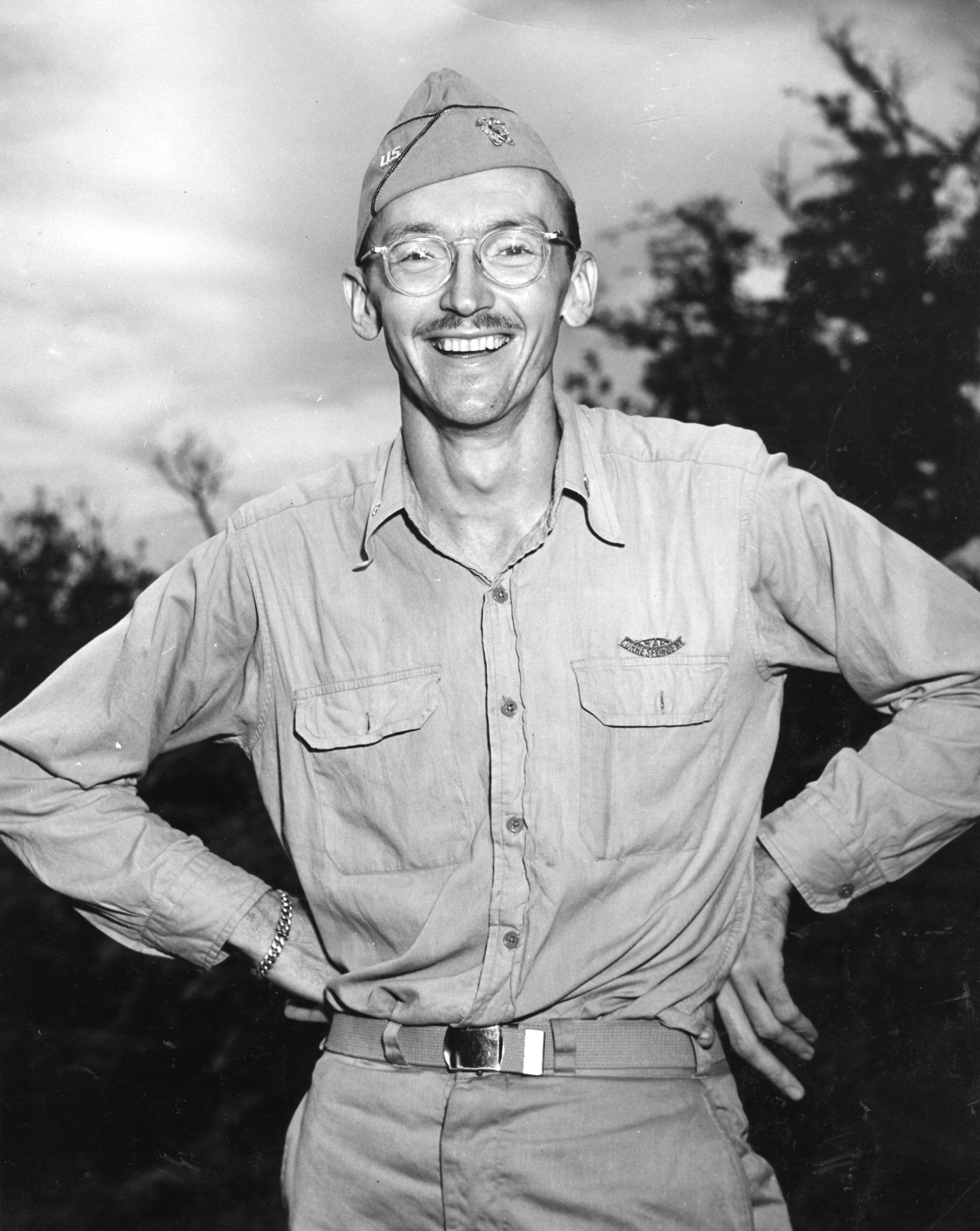
Only two weeks ago, the countryside would have been “spitting fire” at any American planes overhead, but today Tregaskis’s plane landed without incident alongside aircraft bearing the Rising Sun emblem. Setting foot on the concrete taxiway with his tired companions, Tregaskis recalled something an enlisted man with the Military Government Section, Corporal Vincent A. Livelli, a typist from Brooklyn, New York, had said to him in Manila: “Military government follows the glories of victory with the glories of peace.”
The speed and uncertainty of the end of the war in the Pacific had dampened any riotous celebrations in the Philippines. Tregaskis arrived at MacArthur’s headquarters in Manila shortly after the Japanese news agency, Dōmei, had released a statement on August 10 from the Japanese Foreign Ministry announcing the country’s capitulation. 

What followed, noted Tregaskis, was a period of hopeful waiting that soldiers called “the big sweat,” which seemed to drag on for years. “Nobody was sure just when—or if—he should begin celebrating,” he remembered. “It was like the first day of the double-headed V-E Day in New York; unsteady, uneasy, with people milling about and not knowing just what to do, not being sure, half waiting for the official handout on peace, half wanting to celebrate now.” Peace had caught everyone off guard, just as had the start of the war for the Americans with Japan’s surprise attack at Pearl Harbor nearly four years before.

Although the moment did not seem climatic or clear-cut, it did provide inspiration for Lieutenant Colonel Carl Erickson, the acting head of the Military Government Section (shortened to Milgov in Tregaskis’s Post articles) at MacArthur’s headquarters. Erickson, the executive officer for Brigadier General William E. Crist, who was hurrying back to the Pacific from a visit to Europe to review the occupation there, controlled a tiny staff—two other officers and five enlisted men, all of whom had been snatched away from the Philippines Civil Affairs Unit and assigned to the new section. “If Military Government had to be flown into Japan the next day, this tiny detachment, with whatever other officers could be gathered, borrowed or stolen from other outfits, would have to take over the entire job of administering the central government of Japan,” Tregaskis reported.

With the “air thick with plans” for just how to rule over occupied Japan, Tregaskis secured Erickson’s permission to spend the next few weeks tracking the detachment’s unsteady progress from Manila to Tokyo. Uncertainty and improvisation became key parts of the unit’s existence as it waited for reinforcements; Erickson had been promised, Tregaskis wrote, that 230 men with specialized training were on their way from the United States, dispatched with “No. 1 air priority.”

In the meantime, those assigned to the section displayed remarkable skills at scrounging for needed supplies and office space for the new men. Livelli, who had told the correspondent that he had “never felt closer to history,” found a Japanese phrase book produced for Filipinos during Japan’s occupation of that country by one of the invaders’ propaganda agencies. The only linguist during the detachment’s early days, Livelli, who spoke French, Portuguese, Spanish, and Italian, had, in just a few days spent reviewing the phrase book, had mastered some elementary Japanese language characters, including those that indicated “keep off,” Tregaskis reported.

Others on the staff, however, remained more interested in returning home than in participating in the grand adventure awaiting them in Japan. Like many who were still serving in the military, they anxiously tried to figure out where they stood in the “point system” instituted by the U.S. War Department to determine the order of demobilization. The higher the points they had amassed—for such items as time served, where they had served, decorations earned, and number of dependents—the sooner they could expect to be discharged to see their families again.  

Day by day, Tregaskis observed the Military Government Section grow with “the rapidity of a jungle plant in the monsoon season,” taking up space in new offices in another wing of the building. Crist joined his new command, full of lessons he had learned from his European sojourn and determined to avoid the pitfalls he had observed. “It’s inexcusable to make the same mistakes again,” he told Tregaskis, especially since he and his men were on a twenty-four-hour notice for travel to Japan or other occupied zones, including Korea.

The wallboard partitions that marked the boundaries of the detachment’s office in Manila’s city hall expanded as officers, most fresh from Civil Affairs Training schools in the United States, and rookie enlisted personnel joined the staff. It made for a colorful sight, said the reporter, who saw in the building a “motley ensemble of Navy and Army garb, a mixture of colors and patterns which indicated that the officers who would be supervising the government of Japan had been hastily gathered from many sources to be flung into the emergency situation.”

Tregaskis noticed a trend toward mollifying harsh American attitudes about the Japanese occupation. Instead of a strict military government along the lines of the one established in Germany, as had originally been projected, he saw a shift toward “indirect control,” using the existing Japanese government bureaucracy to run the country, overseen, of course, by MacArthur as supreme commander. Crist gave similar welcoming remarks to all new members of his detachment, letting them know that their initial function would be advisory. “We want to avoid disrupting Japan too much,” the general warned his troops. “Above all we must carry out orders. The commander is given tools. He is responsible for the results. We don’t tell him how to use his tools. That’s up to him. It’s up to the commander to use you, or you, or you, or use me, as he sees fit.”

The “tools” that joined Crist’s command were usually older than ordinary line officers, Tregaskis noted, and their “faces carried interesting marks of character, of developed individuality.” They were men of so many specialties that Erickson, who had been told he would be remaining in Manila and not joining the section in Japan, referred to them humorously as “entomologists and anthropologists.” Their specialties included public safety, finance, banking, public health, public safety, public works, industry, and law.

Those who had to stay in the Philippines were jealous of those selected for service in Japan, remembered Tregaskis, who also would be traveling to the defeated foe’s homeland. “We were envied not only for the chance to see the country with the first occupying forces; but also because the military government office in the City Hall was becoming almost mammoth; and like any expanding organization,” he said, “it was obscuring individuals in its expanding folds.” One of the captains left behind lamented to the correspondent: “With colonels all around, what can a mere captain do?”

Upon his appointment as supreme commander, MacArthur had been determined to formulate his own policies and implement them through Emperor Hirohito and the imperial government, running a conciliatory occupation. Unlike Germany, which had been divided into zones for the different Allied Powers (United States, Great Britain, France, and the Soviet Union), the United States, despite Russia’s late entry into the fight, controlled Japan except for token British and Australian troops stationed in Hiroshima. There was an Allied Council for Japan, which consisted of the United States, the Soviet Union, China, and the United Kingdom, meant to advise MacArthur, but the general ignored it, noting that as supreme commander he was the “sole executive authority for the Allied Powers in Japan.”

The general intended to use his unchallenged power to reform the country, to bring it “abreast of modern progressive thought and action” by eliminating its military power, punishing its war criminals, building a proper structure of representative government, modernizing its constitution, giving Japanese women the right to vote, releasing political prisoners, establishing a free press and labor movement, separating church from state, and liberalizing its education system. “It was true that we intended to destroy Japan as a militarist power. It was true that we intended to impose penalties for past wrongs,” MacArthur recalled. “But we also felt that we could best accomplish our purpose by building a new kind of Japan, one that would give the Japanese people freedom and justice, and some kind of security.”

The principles MacArthur planned to follow during the occupation were the same ones, he added, “which our soldiers had fought for on the battlefield.” MacArthur strove to turn Japan into “the world’s greatest laboratory for an experiment in the liberation of a people from totalitarian military rule and for the liberalization of government from within.”

The Military Government Section’s departure from Manila was “a masterpiece of hurry-up-and-wait,” according to Tregaskis, with the U.S. Army playing its old game of ordering someone to be at a rendezvous hours early “so as to allow plenty of time to get there yourself.” The trip involved plenty of discomfort and misery, but the members of the Military Government Section he accompanied endured the hardships with good cheer. “I wouldn’t miss this for the world,” Livelli said as the group waited and waited for the flight to take off from Nichols Field in Manila. A dancer in civilian life, Livelli surprised Tregaskis by sharing that he would be filling his time reading James Joyce’s Finnegan’s Wake, as he was interested in the book “from a philological point of view.”

Another of his companions related to Tregaskis that when he had first joined the army he used to complain quite a bit about its inefficiency. After being in the military for a time, however, he “decided they got things done somehow, so I decided they must be right. Now, I just take it.” Lieutenant Melville Homfeld was probably the most anxious among the group’s members to reach their destination, the port city of Yokohama, located south of Tokyo. When Homfeld entered the army, his wife had also volunteered to serve, joining the Red Cross. She had been assigned to the hospital ship USS Benevolence, which was supposedly anchored in Yokohama Harbor. “Homfeld was very vehement about wanting to see her again,” Tregaskis reported. “In fact, when he talked about the possibility of finding her in Yokohama Harbor, he let out something like a cowboy whoop.”

After a miserable two days at a mosquito-plagued tent camp on Okinawa, Tregaskis set off for the last leg of his trip on a plush C-54E transport plane, equipped with comfortable reclining seats and an electric plate on which the passengers could brew cups of hot coffee. “All around us, on our flanks and ahead, silver specks of other C-54’s, inward bound for Japan, dotted the sky,” Tregaskis wrote. The passengers sat in “awed silence, straining to see everything” as the plane made its descent into Atsugi airfield.

After parking at the end of a long line of C-54s, Tregaskis and his companions climbed down to the tarmac and were met by an American paratrooper in a jeep, who radioed to seek transportation for their party. Unfortunately, the truck that arrived only took them as far as a barnlike wooden hangar located a few yards away to play the army waiting game again. “It was fitting, after all, that we should end our journey to Japan as we had begun it—waiting,” Tregaskis said.

For the next two weeks, the members of MacArthur’s Military Government Section moved slowly, establishing their offices in Yokohama’s customhouse. Tregaskis helped to make signs for the various departments—General Aid, Secretary of Labor, Medical, Finance, Resources, and Public Safety, among others. The correspondent also joined Major Cecil Tilton, Crist’s assistant, and Charles Thomas, a civilian financial adviser, on a trip to the city’s main shopping district to purchase guidebooks and Japanese-English dictionaries. “We found no stores, only piles of rusty iron wreckage, many shacks made out of salvage, and one or two locked and bolted concrete buildings,” said Tregaskis.

Stopping for water for their dilapidated car at a Japanese garage, Tilton asked the proprietor where he could buy books, but discovered there were no bookstores in the city; the nearest ones were in Tokyo. Homfeld had better luck, making it to Yokohama Harbor, boarding the ship on which his wife served, and having a joyous reunion.

Unfortunately, the days soon fell into a deadly dull routine of paperwork and more paperwork. While exciting events were happening elsewhere—the formal Japanese surrender on the USS Missouri in Tokyo Bay on September 2, for example—military government soldiers “worked long hours in the stuffy confines of their Yokohama customhouse office, from eight-thirty a.m. until eleven o’clock at night,” Tregaskis recalled. “And because the high policy was to be cautious and to center responsibility only at the very top, most of the recommendations, instructions and plans prepared by Milgov had to be rewritten, redone.”

Orders for running the country, Tregaskis noted, came from the supreme commander, MacArthur, directly to the emperor or his representatives, then through the Japanese government’s or civil service’s usual channels. “Our Milgov people were only to advise, check up and make reports,” he wrote.

The military government staff did jump in to assist Lieutenant General John R. Hodge’s Twenty-Fourth Corps, which had been ordered to occupy the southern portion of the Korean peninsula, annexed by Japan in 1910. The occupiers were now gone, and, because there were not enough trained men to take over, and there existed infighting among Korean nationalists seeking power, “real Military Government by outsiders—Americans—would have to be provided,” Tregaskis wrote. Crist’s section in Japan had to produce proclamations for Korea that then needed to be translated into Korean. That proved to be a problem, the correspondent noted, as the unit possessed a Japanese interpreter section, but it had no Korean translators. “However, men who could write Korean were discovered in the Psychological Warfare branch, and the job was done,” Tregaskis wrote.

Things did not improve for the Military Government Section when it moved its operation from Yokohama to Tokyo along with MacArthur’s headquarters, which established itself in a six-story insurance building that became known as the Dai Ichi (Number One) building. The military government staff rode on the “vertebra shattering road between Yokohama and Tokyo” to its new offices in a grimy building that was part of the Japanese Forestry Department.

Instead of preparing to help govern the country, however, the officers and enlisted men Tregaskis had come to know were blindsided by a decision from MacArthur’s headquarters (Order 170) creating the Economic and Scientific Section. This new department took over “not only some of the functions but even some of the personnel of the Military Government Section,” he reported. “It seemed evident to many of the Milgov people that this would be only the first of a series of slices into the physical structure of its organization.”

One officer, whose name Tregaskis kept secret for fear his superiors might punish him for his honesty, said his unit had become “a hollow shell” and complained that those who had been trained for their jobs at a cost of thousands of dollars were now in limbo; it seemed as though the Military Government Section would be “liquidated,” with the supreme commander exercising his authority through the Japanese government. MacArthur’s statement that he expected to maintain only a skeleton military force, approximately 200,000 troops, only confirmed Tregaskis’s belief that the occupation was “going to proceed on a cut-rate—for the Americans basis; that the policy of playing with the soft pedal was going to be continued indefinitely.”

Underlying Tregaskis’s reporting on the situation was his own frustration at losing his ongoing access to a story he had been working on for the past few months, and in the process becoming close to several members of a unit that seemed to be vanishing before his eyes. Also, there still existed bitter feelings among some Americans about the war and how severely Japan should be punished for what many saw as reprehensible conduct.

In a Gallup poll taken during the later stage of the war, only 8 percent of Americans had favored rehabilitating and reeducating Japan (13 percent had agreed with the option “Kill all the Japanese people”). Tregaskis reflected some of that animosity against the enemy in his articles for the Post. Writing about the move from Yokohama to Tokyo, the reporter noted that enlisted men and junior officers from military government “had been assigned to dirty quarters in business buildings, with picayune sanitary facilities.” This had caused “understandable growling,” with the Americans wondering: “Who won the war, after all? Why aren’t we in the best buildings in Tokyo?” Also, racial prejudice still marred relations between occupiers and the occupied. 
 
To gain some insight into what the future might bring for military government, Tregaskis arranged interviews with two of MacArthur’s top advisers—Brigadier General Bonner Fellers, the general’s military secretary and head of the general headquarters’ Psychological Warfare Section, and General Richard K. Sutherland, MacArthur’s chief of staff. Fellers, whose department’s name had been changed, “in line with the prevailing trend toward euphemism,” Tregaskis noted, to Information Dissemination Section, said to the reporter that the Japanese government had been “100 per cent not only co-operative but subservient.”

Tregaskis reminded Fellers that he had heard some people in the United States had been critical of what they viewed as “too much softness” when it came to handling Japan. But Fellers warned that if the Americans were too firm, the Japanese would view it as betraying agreements made before their unconditional surrender, including promises that the existing state structure would be maintained. There were also several liberal reformers in Japan who might be able to steer the country toward democracy. The liberals had been beaten down by the militarists who controlled the country in the past and needed to be encouraged to emerge and lead, noted Fellers, who had urged MacArthur against putting the emperor on trial as a war criminal. “The plan is practical,” he told Tregaskis, “and we’re going to let them do it.”

In his discussion with Tregaskis, Sutherland confirmed that Crist’s section would be dissolved and its functions absorbed by other departments, who would make reports to the supreme commander. “We’ll do the same thing with Military Government people that we’ll do with the (fighting) divisions—we’ll release ’em,” Sutherland told the reporter. “They were originally set up for a combat landing, like the divisions. They should be considered as divisions. We’re using those who are needed and releasing the rest—and some of those being released are inevitably going to be high-powered people. It can’t be helped.”

Tregaskis realized that MacArthur was sensitive to the call from many Americans, tired of war and its costs, for the government to send troops home and cut inductions into the armed services (the size of the U.S. military had been reduced throughout 1946, falling from 12 million to 1.5 million). In early 1946 wives of servicemen had organized “Bring Back Daddy” clubs to pressure Congress to speed up bringing their husbands home. Soldiers overseas had also organized protests lambasting plans by the War Department to slow demobilization. Tregaskis could not blame MacArthur “for a policy of expediency when the American people seemed to indicate they didn’t want to follow through either—that they didn’t want to send more boys and dollars to go out and police the world; at least, not until another war came along!”

With the Military Government Section reduced in importance, Tregaskis ended his “Road to Tokyo” series for the Post, returning to the United States to report and write for the magazine for the first five months in 1946 about how veterans were handling their return to civilian life.

Tregaskis, who had been covering the war for the past four years, had his own transition issues, including such simple problems as finding replacements for his size fourteen military issue footwear. Like most men who had been discharged from the army, navy, or marines, Tregaskis was “glad to be alive at the end of the war, to have both arms, both legs, both eyes and both ears; to be reasonably sane; and, immediately, to be able to get something to eat, to be able to bathe in warm water, to sleep between clean sheets.”

Coming from Tokyo, which had been “thoroughly poor, starving and devastated,” Tregaskis viewed his first port of call, San Francisco, as “a pleasant dream.” He went on “an innocent orgy” of window shopping, haunting department stores and making the circuit of hamburger stands, restaurants, and used-car emporiums. “It was a wonderful privilege,” he noted, “to be alive in this country where everyone in the ragamuffin remainder of the world would like to live; where everyone, comparatively, is wealthy.”

Tuesday, August 22, 2023

Our Man in Saigon: The AP's Malcolm W. Browne

The call woke Malcolm W. Browne at 2:30 in the morning on September 18, 1964. He stumbled across his apartment, located above his Associated Press office at 158/D3 Rue Pasteur in Saigon, South Vietnam, to answer. It was from one of his police sources, who informed the AP’s bureau chief that there had been a fight at the docks involving Americans and he might want to visit the scene.

Browne dressed in  hurry and drove to the docks in the office’s Land Rover, painted bright red with white signs in Vietnamese and English reading “Bao Chi,” identifying it as belonging to a member of the press. Once there, he learned that four seamen from Guam had been in a fight with some South Vietnamese Rangers and police; one sailor had been wounded in the throat but had survived. Browne returned to his office, wrote his story, and took it to the telecommunications center to send it to the AP office in Tokyo, Japan, for distribution to member newspapers in the United States. He finally made it back to his bed at 3:50 a.m.

The newsman woke again at 7:15 a.m., showered, and ate his breakfast of a bowl of Wheaties and a cup of strong, black coffee. Finished, he walked downstairs to the cramped AP office, which always looked to him “more like a command post than a news agency office.” Filing cabinets dominated one wall, while others were covered with floor-to-ceiling sector maps of the country with plastic overlays on which the staff kept track of important battles. 

Located near Browne’s desk was the field gear he could grab at a moment’s notice for a dash to the airport to board a helicopter when word came about a new firefight. He skimmed the morning newspapers, then told one of his colleagues to cover a meeting at nine that morning involving Major General Duong Van Minh with civilian politicians organizing a new advisory council. Browne also made sure to book a call to Tokyo from the AP office for later that day on the office’s lone cracked, green telephone. At 8:40 a.m. Browne telephoned a U.S. military spokesman seeking any new developments in the conflict with North Vietnam. What slight details he received from the tight-lipped official he cabled to Tokyo.

By 8:45 a.m. Browne was back in the Land Rover for a meeting with a Vietnamese student organizer, Ton That Tue, seeking his reaction to the formation of the new national council. Tue expressed his dissatisfaction with the new council to Browne, who also learned that the students would probably hold off on any new street demonstrations for now. 

The call from Tokyo came through at 11:17 a.m. and Browne dictated dispatches from himself and his colleague. He was off again a half-hour later, leaving the office to cover a demonstration ten blocks away involving dentists demanding a repeal of an old government decree denying them needed dental materials. The strike appeared to be related to general strike plans of several labor organizations.

Returning to his apartment at 12:30 p.m., Browne ate lunch, consisting of a sandwich, a glass of milk, and more strong coffee. He did not stay alone long; five minutes after beginning to eat, he welcomed a police source, who shared with him new leaflets from the Viet Cong being distributed around Saigon at night. “Text was interesting to me but apparently not newsworthy, so did not file,” Browne recalled. He finished his lunch.

At 1:00 p.m. Browne went to see Colonel Pham Ngoc Thao, whom he believed might be a good subject for a feature story. He waited outside Thao’s office for an hour, then was finally ushered in for “a long and instructive talk. I have known Thao for three years and we talk frankly.” Upon his return to his office, Browne wrote a dispatch to send to Tokyo, scheduled to be transmitted at 5:15 p.m. but which had to be at the telecommunication center by 4:00 p.m.

After writing his Thao article, Browne phoned “an unofficial military source” and heard that six U.S. servicemen had been wounded in the past two days in various actions. He also checked with another official on a United Press International report that Viet Cong activity had been on the rise. “Official denied any noticeable upturn in activity,” Browne reported. He covered all this in one story and added a small piece on the new German ambassador presenting his credentials.

At 4:00 p.m. Browne had time to read his mail, including a letter informing him that his grandmother had died. He also wrote four or five business letters, mainly in connection with money and staff matters. An hour later, he checked with student leaders on the outcome of their latest talks with the government and filed a fresh lead on his article. A spokesman from the U.S. embassy called Browne at 5:20 p.m. to describe Ambassador Maxwell Taylor’s activities during the day, including talks with Vietnamese officials and religious leaders. “Spokesman will not say what they talked about,” noted Browne. “File this as an add to unrest story.”

At 6:30 p.m. he checked the night’s edition of the government’s news agency bulletin but found nothing newsworthy. Five minutes later, a government spokesman called the AP office to let Browne know of a press conference scheduled for the next morning; Browne assigned the story to others in the office. He also cabled Tokyo asking the staff there to call the Saigon office if they did not hear from the office by 10:00 a.m. the next day.

After showering and a quick change of clothes, Browne went to dinner at 7:00 p.m. with the director of a Saigon radio station whose son had just been returned to him after being kidnapped. “This man is my friend, and I’m sorry about kidnapping,” Browne wrote. Back to the office by 8:35 p.m., he received a tip reporting that troops from Cambodia had invaded South Vietnam. “I check for 30 minutes all best qualified sources, determine report is untrue,” he noted.

Shortly after 9:00 p.m., a representative from one of South Vietnam’s smaller political parties stopped by the AP office inviting Browne to an upcoming press conference. He thanked the man and said he would try to send someone if possible. At 9:30 p.m. the AP staff heard a loud explosion outside. Browne checked all his sources and discovered that what they had heard was “merely artillery on a routine firing mission outside” the city. Relieved, Browne and his staff talked about the next day’s schedule.

At 10:00 p.m. Browne, trying to shower, had to step out to answer a call from a U.S. intelligence source wanting to be briefed on what he had heard from Vietnamese students that day. A few minutes later, a Japanese correspondent called Browne also seeking an update on any newsworthy items. “I say nothing much happened,” Browne recalled. “This is approximately the 40th call of day from correspondents, principally American and Japanese, wanting to know what is going on, and I am in a bad temper because these people never give us anything in return. In fact, 90 per cent of their news is rewritten from the AP file.”

Browne received his final telephone call of the day a little after 11:00 p.m.; it came from a police source letting him know that three suspected Viet Cong had just been arrested in Saigon’s fifth precinct. The suspects carried with them “some interesting documents.” Browne concluded that the information was not worth filing anything about. After finishing off another bowl of cereal, he finally gets to bed. “Unpleasant and unproductive day which left too many loose ends dangling,” he decided. Just another day at the office.


Monday, July 3, 2023

A Murder in Michigan: John Bartlow Martin and The Morey Case

On a cool Saturday evening on September 15, 1951, a young medical student, Christian Helmus, was driving with his wife and another couple to their home near the campus of the University of Michigan in Ann Arbor. Helmus saw something in the street and, after dropping off the women, returned to the scene with his male friend after midnight. They were confronted by the body of a woman laying almost in the middle of the street beside the rear fender of a parked car. Checking her pulse, Helmus discovered she was still alive, but only barely; he called the police.

Arriving at the scene, Lieutenant Walter Krasny remembered that the woman moved her head from side to side, “sort of in a rocking motion, and mumbling from the mouth. Couldn’t make out what it was. The victim, a thirty-four-year-old nurse named Pauline Campbell, who worked at Saint Joseph Mercy Hospital, died a few minutes after the police had arrived. An unknown assailant had crept up behind Campbell while she walked home from work and viciously smashed her in the skull with a heavy rubber mallet. “It was a sadistic type of murder,” Krasny said. “He just kept hitting.” The crime sent shockwaves through the quiet college town (home to the University of Michigan campus), with police believing the crime had been committed by “a maniac.”

Residents were stunned, however, when, a few days after the murder, police were tipped off that three teenagers from the nearby town of Ypsilanti—Bill Morey III, Max Pell, and Dave Royal—had committed the crime, with Morey striking the fatal blows. As a reporter noted, the boys “had no felony records. They came from good families. They were nice-looking boys, well-spoken, neat, mannerly.” A jury eventually found Morey and Pell guilty of first-degree murder and sentenced them to life in prison (Michigan did not have the death penalty at that time) without the chance for parole, while Royal was convicted of second-degree murder and received a twenty-two-year-to-life jail sentence. Morey’s father’s reaction to the news, “I can’t believe it—I just can’t believe it,” reflected what many parents thought at the time.

The shocking case drew the attention of a freelance writer uniquely qualified to probe what had happened—John Bartlow MartinAlthough he never consciously set out to specialize in crime, Martin had developed a fascination with the subject during his early days as a freelancer producing articles for such sensationalist true-crime magazines as Official Detective Stories and Actual Detective Stories for Women in Crime. As his career advanced to writing for such prestigious publications as Harper’s magazine and the Saturday Evening Post, he continued to write about crime, criminals, and prison.

Investigating crime offered Martin an opportunity to write about people in crisis and their problems. Crimes, he discovered, did not happen by blind chance—something caused them. “Sometimes the matrix is social, sometimes psychological, most often both,” he said. “Writing about an individual criminal case, then, offers also an opportunity to write about a whole society. Crime in context.” In researching and writing about such cases, as well as other tragedies, including a coal mine disaster in Centralia, Illinois, Martin had come to believe that “our society does not always work as well as it ought,” and that what really mattered to a storyteller was the “individual man, the woman, the child.”

For some time Martin had wanted to do a careful study about a murder involving a teenage suspect. He checked into several of these apparently senseless cases of slayings over a period of years and in each one it did not take him long to discover “that the thing wasn’t really senseless at all, that there was some clear reason assignable if one took the trouble to look—but the reason was so unusual, so special, that it deprived the story of what it ought to have above all else: Wide applicability.” For example, he noted that sometimes a newspaper reported that the youth came from an average, respectable home, but in digging further the mother turned out to be an alcoholic, the father a criminal, or the home was in a slum neighborhood. It was the not the fault of the newspapers, said Martin, as they had to work fast and print what information they could find. “It is for this very reason that I think a magazine or book writer in the fact field can perform a useful service: by coming along after the event has occurred, he gains perspective and can see the event whole,” he said.

Martin investigated and dropped several cases, looking for one that involved young men “in whom any one of us might recognize our own children; parents in whom we could recognize ourselves.” Only then could a single case have a wider application, he added, getting at some of the “fundamental problems and weaknesses of our world as a whole, and more especially of the way our world rears its children.”

When he learned about the Morey case, Martin traveled to Ann Arbor, as it “seemed to be what I was looking for—a crime readily explained by none of the standard ‘causes’ of ‘juvenile delinquency,’ a crime that by all the rules should not have happened but did happen.” (This was a few years before actor James Dean put the issue of teenage angst on the nation’s consciousness with his performance as troubled youth Jim Stark in the 1955 film Rebel Without a Cause.) It turned out to be one of the most difficult stories Martin ever covered, not in a technical sense, but personally. “I have children of my own,” noted Martin. “I know a lot of other kids not very different from Bill Morey. I know a lot of parents not very different from his parents.”

Martin and his friends, when young, had also done some of the stupid and dangerous things Morey had done—drink alcohol before they legally could, drive around recklessly in cars looking for excitement, and base their actions on the opinions of others in their age group. “The story rather frightened me,” Martin said. Ann Arbor and Ypsilanti were by no means unique towns, and the teenagers who lived in those communities were not different from thousands of others in cities across the country. “We all think it can’t happen here, not in my town; but it sure can, it happened in Ann Arbor,” he noted.

Ordinarily, in conducting his legwork for such a story, Martin would have chosen to interview the boys’ parents last, but he realized if they, especially Bill Morey’s parents, refused to talk to him freely, he had no story. He decided to approach the Moreys first, traveling to Ypsilanti by bus and from there on foot to the Moreys’ home on a quiet and shady street. Both parents were reluctant to talk to Martin. By this time the trial had concluded, their son was in prison, and they did not want to relive what they had endured. However, as Martin noted, they were reliving what had happened every day, as they “dated everything in their lives as ‘before this happened’ or ‘after this happened,’ this terrible event, the murder.” He explained to them that he was not trying to write a sensational story, but instead “a thoroughgoing study for a serious magazine [the Post] that would try to discover why it had happened.”

As Martin noted in his four-part series in the Post, although no final answer might be found for the question, “Why did they kill?” perhaps an understanding could be reached by getting at the facts of the case. “All is not,” he added, “cannot be, darkness and mystification.”

Martin shared his own experiences as a sometimes wayward youth and his and his wife Fran’s lives as parents of a young daughter. After a time, the Moreys began to respond to Martin’s gentle nudging, with Mrs. Morey nodding her head to what he was saying and volunteering information about her son. For an hour and a half they talked about Bill, as they still called him, and Martin decided not to press them on anything. Upon leaving, he asked if he could return the next day; they agreed and the three of them talked for two hours, “and the day after that for four hours, and the following week for more,” Martin recalled.

Subsequently, Martin spent weeks talking to the Moreys, to the families of the other two boys jailed for the crime, their schoolteachers, friends, the lawyers defending the boys, a psychiatrist (Doctor O. R. Yoder) who believed Bill had a “psychopathic personality,” and the boys themselves while they were in prison. Martin’s articles also examined the differences between Ann Arbor, the quiet college town, and where the boys had lived, Ypsilanti, which he described as “a blue-collar town turned upside down by the war.”

The war had drawn thousands of “hillbilly” workers from Kentucky and Tennessee to Ford Motor Company’s massive Willow Run bomber plant, and after the war they had gone on “relief and turned Willow Run into a slum,” wrote Martin, with their children running wild, smoking marijuana and drinking. “Ypsilanti and the automobile with its roaring exhaust became characters in the story,” he said. As prosecuting attorney Douglas K. Reading told Martin: “I don’t know why this murder happened, but I can see a part of the picture, I think. Night after night they’re out driving around, drinking beer, getting in a little trouble. They talk big. There aren’t many who will ever do a damn thing. But there is always one who will do it—and by looking at him, you can’t tell him from the others.”

In his concluding piece in the Post, Martin pointed out how hard the case had been to understand, especially given the grief and guilt felt by the boys’ parents and the difficulty in obtaining reliable information from the teenagers involved, as they seemed to inhabit “a world of their own” and were exceedingly loyal to one another. “I never really answered the question of why—why they had killed. Why?—to a reporter, it is the only question that matters and it is the only question he can never really answer,” said Martin.

Although bitter about the way their son had been treated by local newspapers, by police, and by the prosecution during his trial, Mr. and Mrs. Morey, too, had no final answers for what their son had done. When Martin had asked him why his son had killed the nurse, Bill Morey Sr. had quietly responded: “I couldn’t tell you. It is a mystery.” Civic leaders in Ypsilanti and Ann Arbor agreed there existed no more juvenile delinquency in their towns than in most communities, Martin reported. “If this is true, then adult Americans have little notion of what their children are up to—and this is by no means unlikely,” he noted.

The series about the case in the Post prompted numerous letters to Martin, and worried parents in suburban communities across America made stronger efforts, he reported, to cooperate with school officials, civic leaders, and police “in the hope they can find out what is wrong with their own towns and thus, possibly, prevent the same thing from happening again.” Martin expanded what he wrote into book-length form, published by Ballantine Books in 1953 as Why Did They Kill?

Martin’s book received strong reviews upon its release, with Croswell Bowen, a writer for TheNew Yorker specializing in crime, in his critique for the New York Times, describing Martin as “probably the ablest crime reporter in America” and saying the book was “as smooth and gripping as a first-rate novel.” Why Did They Kill? continued to  receive praise from critics in the years to come, especially with the release in 1966 of Truman Capote’s best-selling book In Cold Blood, which examined the vicious murder of Herbert Clutter, his wife, and two of their children in Holcomb, Kansas, by Richard Hickock and Perry Smith, who were found guilty and hanged for the killings.

First serialized in The New Yorker, Capote’s book received strong support for its literary achievement. “It seemed to me,” Capote said in an interview with the New York Times, “that journalism, reportage, could be forced to yield a serious new art form: the ‘non-fiction novel,’ as I thought of it.” He went on to say that very few “first-class creative writers” had ever bothered with journalism, except as a sideline, “something to be done when the creative spirit is lacking, or as a means of making money quickly,” and dismissed journalism as “unbecoming to the serious writer’s artistic dignity.”

Over the years questions have arisen about Capote’s veracity and his claims that the book was “immaculately factual.” Although The New Yorker ran Capote’s articles, its editor, William Shawn, had been concerned about how Capote could be so certain of what had been said in private conversations he had no part in. Shawn later expressed regrets at having published the articles in his magazine. At the time of In Cold Blood’s publication as a book, some writers, including Kenneth Tynan and Ned Rorem, criticized Capote for profiting off the death of two people and not doing enough to save Hickock and Smith from their fate.

Stanley Kauffman in The New Republic denigrated Capote’s work, saying it was “ridiculous in judgment and debasing of all of us to call this book literature,” and spoke for many of the anti-Capote critics by instead recommending Martin’s book as a cut above In Cold Blood. “His 131-page book,” Kauffman said of Martin’s Why Did They Kill? “is superior to Capote’s in almost every way, makes some attempt to answer the question in its title, and is devoid of any suspicion of conscious self-gratifying aggrandizement into Literature.”

Other critics, however, preferred Capote’s work, with Joseph Haas writing in the Chicago Daily News that he read Martin’s book “with respect and pleasure,” writing that it displayed all the virtues of the best modern news writing—accuracy, responsibility, thoroughness, and interpretation. However, Haas added, Why Did They Kill? suffered from a host of limitations. “It tends to pedestrian prose, pat pop-sociological conclusions, uninspired organization and a shortage of perceptive insight. It lacks the substance of art: rich in facts, it is poor in truth,” he wrote. Haas and other Capote supporters may have faulted Martin’s literary skills, but few people ever disputed his facts.

Postscript: In 1970, at the age of thirty-seven, Morey was granted parole and released from prison after Michigan governor William G. Milliken commuted his life sentence (Royal had been paroled in 1962 and Pell in 1967).   


Tuesday, June 13, 2023

Charlemagne’s City: Richard Tregaskis Reporting from Aachen

Peering through the flickering candlelight that offered the only illumination in a massive pillbox that helped make up part of the Siegfried Line near Palenberg, Germany, war correspondent Richard Tregaskis could barely make out the mud-streaked faces of the American soldiers in their olive-drab uniforms who now occupied the bunkroom of their enemies.

Outside that fall in 1944 Tregaskis could hear German shells landing in the woods and U.S. artillery hammering at Nazi positions in preparation for the continued advance through the four-mile breach of the fortified belt that had stretched from near Kleve in the Netherlands to Lorrach on the Swiss border. Although tired and dirty, the GIs, among the first to break through the Siegfried barrier beyond the Wurm River in Holland, had to “take turns in the cold and mud outside to man the foxholes guarding the approaches to this pillbox because of the menace of a German counterattack,” Tregaskis reported.

The soldiers of the Thirtieth Infantry Division Tregaskis followed for the offensive into Third Reich territory had witnessed their buddies being cut down by artillery, mortars, and machine-gun fire. Looking out from their shelter, they could see a grim reminder of what the battle cost—the body of an American GI, the International News Service correspondent recalled, sprawled face down in the mud and grass. “His wet canvas leggin[g]s,” Tregaskis noted, “stiff and inert, are sticking from under the raincoat thrown over his body.”

Nearby, a dead German lay face up, his body uncovered. “Guns were banging outside—our guns—sending metallic echoes dinning through the pillbox,” wrote Tregaskis. “There were a few score of crumping sounds coming from beyond the woods.” The tired soldiers had endured much but saved their biggest complaints for faulty news reports that they had faced only “slight resistance” during the breakthrough, as well as a familiar complaint, Tregaskis pointed out, that the “slogging infantry deserved more credit—which undoubtedly is true.”

In his time covering combat, from the jungles of Guadalcanal to the mountains in Italy, Tregaskis had learned that as one progressed from headquarters behind the lines “down the ladder to the regiment, battalion and company, the war becomes more personal, even though there are only ‘slight casualties.’” As he and the soldiers he gathered with in the pillbox knew, one of those casualties might well be a good buddy. That was also why the GIs were so eager to see their fallen comrades’ names cited in newspaper stories.

When Tregaskis tried to explain why he could not report on everyone, a private, Ralph L. De Roy of Pittsburgh, responded: “They deserve it, especially when they get letters like this.” De Roy showed him a letter from a girl back home, dated two weeks prior, that read: “I hope you are well if you are in that little tussle going on in the vicinity of the Siegfried Line. How do you think you will like the Pacific after having experienced the European theater of operations?” Hearing what the girl had written, the soldiers’ yelled, “Put that in the paper!” Tregaskis obliged.

After recovering in the United States from injuries he suffered while covering the fighting in Italy, Tregaskis, by late July 1944, had returned to action, reporting to the INS bureau manager in London, Joseph Kingsbury-Smith, with whom he got along well. Tregaskis wrote his parents that the “gang at the office has been very good, and all of my Army friends have gone out of their way to be friendly. Sticking at this foreign correspondent racket as long as I have does have its compensations.”

Tregaskis had arrived at an opportune time. Since the successful June 6 D-Day landings, Allied forces had been stuck battling German defenders in the dense, centuries-old hedgerow country, or, as irritated GIs described the bocage terrain, “this goddamn country.” The hedgerows provided perfect hiding places for the enemy, stalemating the advance before a July 25 massive bombing raid—Operation Cobra, involving more than 2,500 planes (fighters, medium bombers, and heavy bombers) dropping approximately 5,000 tons of high explosives—helped to open the way for American forces.

In his initial dispatch on his return to combat, Tregaskis had a perfect view of the death of a German panzer column, flying 200 feet above the town of Gavray, France, in a small reconnaissance aircraft piloted by Staff Sergeant Bernard Brown of San Antonio, Texas. From the small plane, he could see the results of an attack by P-47 Thunderbolt fighter-bombers on a “closely packed fleeing formation” that stretched for as long as four to five miles. “As we shuttle back and forth over Gavray, I can see about 250 vehicles—tanks, trucks and command cars—in flames,” he reported. “This is only part of the destruction of German armored vehicles fleeing before the American advance south of Coutances.”

Back on the ground, Tregaskis joined the Third Armored Division and the First Infantry Division for the breakout beyond Mortain, which the correspondent described as “a blitzkrieg—American style.” Looking down from a rise of ground on the seven-mile-wide escape route, Tregaskis, early in the morning, had observed a platoon of enemy soldiers heading down a dirt road. “They thought they were in safe territory for their helmets were off and they were barely able to walk along,” he recalled. “Suddenly they were blasted by our shellfire and their trucks were destroyed. A few minutes later a German motorcyclist rolled along the road and was potted.”

The action became so intense that the contending forces sometimes confused one another, usually to the detriment of the enemy. One night four enemy trucks pulled up in the moonlight alongside four American trucks and a jeep, “apparently thinking they were German,” Tregaskis noted. “The German vehicles were destroyed and about twenty-five Germans killed or captured.” The carnage pleased one American officer, who commented to the reporter that the enemy was “finally getting [a taste of] some of his medicine.” Tregaskis also talked to a German prisoner, a clerk from a headquarters supply corps, who complained: “You Americans move too fast. There’s no safe job in the German army any more.”

Tregaskis next covered the attempt by the First Infantry Division and Third Armored Division to capture the German city of Aachen. The correspondent had been particularly impressed with the speed of the Third Armored’s tanks, half-tracks, and self-propelled artillery as in just ten days they had driven across Belgium, crossing the Belgian-French border on September 2 and reaching Roetgen, Germany, located a few miles southeast of Aachen, on the afternoon of September 12. The division had averaged about twenty-five road miles per day. “Men and officers whipped themselves forward although fatigue dragged every motion,” Tregaskis wrote in one dispatch. “They knew the war would end more quickly and with fewer casualties if they kept the enemy off balance.” One corps commander admitted to the reporter that in its advance the division had “violated every known principle of the maintenance of armored vehicles and hoped they’d hold together. They did.”

The armored units had been ably supported by big P-47 Thunderbolt fighter-bombers, which acted “as a kind of winged artillery.” While riding in one of the division’s Sherman M-4 tanks, Tregaskis could listen in on the radio traffic between the armor on the ground and the planes in the air as they coordinated attacks on the Germans blocking the division’s advance. He offered a sample of the radio traffic to his readers:  

“You see that tank down there? It’s shelling our men.”

            “Okay, I’ll go down and take a look. I see him.”

            “Okay, then get him. That’s got him.”

“There’s a lot more down there. There’s four armored vehicles going down the road. We can get all of them.”

“I just got another—that makes about 16, doesn’t it.”

“Maybe we can get some artillery on those babies.”

The radio operator in Tregaskis’s tank responded to the last message, passing it along with the proper coordinates. “Artillery picked it up in temp,” he recalled, “and the whole woods ahead now are topped with a fat, far-spreading cloud of smoke and dust, and forward elements were moving again.”

Tregaskis remained with the Third Armored as its tank columns rolled into Roetgen, a border town located approximately nine miles southeast of Aachen; it marked the first Nazi city captured by American troops. Those who had entered the city expected to be met with fear that would quickly turn into cold hostility. After just twenty-four hours, however, the tankers were astonished, noted Tregaskis, that several townspeople had smiles on their faces, displayed the “V for Victory” sign with their fingers, and gave them gifts of green apples. One soldier told the reporter: “Now that they know us they’re beginning to cuss Hitler.” Another member of the division said he had expected to see some “rough looking faces,” but the enemy now seemed as happy to see them as the French had been.

As he had continued traveling with American forces in northern Europe, Tregaskis began to realize that, since his wounding in Italy, he had undergone quite a change in attitude. He had become quite sensitive to the dangers involved in covering combat, making the sounds of battle “crushing and unbearable” to him, and he experienced “a succession of bad ‘nerve shakes.’”

Tregaskis decided to test himself by plunging into covering the U.S. attempt to capture Aachen in early October. Originally, American commanders had hoped to bypass a direct attack on the city, instead having the First Infantry Division surround from the south and the Thirtieth Infantry Division from the north, link up, and convince the enemy to surrender without a fight. Of the approximately 165,000 civilians in Aachen 145,000 had been evacuated, leaving only about 20,000 seeking shelter. Recent American and British bombing raids had also reduced many of the structures to rubble.

The correspondent described Aachen as a typical American city—that is, if it had “every house—every house—smashed to some degree by shellfire or bombs, with rubble, building stone, trolley-car wires clogging the street.” Despite the damage, the German Führer, Adolf Hitler, refused to abandon a city that had been the birthplace of the emperor Charlemagne and had served as a critical symbol for the greatness of Germany, especially the Third Reich. Hitler ordered the approximately 5,000 troops of the 246th Volksgrenadier Division to hold Aachen no matter what the cost in men and equipment.

On October 10 Tregaskis waited a couple of hundred feet away from railroad tracks that marked the boundary between the suburb of Aachen-Forst and Aachen. Three U.S. soldiers—Lieutenant Cedric Lafley of Enosburg Falls Vermont, a former teacher; Lieutenant William Boehme of New York City, who served as interpreter; and Private First Class Kenneth Kading of La Grange, Illinois, who carried a large white banner made from pillow covers. The trio took with them a surrender ultimatum to Oberstleutnant Maximilian Leyherr (later relieved by Colonel Gerhard Wilck) warning him that he had until 10:55 a.m. to surrender his garrison or face sustained air, artillery, and ground attacks. “There is only one choice,” the communique noted, “honorable and immediate surrender or complete destruction.”

Tregaskis recalled that American guns had hurled 12,000 leaflets, printed in German, Polish, and Russian, into the city that repeated the message. When he and his comrades returned, Boehme recalled that none of the Germans they encountered seemed happy to see them. When they finally reached the enemy command post, delivered their message, and received a receipt in return, one of the German officers, a lieutenant, told them: “I can see you have good intentions and want to do the right thing. I will convey the message to the commandant through the proper channels.”

The Germans rejected the American offer, and, after a couple of days of pounding by bombs from P-47 and P-38 aircraft and shelling from the artillery, grounds forces—two battalions of the Twenty-Sixth Infantry regiment—assaulted Aachen on the morning of October 13. Lieutenant Colonel Derrill M. Daniel, the Second Battalion’s commander, noted that he and his men had come up with the slogan for the upcoming fight: “Knock ’em all down.” After all, Daniel pointed out, Aachen’s defenders would not be able to “deliver accurate fire with buildings falling about their ears.” They had also determined to clear everyone out, civilians and soldiers, “from each building before passing to the next. We planned to search every room, every closet, every cellar, even manholes in the streets, to be absolutely certain that no German was left behind our front lines.” It would be slow, he noted, but the “only alternative was to be subjected to sniping from our rear.”

For the advance, Tregaskis found himself with the infantry of Easy Company of the Second Battalion, which had pushed across the railroad tracks into the city’s center at about 9:30 a.m. on October 13, throwing grenades to clear the path before them. The correspondent followed the company into Aachen at noon to the sounds of sniper bullets and small-arms fire as the GIs, supported by Sherman tanks, M10 tank destroyers, and antitank guns, and resupplied with ammunition by M29 Weasel cargo carriers, engaged the Germans.

From his lookout inside a former school building, Tregaskis could see that the buildings in the vicinity all had their windows broken and many were “crushed in from the roof down.” To him Aachen appeared as “a mass of burned, broken buildings, great craters—some of them so old the grass had grown back into them—and the streets glitter with broken glass that crunches and protests under the thick soles of advancing Americans.”

According to Captain Ozell Smoot of Oklahoma City, Oklahoma, the commander of Easy Company, the initial opposition was “not as rough as we figured,” adding that the Germans had not been resisting “as stubbornly as had been anticipated and were surrendering at every chance they got.” The captain did warn that the Americans still had to “go through every damned building where snipers are hiding and dig ’em out.” As he moved farther into Aachen, Tregaskis witnessed smoke billowing up from the city’s center; it enveloped the Aachen cathedral’s dome and spire and he could not determine if the historic monument had been hit, but noted that it “will be a wonder if it escapes all the destruction being hurled into the town.”

The destruction only got worse and casualties mounted for Easy Company as it made its way farther into the city. Tregaskis learned that street fighting had much in common with the combat he had seen in the Pacific jungle. “In the civilized jungle which is a contested city or town, windows are bushes, houses are trees,” he pointed out. “Every one of the thousands of windows, like every tropical bush or plant in the jungle, is a potential source of danger. And every house in a city, like every tree in the jungle, must be checked for enemy soldiers—probed by high explosive or an American foot soldier.”

The GIs blasted their way through the middle of a block of houses when they could, Tregaskis wrote, just as one would carve a path through a jungle’s tangled growth with a machete. The agreed-upon technique involved blowing a hole through a wall large enough for a solider to walk through. “You see, when engaged in the war of the streets, you are supposed to stay out of the streets when you can; an anomaly when you consider it’s called street fighting,” he wrote. Streets, however, were dangerous to a soldier, as they were straight and relatively open. “A man walking down an avenue is a good target for a machine gunner or sniper sitting at any one of the hundreds or thousands of windows commanding the open stretch,” said Tregaskis. Instead, he noted, squad leaders took their men through backyards and over fences and roofs; if they came up against a wall too high to climb, an officer would call for a bazooka team to blast it down.

Tregaskis had an intimate view of what an infantry platoon went through in Aachen during a few days of fighting before Wilck finally capitulated on October 21. He attended a briefing one morning at a platoon headquarters in the tiled kitchen of a wrecked house; one of several such posts that day as the soldiers moved inexorably through the town. Lieutenant George Tragnitz gave some advice to his platoon: “I want you to clear out those basements even if you have to use a lot of thermite grenades. Give them a chance to come out. Yell down into the cellars and demand that if anybody is down there he must speak up. If you don’t get an answer, throw the grenades in there.”

About fifteen minutes later, the platoon’s squads began their push, which was signaled, Tregaskis recalled, by an intensification of noise, including the snap of M1 Garand rifles, the regular “tac-tac-tac” of Browning automatic rifles, and the louder explosions of bazooka shells and tank cannons. As a conscientious commander, Smoot circulated among his men, followed closely by Tregaskis, who joined him near the front lines. “Large guns were firing, swelling the clamor,” the reporter wrote. “After another block, we saw two Sherman tanks squatting back to back in a little square. The muzzle of one of them was flashing out yellow fire, and the firing was filling the air around the tank with a mist of dust and smoke.”

One incident typified the bloody battle for the city for Tregaskis. As he crouched for cover with Smoot, two grimy soldiers hustled up carrying a badly wounded officer, the right side of his chest “an ugly blob of blood and red-soaked uniform ‘Jesus . . . Jesus,’ the wounded man mumbled.” The correspondent noted that Smoot tended to the lieutenant, carefully cutting his torn clothing away from his gaping wound, feeding him sulfa tablets, offering “the tender, unprintable things that one brave man will say to another,” and, now and again, shouting out profane words to someone to “bring up a stretcher, a jeep, a medic.” The captain also had the presence of mind to notice that his men were bunching up, “as human beings instinctively will do in a time of danger,” and yelled at them to spread out.

A litter squad finally arrived and hoisted the wounded officer on their stretcher, promising him they had a “powerful” jeep ready to whisk him to the rear. As the aid men carried their burden away, the other soldiers returned to action, with Tregaskis noticing a machine gun firing to cover the soldiers’ movement and a tank, “snorting and clanking like a pre-historic monster,” pausing to fire five rounds at the house thirty feet away that had held the sniper. “Clouds of smoke, rosy with brick dust, ballooned out from the house’s wall, smothering all sight of the place,” Tregaskis wrote in his dispatch about the incident. “Then the tank went on about its day’s business and when the smoked cleared there was no house, just more wreckage to add to the most-wrecked city I ever saw.”

Two days later, Tregaskis had a detailed view of another destructive phase of the fighting. He followed Tragnitz’s platoon—veterans of the campaigns in North African and Sicily—on one of its bazooka team’s “block-tunneling” missions. The correspondent had spent the night before with the first squad of the first platoon in the cellar of a German home, stopping first in the kitchen for a supper of scrambled eggs, a staple dish prepared for him by Private First Class Ed Gaetke from Saint Paul, Minnesota. One of the few advantages of fighting in Aachen was that soldiers discovered that kitchen larders were well stocked with such items as home-canned vegetables, hen and goose eggs, bread, cakes, and preserves. “Two or three members of the squad sat watching and whispering among the debris of the elaborate kitchen,” Tregaskis remembered, “and periodically one of the men standing guard outside poked his head in and shushed us, reminding us that there were Germans on the other side of the street.”

The reporter and the squad retired to the basement, where the previous occupants had erected a makeshift shelter under arches of whitewashed bricks and equipped with three beds with sheets and blankets. From a tiny piece of paper, Sergeant Julius Oster, a veteran from Borough Park, Brooklyn, read the names of those taking successive three-hour watches. “They’d work in pairs: Kroll and Lawrence, Smith and Gaetke, Vereroni and Murphy, and so on,” Tregaskis wrote “The sergeant said that things would probably be O.K. for the night; if a Heinie patrol jumped us, there was another cellar room beyond this, with windows.”

The sergeant’s statement had the reporter having visions of six to eight Americans attempting to find their way through the pitch dark and through the windows as enemy soldiers followed and shot at them. After a late night of sharing stories about “characters” who had been in the squad but had been killed, the men finally went to sleep, only to be awakened by enemy shells landing around the building, with “two landing practically on top of us,” noted Tregaskis. He listened for the loud cries of a wounded man, but none came. “Everyone woke up, and after a pause somebody said something about being afraid the beer bottles upstairs would break,” he wrote. “That released the tension.”

Early the next morning, Tregaskis followed the first squad of the first platoon through hallways, kitchens, two gardens, over an iron fence, over two garage roofs, through an alley, and a school all in order to travel just one block. On approaching a wall too high to surmount, a bazooka team knocked a hole through the wall so the GIs could push ahead. Although they had been able to outflank the streets, soldiers still had to investigate each house they had bypassed. Tragnitz’s squads had developed a procedure for handling Aachen’s buildings, Tregaskis wrote:

The men moved fast, running most of the time, keeping under cover when possible, for they knew that they might run into enemy fire at any time, from any house. The technique was this: the G.I. would run up onto the front porch, place the muzzle of his rifle at the lock, blow off the lock, kick in the door, rushing in with the rifle at the ready; then you’d hear him yelling from inside as he presumably banged on every door and checked every room. I listened to one soldier bawling steadily, “Let’s go! Come out, come out, you —— Heinies!”

Occasionally, there’d be a blast or two inside the house, like a muffled cannon, as the men shot off locks or tossed grenades into suspicious rooms. First, however, they gave plenty of vocal warning to any possible civilians inside, in accordance with instructions.

And once, in this line of houses, they did unearth civilians. There was a commotion, a blur of sobbing voices, and out came a short, fat, bespectacled German, a very scare[d] man wearing a tweed suit and stiff white collar, his stubby arms elevated in token of surrender. His sobbing Frau followed, her arms similarly raised. Desperate fear marked their faces, as if they expected to be shot. The German propaganda leaders had forecast that the Americans would be looters, beasts and rapists.

The worried fat man in the tweed suit trotted down the middle of the street, with an occasional apprehensive glance to the rear to see whether he was going to be murdered. He and his wife passed the corner where I was standing, and hurried half a block beyond; and then, when they found out they were not going to be shot, they stopped, carefully lowered their hands, and the man straightened his vest and reassumed his dignity.

The strain of street fighting in Aachen took a toll on Tregaksis, who worked, as he wrote his parents, day and night, having little time for anything else except for a walk in the evening before bed when the “sky isn’t pouring rain” in order to satisfy his employers’ call for stories about the battle. He had endeavored to keep pace with the other news services, organizations such as the Associated Press and United Press, each of which employed two men to tackle the assignment. “I’m alone and must watch news breaks night and day, on all fronts,” he told his parents.

Tregaskis had asked his editor, Barry Faris, to send someone to assist him so he could take a little time off or even return to the United States for a rest. “The office is very reluctant to let me go home,” he noted, “but I can always just get up and go if I want to; that’s one nice thing about not being in the Army. And perfectly proper, provided I give notice that I’m leaving.”

In addition to being overworked, Tregaskis had been shaken by a tragedy involving one of his colleagues, David Lardner, the son of the famous writer and humorist Ring Lardner. David had just been accredited to cover the war for The New Yorker; his brother, John, had been writing about the war for Newsweek for some time and had been with the first American troops sent to Australia. “More introverted than John, Dave was also a more skillful and unique writer,” Tregaskis noted.

On October 19 Lardner, Tregaskis, and Russell Hill of the New York Herald Tribune had gone up to the front; Tregaskis was set to stay in Aachen, while Lardner and Hill talked to him about the road back to Eupen, the site of First Army headquarters across the border in Belgium, where they were headed to write their stories. “I advised against following the main highway,” Tregaskis recalled. “There were too many areas marked with engineers’ tape, the route hadn’t been demined. It was better to follow the more tedious, intricate back-road pattern which the tank columns of the Third Armored had taken.”

Lardner, Hill, and their driver, however, took a jeep down the main highway and on the way hit a German Teller mine on Aachen’s outskirts. “Lardner sustained severe wounds from fragments, and, without regaining consciousness, died at 9:10 p.m. in a field hospital, five hours after the accident occurred,” Tregaskis wrote in an article about the accident. The driver was also killed, while Hill suffered a broken right arm and a forehead laceration. “I should have been more insistent,” Tregaskis later lamented.