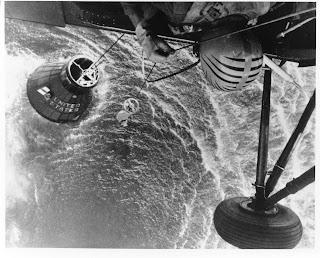
Early in the morning on July 21, 1961, a Redstone rocket
blasted off from a launch pad at Cape Canaveral in Florida. At the top of the
rocket in the tiny Mercury spacecraft sat a Purdue University
graduate who had earned his wings as a pilot with the U.S. Air Force, flying
approximately a hundred combat missions during the Korean War. One of seven men
selected by the federal government to become the country’s first astronauts,
Gus Grissom sat posed to become only the third man and second American to
journey into space. His trip proved to be an eventful one.
Born and raised in Mitchell, Indiana, Grissom, the son of
a railroad signalman, had turned to flying for a career after receiving a
degree in mechanical engineering from Purdue. After his service in
Korea, Grissom had returned to the
United States and had become a test pilot at the
Wright-Patterson Air Force Base near
Dayton,
Ohio. He was still at the
Dayton facility testing aircraft like the F-104 Starfighter
on 4 October 1957, when the
Soviet Union
shocked the world by announcing it had successfully launched the first
satellite,
Sputnik, into space. The 184-pound satellite, the size of a
basketball, could be heard by American tracking stations as it circled the
globe making its “beep-beep” sound. The space race had begun.
After a few false starts (early American rockets had the
disconcerting habit of blowing up), scientists managed to put the first U.S.
satellite, Explorer 1, into orbit
nearly four months after the Russians’ space success. As the public and
politicians clamored for action, the United States initiated in 1958 its
first man-in-space program, Project Mercury. President Dwight Eisenhower
decided that the astronauts for the space program should come from the ranks of
military-service test pilots, and the National Aeronautics and Space
Administration asked the services to list their members who met specific
qualifications. Approximately five hundred candidates qualified; one hundred
and ten survived the initial screening process.

One of the pilots called to Washington, D.C., at the
beginning of February 1959 to be evaluated as a possible astronaut was Grissom,
who received the top secret news from the adjutant at Wright-Patterson, who
asked him, “Gus, what kind of hell have you been raising lately?” A confused
Grissom expressed puzzlement over the question and learned that he had received
orders to report to
Washington
wearing civilian, not military, attire. Before he left home, Grissom's wife, Betty,
thinking of the wildest possibility, prophetically asked him: “What are they
going to do? Shoot you up in the nose cone of an Atlas [rocket]?”
Reporting to the nation's capital (he felt like he had “wandered
right into the middle of a James Bond novel”), Grissom was ushered into a large
reception room filled with men who were, he discovered after a brief time
talking with them, fellow test pilots. From this group, a total of thirty-nine
men, Grissom included, were sent to Lovelace Clinic in Albuquerque, New Mexico,
to be probed and prodded by scientists. They later underwent pressure-suit
tests, heat tests, acceleration tests, and vibration tests at the Aeromedical
Laboratory of the Wright Air Development
Center in Ohio.
From this torturous process NASA picked seven to serve as
Project Mercury astronauts and presented them to the public in April 1959. The
American astronauts were, from the Marines, John Glenn; from the Navy, Walter
Schirra, Alan Shepard, and Malcolm Scott Carpenter; and from the Air Force,
Donald “Deke” Slayton, Gordon Cooper, and Grissom. The Hoosier flier had almost
missed out on the historic designation when doctors during their wide-ranging
tests discovered that Grissom suffered from hay fever. His pointed reply—“there
won’t be any ragweed pollen in space”—saved him from being dropped from
consideration.
With his allergy problem out of the way, Grissom and his
fellow astronauts underwent training to see which one, NASA confidently
predicted, would be the first man in space. The astronauts, except for Glenn,
seemed more at ease with training for going into space than they did with
dealing with the crush of media attention on them and their families. The media
scrutiny would only grow as time went by. On January 19, 1961, Robert Gilruth,
head of Project Mercury, confidentially informed the astronauts of the flight
order: Shepard would be the first man to ride the Redstone rocket; Grissom had
the second flight; and Glenn would be the backup for both missions.
It failed to work out as the American space agency had
hoped; on April 12, 1961, Russian cosmonaut Yuri A. Gagarin made a one-orbit
flight around the Earth that lasted one hundred and eight minutes in his Vostok
spacecraft Swallow, winning for the Soviet Union the honor of being the
first nation to put a human being into the inky void of space. Shepard followed
Gagarin into space with his suborbital flight aboard Freedom 7 on May 5,
1961.
On the morning of his scheduled flight aboard his
spacecraft, designated as the
Liberty Bell 7, Grissom appeared calm and collected. During a last-minute physical,
the doctor examining Grissom had been surprised at his subject’s low blood
pressure. Grissom’s fifteen-minute, thirty-seven-second flight went off without
a hitch, as his capsule made a successful splashdown in the Atlantic Ocean.
From that point on, however, everything that could go wrong did go wrong.
As Grissom waited to be picked up by Marine helicopters from
the carrier Randolph, he informed the chopper pilots that he would need
three or four minutes to check the switch positions on his instrument panel.
According to the recovery plan, the helicopter pilot was supposed to radio to
Grissom as soon as he had lifted the capsule from the water. At that point,
Grissom would remove his helmet, blow off the hatch, and exit the spacecraft.
“I had unhooked the oxygen inlet hose by now and was lying
flat on my back and minding my own business,” Grissom recalled, “when suddenly
the hatch blew off with a dull thud. All I could see was blue sky and sea water
rushing in over the sill.” Tossing off his helmet, the astronaut hoisted
himself through the hatch. “I have never moved as fast in my life,” said
Grissom. “The next thing I knew I was floating high in my suit with the water
up to my armpits.”
Although a helicopter managed to snag the capsule, it could
not handle the weight of the waterlogged spacecraft and had to cut it loose; it
was the first time in his long flying career that Grissom had ever lost an
aircraft. (On July 20, 1999, undersea explorer Curt Newport raised the Liberty Bell
7 from its resting place on the ocean floor. Today the spacecraft is part
of the collection of the Kansas Cosmosphere and Space Center in Hutchinson,
Kansas.)
Meanwhile, the astronaut was struggling to keep from
drowning. Although his space suit kept out the water, he was losing buoyancy
because of an open air-inlet port in the belly of his suit. As he fought to
stay afloat, Grissom regretted the two rolls of dimes, three one-dollar bills,
two sets of pilot’s wings, and some miniature models of the spacecraft he had
stowed in the leg pocket of his space suit as souvenirs of his flight. “I
thought to myself, ‘Well, you’ve gone through the whole flight, and now you’re
going to sink right here in front of all these people,’” Grissom recalled.
An exhausted Grissom finally managed to grab a horse-collar
by a helicopter, and found he had the strength once onboard to grab a Mae West
life jacket and put it on for the flight back to the aircraft carrier. “I
wanted to make certain that if anything happened to this helicopter I would not
have to go through another dunking,” he said.
Once Grissom was safely onboard the Randolph,
an officer came up to him and handed him his space helmet, which had been
plucked from the water by the crew of an escort destroyer. “For your
information,” the officer told the astronaut, “we found it floating right next
to a ten-foot shark.”
After his harrowing near drowning, Grissom had enough
composure to call his wife from Grand
Bahama Island.
A relieved Betty Grissom lightheartedly informed her husband that she had heard
he had “got a little bit wet.” Moving on to more serious matters, she asked him
the crucial question: had he done anything wrong that contributed to the
capsule’s sinking? “I did not do anything wrong,” Grissom emphatically replied.
“That hatch just blew.” With that matter resolved for the moment, the astronaut
calmly ended the conversation by asking his wife to bring some extra slacks and
shirts with her when she met him in Florida.
Although an accident review panel cleared Grissom, and the
other astronauts supported him, unanswered questions about the hatch dogged the
Hoosier native for the rest of his career. In his book The Right Stuff by Thomas Wolfe and the movie of the same name
based on the work, the author and filmmaker insinuated that Grissom panicked
and had been to blame for the hatch coming off ahead of schedule. According to
astronaut Gordon Cooper, these allegations were false. “He [Grissom] did not
screw up and lose his spacecraft,” Cooper said. “Later tests showed the hatch
could malfunction, just as Gus said it did.”
Even the actor who played the unlucky astronaut in the movie
The Right Stuff, Fred Ward, expressed doubt about Grissom blowing the
hatch on purpose. Ward learned that all the astronauts who did blow their
hatches suffered bruised knuckles, and Grissom's knuckles were not bruised. “I
think NASA sort of pointed the finger at him to take the blame off themselves
for losing the capsule,” Ward said. “I don’t think he was responsible at all.”
NASA must have agreed, as it tapped Grissom and John Young
to test out the new two-man Gemini spacecraft on its maiden voyage into space
on a three-orbit mission on March 23, 1965. The agency also selected Grissom to
command the first manned Apollo mission, one of the initial steps on the way to
meeting President John F. Kennedy’s goal of landing a man on the moon and
returning him safely to earth before the end of the decade. Deke Slayton,
responsible for selecting flight crews, privately told his friend Grissom that
if all went well, the Hoosier native would be first in line to command a lunar
mission.
All did not go well. On Friday, January 27, 1967, Grissom
and his crewmates—Roger Chaffee, a rookie and the youngest person ever selected
to join the astronaut corps, and Ed White, the first American to walk in space—were
involved in a simulated countdown of the three-man Apollo spacecraft at the
Kennedy Space Center's Pad 34. At one o’clock in the afternoon astronauts; and
Hoosier native Gus Grissom, the first American to fly in space twice; entered
the Apollo command module, built by North American Aviation. They never made it
out alive. At 6:31 p.m., flight controllers on the ground heard an astronaut,
probably Chaffee, calmly announce: “Fire. I smell fire.” Seconds later, White
more urgently stated: “Fire in the cockpit.”
The intense heat and smoke hampered rescue efforts, but pad
workers finally were able to open the hatch. They were too late; the three
astronauts were dead, killed not by the fire, but the carbon monoxide that
filled the cabin and entered their spacesuits after flames had burned through
their air hoses. Doctors treated 27 men involved in the rescue attempt for
smoke inhalation. Two were hospitalized.
It took NASA more than a year after the accident, during
which time the spacecraft underwent extensive modification, to launch another
manned mission. Apollo 7, commanded by Grissom’s friend Wally Schirra, an
original Mercury astronaut, made 163 orbits during its eleven-day mission in
the redesigned command module; America was back on its way to the moon.
Looking back on the tragedy from a perspective of many
years, NASA flight director Chris Kraft noted that while it was “unforgivable
that we allowed that accident to happen,” if it had never occurred American
would not have gone to the moon when it did. “We made a lot of changes to the
command and lunar modules as a result of that experience,” Kraft said. “I think
we would have had all kinds of trouble getting to the moon with all the systems
problems we had. That terrible experience also brought a new resolve and a
renewed commitment to get the job done.”
It was Grissom himself, however, who perhaps best summed up
the feelings of the astronauts, many of them test pilots used to losing friends
in the line of duty: “If we die, we want people to accept it, and hope it will
not delay the space program. The conquest of space is worth the risk of human
life.”
 Join me as I take a trip back to the nineteenth century and talk to one of Indianapolis's most inspiring women, May Wright Sewall, as we discuss her remarkable life and contributions to the city in a Spirit and Place program at 7 p.m. Friday, November 13, at the Indianapolis Propylaeum Club.