Thursday, July 16, 2020

Campaigning with Kennedy: John Bartlow Martin and the 1960 Election

In June 1960, as Democrats prepared to gather in Los Angeles, California, to nominate their candidate for president, a respected freelance reporter, John Bartlow Martin, sat down and typed out a ten-page memorandum with suggestions for one of the leading candidates for the nomination, U.S. Senator John F. Kennedy of Massachusetts, about how a speechwriting group for a presidential campaign should be organized. Martin, whose work often appeared in the Saturday Evening Post, produced his memo after meeting with the candidate’s campaign manager and brother, Robert Kennedy, who had been asking Martin to serve as a speechwriter if John Kennedy captured the nomination.

From the outset, Martin, who had been a speechwriter for Adlai Stevenson’s presidential efforts in 1952 and 1956, warned that no matter how carefully advance preparations were made, a campaign was “a fast-developing constantly changing affair, and so most speeches that get delivered are, with a few exceptions . . . written almost immediately before delivery. Therefore, a certain amount of helter-skelter confusion is inevitable.”

In addition to establishing a competent research staff at campaign headquarters, which Martin assumed would be in Washington, D.C., he said that when it came to speechwriters, too many “writers-in-residence are an embarrassment, and they tend to talk, not write.” He advised having no more than six full-time writers on the campaign staff, with two based at headquarters producing major speeches a week in advance of their delivery by the candidate. Another two writers should travel with the candidate, revising speech drafts “in the light of current developments.” These writers, noted Martin, often might have to set aside a prepared speech and produce a new one at a moment’s notice. “It will probably turn out that a great deal of what actually gets delivered will be written by these writers who travel with the candidate, particularly as the pace increases toward the end of the campaign,” he said.

The final two speechwriters, whom he described as “legmen and writers,” would be responsible for the position Martin pioneered while with Stevenson in the 1956 California primary—editorial advance. They would be responsible for talking to local political leaders and other sources to find out what should be discussed in a speech, what local luminaries to mention, what kind of crowd to expect, what the physical surroundings would be, and “what the local pitfalls and beartraps are,” Martin explained.

Although it might not seem so at first, the work of these writers “is extraordinarily important,” he said, as a candidate could not deliver a thoughtful speech on a difficult subject if he had been scheduled to appear at, for example, a boiler factory. If the editorial advance men did not do their jobs well, “the headquarters writer may dump the candidate into this trap.” Martin also counseled Kennedy to be open to accepting speech drafts from writers who were not part of the staff, particularly during the end of the campaign. “At that time everybody is exhausted, running out of ideas, running dry on language; and it is extremely helpful during the last two weeks of October to be able to call on somebody wholly new,” Martin said.

Just a few days after receiving Martin’s memo, Robert Kennedy responded, saying what he had provided was “very helpful and much appreciated. It brought back some vivid memories of the [Stevenson] campaign.” Kennedy also added that his brother was “very enthusiastic” when he told him Martin might work on a draft of an acceptance speech to be given in Los Angeles.

On July 11 the Democratic National Convention began in Los Angeles. Although Kennedy and his supporters were urging the 4,509 delegates and alternates gathered at the Sports Arena that it was “time for a new generation of leadership,” the old guard seemed unwilling to depart the stage. Former President Harry Truman said Kennedy lacked “maturity and experience,” and Johnson had announced six days before the convention opened that he, too, would seek the nomination. Those wishing to stop Kennedy from winning the nomination on the first ballot—Johnson, Symington, and Stevenson—believed that by doing so many delegates would abandon the Kennedy cause and look to one of them as the Democratic Party’s nominee.

There were signs, however, that Kennedy was quite near obtaining the 761 delegates needed to win the nomination, as both the vital Pennsylvania and Illinois delegations had broken in his favor, with Stevenson’s home state pledging him only two delegates to fifty-nine for Kennedy. Those working on Kennedy’s behalf were optimistic that even if he failed on the first ballot, their candidate had enough strength to eventually win the nomination. Although there were wild, clamorous demonstrations on the convention floor and in the galleries on Stevenson’s behalf, the outpourings of emotion for the party’s two-time presidential candidate failed to change the outcome, and Stevenson himself did little to push the issue—a grave disappointment to his devoted supporters. Late on Wednesday evening, July 13, near the end of the roll call vote, Wyoming pledged its fifteen delegates to Kennedy, clinching for him the nomination.

From the beginning of Robert Kennedy’s approach to him about being part of his brother’s speechwriting team, Martin had expressed some uneasiness. It seemed to him that Theodore Sorensen, who had joined John Kennedy’s staff as his chief legislative aide when he started his work in the U.S. Senate in 1953, had already become Kennedy’s main writer through his close contact with the senator as the two of them had traveled around the country wooing local party leaders for the past several years. “Bob said that situation would have to change—Sorensen simply could not, in a presidential campaign, remain the only one [speechwriter], and he intended to persuade Jack of this,” said Martin. At the campaign’s outset there did seem to be a division of labor that followed the speechwriting operation as outlined by Martin in his memo to Robert Kennedy.

Shortly after the convention ended, Archibald Cox, a Harvard University law professor who had headed an academic advisory group for John Kennedy before his nomination, met with the candidate at his home in Georgetown. Kennedy asked him if he “would spend full time heading up a unit which would be sort of an intellectual apparatus, preparing speeches,” Cox recalled. “And he was very candid in talking about Ted Sorensen and Ted Sorensen’s fear that somebody was going to elbow his way in between him and Kennedy, and did I think I could get on with Ted Sorensen. And I didn’t see why not, that I could think of only one person in my life that I hadn’t been able to get on with at all. So why shouldn’t I be able to get on with Sorensen?”

Cox established a speechwriting and research team based in offices at 1737 L Street in Washington, D.C., and he hired a staff that included William Atwood, a former Stevenson speechwriter and editor at Look magazine; Joseph Kraft, a former reporter with the New York Times and Washington Post; James Sundquist, a former Truman speechwriter; and Robert Yoakum, a newspaper columnist. The plan, said Kraft, was to try to set up in advance “certain fixed speeches, and he [Cox] assigned those out as soon as we got there. The idea was that these would be done in August before the Senator went on the road.”

Longtime Kennedy assistant Myer “Mike” Feldman headed of the research team, housed in the same building as Cox’s group, and collected reams of material on their Republican opponent, Vice President Richard Nixon. Sorensen and his chief assistant, Richard N. Goodwin, who had joined the Kennedy staff in the fall of 1959 after working as special counsel for a congressional investigation of improprieties in television quiz shows, handled speechwriting chores for Kennedy while he traveled on his private plane, a Convair 240 series twin-engine propeller aircraft named Caroline in honor of his daughter. The plush, for the times, sixteen-seat aircraft did yeoman work during the 1960 presidential campaign, transporting the candidate, his staff, and selected members of the press on flights totaling 225,000 miles.  

The Kennedy team did not forget Martin’s editorial advance idea. They sent Goodwin to Martin’s home in Highland Park, Illinois, to talk to him about issues and positions for the fall campaign, as well as informing him that John Kennedy wanted to try out his system during a whistle-stop trip down California’s Central Valley in mid-September. Martin spent a week in California doing legwork and writing briefing sheets in advance of Kennedy’s visit.

Once done on the West Coast, he journeyed to Detroit to do the same thing for Kennedy in Michigan. “On Labor Day, I stood in the crowd in Cadillac Square, watching Kennedy speak, as I had watched Stevenson speak,” Martin said, “and I was struck by how much more forceful, even aggressive, Kennedy was. He seemed to assume this labor crowd was with him, and if it wasn’t he would convert it, and he did, to cheers.” Martin accompanied Kennedy aboard the Southern Pacific’s New Frontier Special (named for the theme Kennedy had outlined in his acceptance speech at the convention) as it hauled the fifteen-car campaign train for its two-day trip through the Central Valley, with stops in Redding, Sacramento, Richmond, Roseville, Oakland, Bakersfield, and ending with a Democratic rally jammed with 7,000 supporters and another 2,000 waiting outside the Shrine Auditorium in Los Angeles. At each of the whistle-stops, Kennedy gave a five-minute speech from a platform at the train’s rear, and before each Martin supplied him with the briefing sheet he had prepared for the occasion. Kennedy liked what Martin had done with the briefing sheets he provided and asked him to continue doing so throughout the rest of the campaign.

In the end, Martin spent about half of his time out ahead of Kennedy doing his editorial advance work, and the rest of the time with the candidate on the Caroline. There was plenty of work for the speechwriters, noted Sorensen, as Kennedy spoke eight to ten times a day, sometimes in four or five states. In one week of eighteen- to twenty-hour days, the candidate visited twenty-seven states. On the first full campaign weekend alone Kennedy visited Massachusetts, New Hampshire, Maine, California, Alaska, and Michigan. Looking at the packed schedule for the next few months up to Election Day, Martin realized he could never do all the briefing sheets by himself, and so trained Kraft, whom he described as “very bright, a good writer, a good reporter,” to do the work. Kraft, who got on well with both Sorensen and Goodwin, turned out to be an excellent pupil, and he joined Martin in the editorial advance assignment the second week of the campaign during a tour of Texas.

Kraft had been a Kennedy supporter since seeing him at a meeting of Maryland Democrats in January 1960, so when he received the call from Cox to join his “speech factory,” he was glad to offer his assistance. After doing the editorial advance work in Texas, Kraft returned to Los Angeles with the idea that he would be shuttling back and forth from the Cox group to the speechwriting team (Sorensen, Goodwin, and Martin) with Kennedy on the campaign trail. “I never went back to the Cox factory,” Kraft recalled. “I stayed doing the advances and largely being on the plane all the way through the campaign.” He and Martin played leapfrog, with one of them doing advance work in a state, then accompanying the candidate as he made his campaign appearances there, while the other writer did the same in a different state.

Kraft said both Martin and Sorensen advised him on people to see and reporters in the area also offered suggestions. There were some difficulties in the beginning for Kraft, particularly during his first trip into Texas, where he remembered Kennedy saying to him, after one visit, “You can’t leave me naked here like that.” An appearance in Lubbock, Texas, had turned into a near-disaster because Kraft failed to tell Kennedy how to pronounce the name of the town. “He knew about the German town on the Baltic [Sea] and started out . . . saying, ‘It’s great to be here in Lubeck.’” Kraft, however, soon developed a better feel for his position, and it became easier and more routine for him. “A large part of my job was getting to know Sorensen and Goodwin, getting to relax with them, getting to relax with the Senator,” Kraft noted. “He [Kennedy] really liked a relaxed relationship, and you had to know him a little bit in order to achieve it. I only achieved it with time.” The editorial advance system meshed well with the candidate, said Kraft, as Kennedy proved to be adept “at taking a fast briefing, just very, very good at switching gears and picking up something.”

In addition to finding an editorial advance partner in Kraft, Martin had discovered, by the end of the California trip that he had a candidate for president he truly believed in. He had begun his work with some misgivings about Kennedy, a man younger than he was and who appeared to be “a totally different man from Stevenson, and I had admired Stevenson so long. Transferring political loyalty is not easy.”

Sometimes when he watched Kennedy delivering a speech, Martin felt nostalgic for Stevenson’s “graceful prose.” He soon realized, however, that Kennedy was far more effective than Stevenson had been in rallying the country behind his candidacy and, unlike the man from Illinois, spent less time agonizing about the content of his speeches and more time meeting with local politicians. Kennedy also did not mind repeating the same stump speech over and over again. In working for Stevenson, his speechwriters had placed their emphasis on good writing, Martin observed, while for Kennedy, the emphasis was placed on the speech’s political effect. “His speeches did not soar and capture the imagination as has Stevenson’s 1952 speeches,” Martin said of Kennedy, “but they got his message across—that he was young, vigorous, and could get this country moving again.”

Kennedy, who rarely followed the prepared text word for word, did not seem to mind whether or not people admired him for his oratorical skills, but he did care “a great deal about whether his speeches made people want to follow him, to vote for him,” Martin noted. The candidate also had a keen ear on what language worked in a speech, and what failed to move audiences.” When a line proved successful at one stop,” recalled Sorensen, “whether planned or improvised, he [Kennedy] used it at the next and many times thereafter.” Ironically, Stevenson perfectly captured the difference between Kennedy and himself when, introducing the candidate at a rally, he had pointed out that in classical times when Cicero finished speaking people remembered how well he spoke, but when Demosthenes finished speaking people were moved to take action. “It was so apt it stung,” Martin recalled.

Martin found Kennedy much easier to work with than Stevenson, as Kennedy maintained an even keel during the campaign’s rigors and proved to be far more accessible. “He took advice more readily, made decisions faster,” Martin said. “He wasted no time. He used his staff well.”

Connecting with the candidate was not the only hurdle Martin had to face during the campaign. He also had to forge a relationship with Sorensen, who zealously guarded his closeness with Kennedy and wrote, re-wrote, or reviewed every speech. When he had first gone aboard the candidate’s plane, Martin recalled that Sorensen had taken him aside to remind him, “A Kennedy speech has to have class.” In a memorandum to speechwriters he distributed in late July 1960, Sorensen had established the basic theme for campaign speeches that included “the action, summoning every segment of our society; the result, to restore America’s relative strength as a free nation; and the purpose, in order to regain our security and leadership in a fast-changing world menaced by communism.” He continued that a speech should leave behind with an audience the general impression that a Kennedy administration, unlike a Nixon one, could “be trusted to ‘get things done’ on all the new problems that are coming up on ‘the new frontier’ of the 60’s . . . through specific steps that require effort by all the people as well as vigorous Presidential leadership, characterized by both courage and compassion.”

Sorensen and Kennedy had developed such a symbiotic relationship that they communicated “almost by shorthand,” said Martin. He remembered how, when the Caroline stopped for brief appearances at local airports, Kennedy, who viewed Sorensen as “indispensable,” paused before his speech for a word or two from Sorensen, who would “look up at him [Kennedy] and utter a sentence or two, suggesting a speech theme, and Kennedy would think, nod, remember, and go out and deliver it.” Some of the most eloquent campaign prose in his time came from Kennedy, said Martin, who particularly admired the ending of his speeches, which he compared to parables. And when the candidate spoke about such weighty issues as foreign affairs, he did not seem to be tentative and burdened as Stevenson had been. Instead, Kennedy appeared to know “exactly where we should go and how we should get there,” said Martin.

Sentiment played no role during the campaign. “The Kennedys played with a hard ball,” said Martin. He remembered how Sorensen sat outside the door to the senator’s private cabin on the Caroline, “the keeper of the portal,” personally approving anyone who entered. “It was a no-nonsense campaign, work to be done, no time wasted on people’s feelings,” said Martin. He had received a call from his old friend Arthur Schlesinger Jr., offering his speechwriting assistance on Kennedy’s travels. Martin passed the request along to Sorensen, but he nixed the idea, believing the candidate might be criticized by the Republicans (in his speeches Nixon had denounced the Democrats as “the party of Galbraith and Schlesinger and [Chester] Bowles) and the press as being a captive of the liberal Americans for Democratic Action, a group with whom Schlesinger had long been associated. “It was a hardboiled political decision,” said Martin.

Schlesinger said he had offered to do anything the candidate wanted, including joining him on tour, and Sorensen had reacted by telling him he wanted him to do some major speech drafts, but “it was evident that he wished them done at a distance.” Sorensen and Goodwin had “managed to maintain a stranglehold on the speech situation,” Schlesinger said, including blocking for the most part speeches from the Cox group. Cox tried to funnel ideas through Kraft, but it never worked. “A lot of it was spitballing, it had to be spitballed. It would have been impossible really to integrate the Cox operation with the plane operation,” said Kraft. “In a sense it would have been like trying to funnel Niagara into a hose.” It was not, Cox recalled, a “happy time” in his life. Goodwin did note that the material provided by the Cox group made a valuable contribution during the campaign, as it became a sort of traveling library that he carried along on the Caroline in a Sears and Roebuck footlocker and a suitcase. “I don’t know what the hell we would have talked about without it,” Goodwin said.

The pragmatic Martin must have passed muster with Sorensen, as he became, as Kraft noted, the only person closely associated with writing for Stevenson to be a regular part of the Kennedy speechwriting team on the plane. Sorensen had complained that at times the candidate believed the material arriving from the Cox group in Washington, D.C., had not been “responsive to what he wanted.” Still, Kennedy, Sorensen said in his memoirs, had insisted that he find some way to accommodate the speeches Cox and his group produced. “I very much wanted to do so,” said Sorensen. “But Archie was many miles away, out of touch with the every-changing tempo of the campaign.”

The same could not be said of the information provided by the able editorial advance team of Martin and Kraft, collecting, as they were, Sorensen noted, local color, opinion, and commentary, as well as providing “draft introductions, notes, conclusions, and themes for the final speeches to be delivered by the candidate. We almost always made good use of their material.” Pierre Salinger, who handled press relations for the Kennedy campaign, noted that Martin’s local speech inserts were often given more attention by the community’s reporters in their news stories than had the central theme of the candidate’s remarks.

Amidst the endless toil of the campaign trail, there were some lighthearted moments, particularly at the expense of Kennedy’s opponent. On September 26, Kennedy and Nixon faced off in the first-ever televised debate, which was witnessed by an estimated 70 million people; by this time 88 percent of American families owned television sets. “We knew the first televised debate was important,” said Sorensen, “but we had no idea how important it was going to turn out.” Kennedy, tanned from campaigning outdoors, refused makeup, as did Nixon initially. His advisers, however, realizing something needed to be done, used some shave stick to cover up his five o’clock shadow.  It did not work; viewers could see on their television sets a tanned, calm, and confident Kennedy, while Nixon, who had injured his knee during the campaign slamming it on a car door, appeared ill and sweaty under the harsh glare of the television lights. Journalist White, whose book on the campaign, The Making of the President, 1960, became an instant classic, was astounded about the contrast between the two candidate’s faces, with Nixon appearing “tense, almost frightened, at turns glowering and, occasionally haggard-looking to the point of sickness.”

On election night, November 8, Martin and his wife were at the Kennedy compound in Hyannis Port, Massachusetts, where they spent a long and tense evening watching and waiting to see if their candidate won. Campaign staff converted Robert Kennedy’s house, next to his father’s mansion and across the back lawn from John Kennedy’s cottage, noted O’Donnell, into a “communications and vote analysis center that included an array of telephones staffed by fourteen operators to keep in touch with party leaders and poll watchers from across the country.”

The operators, all women, were kept quite busy that night. Although the ballot counting went on into December, Kennedy won a narrow 112,803-vote victory over Nixon out of the nearly 69 million votes cast; the Democrat’s margin was greater in the Electoral College, where he had 303 votes to 219 for Nixon. The vice president had captured more states (twenty-six to twenty-three) than Kennedy, but the Democrat’s strategy of focusing attention on the more populous states had paid off, as he won Illinois, Texas, Michigan, Pennsylvania, and New York. Kennedy’s controversial choice of Johnson for vice president proved to be a fortunate one, as the Democrats won back some of the southern states they had lost to Eisenhower in previous elections, with the big prize being Johnson’s home state of Texas. The Kennedy-Johnson ticket also won in North Carolina, South Carolina, Georgia, Louisiana, Arkansas, and Missouri.

On his third try, Martin had finally been on the winning side of a presidential contest. He spent less time in celebrating Kennedy’s victory, however, than in pondering what his time with the campaign had done to him. In a sense, he said, he had “grown up politically” during his work for Kennedy. Looking back on Stevenson’s 1952 presidential campaign, and even during his time as governor of Illinois, Stevenson had maintained, according to Martin, a particular “amateur attitude toward politics,” an attitude most certainly not shared by the Democratic candidate in 1960. “From him [Kennedy] and his staff and his campaign strategy, I learned hard politics. And this was backed up by what I had learned writing about politics,” Martin noted. For the first time, he began thinking of himself as, while not a professional politician, “at least no longer an amateur.” 

The only regret Martin had after Kennedy had been confirmed as the nation’s thirty-fifth president and he and Fran had been on hand in Washington, D.C., for the inauguration, was that his father had not lived just a few months longer to see another Democrat in the White House. And, as Franklin D. Roosevelt had been the president of his father’s life, Kennedy became the president with whom Martin most identified.

Monday, June 29, 2020

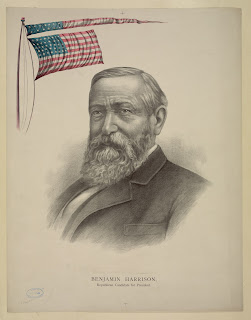
"He's All Right": Electing Benjamin Harrison

On a fall day in 1888 the sound of marching feet echoed through the streets of Indianapolis. Armed with red, white, and blue parasols and led by drummers from eleven states, a crowd of approximately forty thousand commercial travelers marched up North Delaware Street to call upon a local lawyer, who happened to be the Republican nominee for president. As the attorney and his wife appeared at the front door of their sixteen-room Italianate Victorian mansion, the travelers responded with “cheers upon cheers,” one eyewitness, Mary Lord Dimmick, remembered later. The cheers lasted until the attorney spoke, she said, and “then . . . you could have heard a pin drop.”

The crowds that flocked to Indianapolis in 1888 came to visit a man who, from an early age, seemed destined for political greatness. Benjamin Harrison was the son of John Scott Harrison, a two-term congressman from Ohio; grandson of William Henry Harrison, the first governor of the Indiana Territory and ninth president of the United States; and the great-grandson of Benjamin Harrison V, governor of Virginia and a signer of the Declaration of Independence. Benjamin Harrison captured the presidency that year, defeating incumbent Grover Cleveland.
  
The future twenty-third president was born on his grandfather’s farm at North Bend, Ohio, on August 20, 1833. After receiving his early education at Farmers’ College in Cincinnati, Harrison graduated from Miami University in Oxford, Ohio, in 1852. After graduation, the young man studied law for two years with a Cincinnati firm and married Caroline Lavinia Scott, an Oxford Female Institute graduate and an accomplished artist and musician. In 1854 the twenty-one-year-old Harrison and his wife moved to the growing city of Indianapolis, and Harrison established his own law practice.
  
Given Hoosiers’ love of politics, and the famous Harrison name, the young lawyer became drawn—somewhat reluctantly—into the political scene. In 1856 while busy working at his law office, Harrison was interrupted by some Republican friends who dragged him from his office to speak before a political gathering. Introduced to the crowd as the grandson of “Old Tippecanoe,” Harrison firmly replied: “I want it understood that I am the grandson of nobody. I believe that every man should stand on his own merits.”
  
The Harrison family’s strong political background, however, did aid young Harrison as he undertook a political career, becoming Indianapolis city attorney in 1857 and being elected to the post of Indiana Supreme Court reporter three years later. The Civil War halted Harrison’s political career. Asked by Indiana governor Oliver P. Morton to recruit men for the Seventieth Indiana Volunteer Infantry, Harrison served as a colonel with that outfit and offered sterling service to the Union cause in the battles of Peach Tree Creek and Resaca, Georgia. During the war Harrison received the nickname “Little Ben” from his troops (he stood five feet, six inches tall).
  
In a one-month period during the Union’s fight to take Atlanta, Harrison, now in charge of a brigade of regiments that included the Seventieth, had participated in more battles than his grandfather, William Henry Harrison, had fought during his lifetime. At New Hope Church, Georgia, Harrison had his troops fix bayonets to attack the enemy position “Men, the enemy’s works are just ahead of us, but we will go right over them. Forward! Double-quick! March!” he ordered.
  
After a bloody action at Golgotha Church near Kennesaw Mountain on June 15—fighting where two or three of his men had their heads torn off down to their shoulders—Harrison pitched in to help with the wounded, as the brigade’s surgeons had scattered in the fighting. “Poor fellows!” Harrison said of the casualties who had taken shelter in a frame house. “I was but an awkward surgeon of course, but I hope I gave them some relief,” he wrote Caroline. The colonel treated some “ghastly wounds,” including pulling from a soldier’s arm a “splinter five or six inches long and as thick as my three fingers.” He also ordered tents to be torn up so the strips of cloth could be used to bandage the wounded.
  
Mustered out of the Grand Army of the Republic with a brevet brigadier general’s commission, Harrison returned to Indianapolis to fill out his term as Indiana Supreme Court reporter before returning to his private law practice. Paradoxically for Harrison, his biographer Harry J. Sievers noted, the financial panic that gripped the country in the early 1870s aided his firm as “defaults, mortgage foreclosures, and bankruptcy cases flooded the office.”
  
Financially secure, Harrison turned his attention to building a new home for his family, which included at that time two teenage children, Russell and Mary. In 1867 Harrison had purchased at auction a double lot on North Delaware Street, and it was here that the family’s new red brick home was built during the fall and winter of 1874 and 1875 at a cost of approximately $20,000. Along with a library for Harrison’s substantial book collection, the home possessed a ballroom and became a popular location for society events, including Thursday afternoon teas hosted by Caroline Scott Harrison, first president-general of the Daughters of the American Revolution.
  
In 1876 Harrison returned to the political arena, running as the GOP candidate for Indiana governor. He lost to Democrat James “Blue Jeans” Williams; his electoral failure, however, did not hurt his strong standing with Hoosier Republicans. In 1881 the Indiana legislature, controlled by the GOP, elected Harrison to serve a six-year term in the U.S. Senate. Harrison arrived on the national scene at an opportune time where Indiana played a prominent role on the national political scene following the Civil War. To attract Hoosier voters, political parties often selected “favorite sons” from Indiana to bolster the parties’ chances in November.
  
In 1888 the Republican Party nominated Harrison as its presidential candidate. Like most presidential contenders of that time, Harrison refused to barnstorm around the country for votes, preferring instead to remain at home. “I have a great risk of meeting a fool at home,” he told journalist Whitelaw Reid, “but the candidate who travels cannot escape him.”
  
While Cleveland remained in the White House, content with his duties as president and believing in the dictum “the office sought the man,” Harrison embarked on a busy speaking schedule that saw him give more than eighty extemporaneous talks to more than 300,000 visitors to Indianapolis from July 7 to October 25. Usually, there were anywhere from one to three delegations per day, but at one point Harrison met seven on one day. To meet the demand posed by those who clamored to see the candidate at his Indianapolis home, a “committee of arrangements” was formed to manage the deluge of letters sent to Harrison and to schedule and control visitors.

The crowds soon overwhelmed the space at the Delaware Street house, and instead were moved about a mile away to University Park, the former drilling ground for Union soldiers. Marching bands were on hand at Union Station to welcome delegations as they arrived and accompanied them as they walked to the park. All the remarks made by outside groups were closely scrutinized to ensure that no controversial statements were uttered, and Harrison listened to them and often adjusted his speech to reflect what had been covered. Delegations included such groups as commercial travelers, Union war veterans, railroad workers, African American supporters, young girls who had formed a Harrison Club, and old followers of William Henry Harrison’s 1840 presidential campaign.
  
Although at the beginning of the campaign Harrison had called for the two parties to “encamp upon the high plains of principle and not in the low swamps of personal defamation or detraction,” his hopes were dashed by the 1888 election’s two great controversies—one that damaged Cleveland’s chances, and one that hurt Harrison. 

The first broadside came in October with what became known as the MurchisonLetter. A California Republican had sent a letter, signed as Charles F. Murchison, to Sir Lionel Sackville-West, the British minister (ambassador) to the United States, asking his advice on how to vote. Not suspecting a trap, Sackville-West answered the letter with friendly words and support for the Cleveland administration as the best choice for British interests despite recent tensions over a dispute regarding fishing rights in Canada. Republican officials released Sackville-West’s letter to the press. The seemingly friendly relations between the hated British and the Cleveland administration infuriated Irish-American voters in New York, and Cleveland had to call for Sackville-West to be dismissed.
  
Shortly after the Murchison Letter had caused such a furor, the Democrats struck political gold with another letter, this one involving William W. Dudley, the Republican National Committee treasurer, and featured the class of voter known as a “floater,” a person with no fixed party allegiance who sold his ballot to the highest bidder, be it Republican or Democrat. Party workers could buy these votes for as little as two dollars or as high as twenty dollars in close elections, and since political parties, not the state, printed and furnished ballots to voters, could ensure that once a “floater” was bought, he stayed bought. “This infamous practice,” complained the Shelbyville Republican, “kept up year after year by both parties, has brought about a state of affairs that cannot be contemplated without a shudder.” The newspaper went on to lament that a third of the state’s voting population “can be directly influenced by the use of money on the day of election.”
 
In a letter sent to an Indiana Republican county chairman, Dudley warned that “only boodle and fraudulent votes and false counting of returns can beat us in the State [Indiana].” To counter this threat, he advised Republican workers to find out what Democrats at the polls were responsible for bribing voters and steer committed Democratic supporters to them, thereby exhausting the opposition’s cash stockpile. The most damaging part of the letter, however, appeared in a sentence where Dudley advised: “Divide the voters into blocks of five, and put a trusted man, with necessary funds, in charge of these five, and make them responsible that none get away.”
  
The political dynamite in Dudley’s letter found its way to the opposition thanks to a Democratic mail clerk on the Ohio and Mississippi Railroad who was suspicious about the large amount of mail being passed from Republican headquarters to Indiana Republicans. He opened one of the letters, recognized its value to his party, and passed the damaging contents to the Indiana Democratic State Central Committee. The Sentinel printed the letter on October 31, 1888, under a banner headline reading: “The Plot to Buy Indiana.” 

Although an indignant Dudley and other top Republican officials declared that the letter was a forgery, and denounced the person responsible for interfering with the mail, its contents received nationwide attention, with newspapers supporting the Democratic cause, including the Sentinel, happy to lambast Harrison for his ties to such chicanery, while Republican papers defended their candidate’s character. A political veteran such as Michener said that the instructions Dudley outlined were standard practice by both parties in Indiana, and found nothing in the letter “unusual, illegal or immoral.”
 
 What effect both scandals had on the campaign’s outcome is still debated by historians, with Charles Calhoun, in his book on the 1888 election, arguing that underhanded practices by both parties in New York and Indiana “may well have canceled each other out," while racist voting restrictions in the South blocked most African Americans from casting ballots for Republican candidates. 

Whatever the impact nationally, in Indiana the Dudley letter had failed to dampen the enthusiasm of Hoosier Republicans for their favorite son. The day before the election, Harrison, on his way to his downtown law office, was greeted with applause and cheering. On Election Day, Tuesday, November 6, Harrison walked from his home, accompanied by his son, Russell, to Coburn’s Livery Stable at Seventh Street between Delaware and Alabama Streets, the polling place for the third precinct of the second war. To a cry from a supporter of “There comes the next President,” Harrison cast the ballot he had carried with him from his home.
  
After voting, Harrison returned home to learn his fate as a candidate, with regular reports coming to him in his library through a special telegraph wire connecting him with Republican headquarters in New York. After the polls closed, downtown streets in Indianapolis were clogged with people eager to hear the results, with many gathering near newspaper offices to receive reports. “As the morning drew nearer,” noted an article in the Indianapolis Journal, “the wild crowd, growing hilarious with excitement, would receive a return with cheers, and the next moment follow it up with a refrain of ‘Bye, Grover, bye; O, good-bye, old Grover, good-bye.’ Another return, and ‘What’s the matter with Harrison? He’s all right.”
  
Several people gathered around a large, oval writing table in Harrison’s library to read over the returns. When vote totals arrived over the wire from New York, they were read aloud, sometimes by Harrison and sometimes by his law partners, while Russell sorted bulletins by state. The Journal described the scene as “a quiet gathering of a few neighbors,” adding that Harrison seemed “cool and self-possessed,” sometimes retreating to the parlor to talk with his wife, Caroline, and her guests. According to one account, when returns from the state of New York seemed discouraging, Harrison took the news well, telling his friends to cheer up. “This is no life and death affair. I am very happy here in Indianapolis and will continue to be if I’m not elected. Home is a pretty good place.”
  
Harrison seemed much more concerned about whether he won Indiana, closely perusing returns from each of the state’s ninety-two counties. When his son-in-law, at about 11:00 p.m., announced that it looked as if Indiana had been won, Harrison responded: “That’s enough for me tonight then. My own State is for me. I’m going to bed.” 

At the White House, Cleveland also monitored the election results. At midnight in Washington, D.C., Secretary of the Navy William Collins Whitney, walked out of the telegraph room and down a corridor to announce: “Well, it’s all up.” Asked the next morning how he could go to sleep still not knowing whether he had won the presidency, Harrison noted that his staying up would not have changed the results if he had lost, and if he won he knew he “had a hard day ahead of me. So I thought a night’s rest was best in any event.”
 
The Hoosier candidate won the presidency, securing the Electoral College with 233 votes to 168 for Cleveland. Harrison had been able to grab the crucial states of New York and Indiana, winning both by the barest of margins (by 2,376 votes in the Hoosier State and 14,373 votes in New York; in both states turnout exceeded 90 percent); both of these were states that Cleveland had captured in the 1884 election. In the popular vote, Cleveland bested Harrison, with 5,534,488 votes to 5,443,892 for his opponent, becoming the third of five presidential candidates to win the popular vote but lose in the Electoral College (the other losing candidates were Andrew Jackson in 1824, Samuel Tilden in 1876, Al Gore in 2000, and Hillary Clinton in 2016). 


Friday, May 15, 2020

John Bartlow Martin and the Upper Peninsula of Michigan

Since his boyhood growing up in Indiana, John Bartlow Martin had sought relaxation through outdoor pursuits, continuing to do so during his days as a reporter for the Indianapolis Times and while he eked out a living as a fledgling freelance writer in Chicago for true-crime magazines. Newly married in the summer of 1940, Martin pondered where he and his new wife, Fran, could travel for their honeymoon.

Although he was used to retreating to rented cottages in northern Wisconsin on fishing expeditions, Martin had begun to believe that Wisconsin had become “too civilized, too crowded with tourists, too organized,” he sought a more remote spot for time alone with his new bride. The couple decided to try Michigan’s Upper Peninsula, a region that one writer described as “a wild and comparative Scandinavian tract—20,000 square miles of howling wilderness on the shores of Lake Superior.”

The couple picked out “an isolated town on the map with a name we liked, Michigamme,” Martin recalled. They rented a camp—as cottages and cabins were called in the region, a holdover term from the days when lumberjacks lived all winter in logging camps—without electricity or running water at the town of Three Lakes, named for the nearby Ruth, George, and Beaufort Lakes. “Some honeymoon!” Martin recalled “But it was on the shore of a beautiful lake and it shared the shore with only a few other camps, and the fishing was excellent, and we met people who remained our friends until they died."

When the Martins first visited, Three Lakes consisted of just one country store, Numi’s Service Station, operated by Earl Numinen, the son of a Finnish immigrant. As the social center for the tiny community, the store offered local residents and tourists such supplies as gasoline from its two pumps (only one actually worked), fresh fruits and vegetables (once a week), beans, cigarettes, socks, Finnish boot grease, slabs of bacon, and a mosquito repellent known as Lollacapop. On Friday evenings Numinen’s father fired up the sauna, or Finnish steam bath, and those who braved its overwhelming heat included miners attempting to sweat the hematite out of their pores and a few poor souls looking for relief from their hangovers. “A day lived at the store is like a year lived elsewhere,” Martin said. 

The Martins’ honeymoon marked the first of many summer trips to the Upper Peninsula in the years to come. The couple purchased a camp of their own on Three Lakes and Martin discovered that those who lived in the region did not bend over backwards to welcome outsiders. “You will have to do nearly everything for yourself,” he warned would-be tourists. “The region is not geared to make your visit painless.” The lack of modern conveniences and the clannishness of the locals could be maddening, he said, but if an outsider adjusted his thinking and fit into the region’s ways, he could find “no better vacation spot."

Although a relative newcomer, Martin, from the first, believed that he could write something about this wild country and its “magnificent waterfalls, great forests, high rough hills, long stretches of uninhabited country, abundant fish and game.” With the aid of a Chicago bookstore owner and a New York publisher, Martin, who had begun to break out of the true-crime field with “serious nonfiction” contributions to prestigious national magazine, saw his wish come to fruition with the publication on May 15, 1944, of Call It North Country.

Martin had been able to capture in his first book not only the region’s wild beauty, but the character of those who lived there—people “among the finest and friendliest on earth,” who, he said, “when they know you and like you, there is absolutely nothing they will not do for you. But this takes time, you must not push, they have to find out about you.”

During the summer of 1943, Martin, assisted by Fran, drove to the Upper Peninsula to conduct research, visiting the Marquette County Historical Society, consulting newspaper clipping files, reading books, and interviewing a number of people in the region’s logging and mining communities—lumberjacks, miners, trappers, newspapermen, saloonkeepers, local historians, police officers, shop owners, retired prostitutes, game wardens, and plain citizens, “some of them,” Martin noted, “old-timers with long memories.”

Martin realized that his work on the Upper Peninsula could be what came to later be known as social history, as it portrayed “how the American people talked, worked, and behaved.” The stories he garnered from the people he interviewed were important because nearly everybody whose recollections of the old days were “entombed” in the book were themselves entombed not long afterwards. “It wasn’t a bad idea to get them down on paper for our children,” Martin said. 

Martin and Fran spent hours reviewing proofs sent to them by the Knopf publishing firm. “Proofreading,” he wrote a friend, “is a job unfit for human consumption. I had no idea it was a big a job as it is.” The couple was also responsible for preparing the book’s index. “God! Publishers certainly get their thousand dollars worth,” Martin joked about the advance he had received from Knopf.

Martin did note that an author seeing his first book in type “probably is a kick never repeated. You sign a contract then go out and do a lot of legwork then type page after page of copy and send it in—and then nothing happens, and you begin to wonder if maybe you weren’t just sort of making it up. Then along come the proofs and bang—it’s really going to be a book after all.”

The book also marked the first time Martin used his full name, John Bartlow Martin, for his byline, as there were other authors who wrote under the name John Martin. He later had second thoughts about his decision, believing the name was too long to print or pronounce, “like a pompous Christian divine’s, but once I did it I was stuck with it.”

Call It North Country, which had a second printing by Knopf in July 1944, sold well for a regional book, approximately ten thousand copies, Martin estimated, and received solid reviews from major newspapers in New York and Chicago.

Martin was most pleased, however, by the book’s acceptance by the people it described and its longevity. On his many trips to the Upper Peninsula, Martin often came across old copies of his book in other people’s houses or on bookshelves in camps. These were copies that had been “almost read literally to pieces, their spines cracked, pages loose, pages pencil-marked and with coffee spilled on them, books that have really been read. That is the readership an author appreciates.”


Tuesday, May 12, 2020

The Other Hoosier Poet: William Herschell

Upon awaking one day in May 1919 at his home at 958 Tecumseh Place near Woodruff Place in Indianapolis, a longtime feature reporter for the Indianapolis News, William Herschell, trudged wearily to breakfast. Turning to his wife, Josephine, the journalist complained that he had no idea what to write about for that day’s issue.


Unsure of what to do, Herschell picked up his typewriter and traveled out of town, finally ending his sojourn in the countryside at Brandywine Creek in Greenfield, Indiana. At the creek he spied an older man fishing while sitting on a log. When the reporter commented on the area’s beauty, the fisherman responded, “I can’t complain, after all God’s been pretty good to Indiana, ain’t he?”
   
The offhand remark on this lonely stretch of water inspired Herschell to write his masterpiece, “Ain’t God Good to Indiana?” The poem proved popular with not only with Hoosiers (the work is inscribed on a bronze plaque in the rotunda of the Indiana Statehouse), but with readers from around the country who clamored for copies. The demand grew so great that Herschell’s wife had to issue special printed facsimiles of the poem.

During his career at the News, which started in 1902 and ended with his death at age sixty-six in 1939, Herschell contributed countless poems and feature articles for the newspaper’s Saturday edition. In addition, his World War I song “Long Boy” contributed the doughboy refrain, “Goodbye Ma! Goodbye Pa! Goodbye mule with your old heehaw!” to the nation’s vocabulary. Herschell, a close companion of famed Hoosier Poet James Whitcomb Riley, worked in a corner of the newspaper’s ninth floor that came to be known as the Idle Ward. Along with Herschell, other members of that delightful company included cartoonists Gaar Williams and Frank McKinney “Kin” Hubbard, creator of the renowned cracker-barrel philosopher Abe Martin. The three men were all quite productive when it came to producing copy and illustrations, but they seemed idle to other newspaper employees because they always seemed to be able to find time to discuss and gossip about the issues of the day.
  
Born in Spencer, Indiana, on November 17, 1873, Herschell was the eldest of six children born to Scottish immigrants John and Martha (Leitch) Herschell. Trained as a blacksmith in his native Scotland, John worked for the Indianapolis and Vincennes Railroad and later served as foreman for a quarry near Spencer that supplied limestone for the state capitol in Indianapolis. One of William’s earliest memories involved his father sitting by lamplight to recite to his family the poems of Robert Burns. John’s work with the Evansville, Rockport, and Eastern Railroad took him and his family to a succession of communities in southwestern Indiana, including Rockport, Evansville, Huntingburg, and Princeton.
 
Although at best an unfocused student, Herschell did display some of the writing talent he later used during his newspaper career. While in the Huntingburg school system he was falsely accused of running away with the teacher’s pet dog. An unabashed Herschell penned the following in reply: “Teacher says I stole his dog / But why should I steal Jim, / When teachers with me all day long / And I can look at him?” Herschell’s talent for thumbing his nose at the school’s authorities proved to be his undoing.
  
As a seventh grader, Herschell, already a solid supporter of the Republican Party, played hooky from school to carry in a political parade a banner that proclaimed, “A Vote for [Grover] Cleveland Means Souphouses.”  The school’s principal found out about Herschell’s truancy—and political persuasion—and expelled him from school, noting, “Inasmuch as William Herschell had gone into politics he could not possibly wish further education.”
  
With the assistance of his father, Herschell found work as an apprentice railroad machinist. In 1894 when Eugene Debs’s American Railway Union told its members to refuse to handle Pullman cars in support of striking workers at the Pullman plants in Illinois, Herschell allied himself closely with the union cause. With the strike’s failure, Herschell found himself out of a job. Leaving the Hoosier State, Herschell toiled at a succession of jobs, including stints in Chicago, Buffalo, and Canada. Returning to the United States, he worked at an electric-light plant in North Tonawanda, New York. He eventually found his way back to his native state, where he worked as a night machinist for the Monon Railroad.
  
On a visit to his family in Princeton in 1896, Herschell met James McCormick, who just three years before had started the Princeton Evening News, an independent Republican Party daily. McCormick offered Herschell a job, telling him, “I’ll give you $9 a week, if you can get it.” Herschell did not discover what his editor had meant until the end of his first week at the newspaper. After everyone else on the paper had received his wages, there remained only four dollars left for Herschell.

Week after week there never seemed to be enough funds to pay Herschell his full salary. On one occasion, McCormick even had to borrow brown wrapping paper from a local butcher to publish his afternoon newspaper. An editorial dedicated the issue as “A Souvenir Edition to Our Creditors.” To supplement his meager income, Herschell served as the Princeton correspondent for several larger newspapers, including the Indianapolis News. Herschell sometimes used his money from other publications to buy enough newsprint for McCormick to print his paper.
  
Although McCormick and Herschell became close friends, the publisher did not stand in his protégé’s way when, in 1898, Herschell received a job offer from the Evansville Journal. Before Herschell left for his new duties, he found waiting for him in the newspaper’s editorial office a gold watch—a going-away present from McCormick. Later, Herschell dedicated his 1922 book Howdy All: And Other Care-Free Rhymes to McCormick, noting that the editor taught him it was “easier to swing a pencil than a hammer.”

A year after starting at the Evansville newspaper, Herschell left to join the staff of the Indianapolis Press as a police reporter. With the folding of the Press after only sixteen months, Herschell moved to the Terre Haute Tribune. He returned to Indianapolis in 1902 for a position with the Indianapolis Journal. Herschell’s work at the Journal soon caught the attention of Dick Herrick, secretary to Indianapolis News editor Hilton U.Brown. Herrick told his boss that Herschell was “full of fun, can write rhymes and can make the dullest story read like a novel. He belongs here and ought to make a top feature man.” Taking his secretary’s advice, Brown hired Herschell in April 1902, beginning the reporter’s thirty-seven-year association with the newspaper.
  
In his early years on the News, Herschell served as a police and court reporter and won the lasting respect of the Indianapolis police department. At slack times, members of the department and local media conducted mock trials at an old bicycle barn. Conducted by the newspapermen, these trials often concluded with the officers having to pay a cigar or two in fines. Herschell presided over the proceedings as judge. His wife, Josephine, who also worked at the News, noted that her husband acted like “a regular roughneck when he came home at night after hanging around the police station all day. But he changed a lot after he became a feature writer.” Josephine also noted that her husband used to jokingly scold a clock that he had been given as a boy, especially when he arrived home later than he had told her to expect him. “We had a lovely life together,” she said.
  
In 1911 News editor Richard Smith, impressed with Herschell’s poetry, assigned him to write poems and feature articles for the newspaper’s Saturday edition. Herschell’s poems about such staples of city life as policemen, firemen, street urchins, and other characters appeared in a series titled “Songs of the City Streets.” Later, his paeans to rural life were highlighted in the series “Ballads of the Byways.”

A fellow News employee noted that Herschell was a true democrat, a friend to everyone from bank presidents to truckers, and a person who could “rub elbows with prominent men at some important banquet, and the next day revel in a picnic at [Indianapolis’s] Douglass park.” The poetry Herschell wrote for the newspaper was collected and published in a number of books during his lifetime, including Songs of the Streets and Byways (1915), The Kid Has Gone to the Colors and Other Verse (1917), The Smile Bringer and Other Bits of Cheer (1919), Meet the Folks (1924), and Hitch and Come In (1928). A posthumous collection, Song of the Morning and Other Poems, which was put together by his widow, appeared in 1940.
  
Known simply as Bill to his friends inside and outside the newspaper, Herschell won the esteem of readers through his simple verses, flavored as they were with the dialect style pioneered so successfully by Riley. “There was no dullness where he was and there were no dead lines in what he wrote,” Brown said of Herschell, who became well known for his laugh, described by Brown as a “musical roar” and which “preceded him wherever he appeared.”

Profiling Herschell for a biographical pamphlet produced by the News in 1926, B. Wallace Lewis described him as looking “more like the manager of a successful retail store than a poet. He is big, with the kind of bigness that goes clear through. A round head, hair trimmed close, joins to a massive trunk with a powerful neck. The hands that once wielded a machinist’s hammer are strong and grip yours as if they meant it.” 
  
With America’s entry into World War I, the subject of Herschell’s writing began to turn more and more to wartime matters. He produced for the News such poems as “The Service Flag” and “The Kid Has Gone to the Colors.” His most successful effort, however, came after he spent time at Indianapolis’s Fort Benjamin Harrison, which then served as an officers’ training camp. Herschell became close friends with the camp’s commander, Major General Edwin F. Glenn. The two men often spent a part of each morning discussing news about the war and what was going on at the camp. During one meeting on May 18, 1917, Glenn asked Herschell to use his talents to write a war song. “These boys out here,” Glenn said, “are sick of singing about ‘Mother Dear’ and ‘Broken Hearts’ and ‘Gentle Eyes of Blue.’ Give us something that will keep down homesickness, the curse of an army camp.”

As he crossed the parade ground on his way to return to the office, Herschell spied a company of tall soldiers passing by, which gave him the inspiration to write about the army’s “long boys.” Driving back to downtown Indianapolis, he began to formulate the song’s words and sang them to News photographer Paul Schideler. Charles Dennis, who worked just a few desks down from Herschell at the newspaper, remembered the day the reporter came back from Fort Harrison to work on the song “with pursed lips and corrugated brow, his blue eyes in a fine frenzy rolling.”

After seeing Herschell finish his writing, Dennis slipped into a chair next to the poet to view and hear the result. “As he voiced the verses the workers in this hive of industry gathered about him,” said Dennis. “Other workers from various parts of the building came in. He was obliged to sing it over and over again and though his throat became raw and raucous he kept his good humor through seventeen recalls, and the curtain went down amid the most appreciative applause.”
  
The next day, Herschell submitted his work, titled “Long Boy,” for Glenn’s review. The general took an immediate liking to the song, especially the chorus line “I may not know what th’ war’s about, / But you bet, by gosh, I’ll soon find out.” Several members of Glenn’s staff also expressed their satisfaction with the song, and the general asked Herschell to find someone to set the words to music so his troops could sing it on parade.

Herschell responded by turning the lyrics over to Bradley Walker, an Indianapolis composer, who produced the music for the song. Just a week later, the troops at Fort Harrison sang “Long Boy” as they passed in review before Ohio governor James M. Cox. The song became an instant success, selling more than a million copies. Wabash College honored Herschell for his war verse by awarding him an honorary degree.
  
Herschell died on December 2, 1939, at his Indianapolis home. His last words to his wife were: “I’ll whip it yet, Jo.” Reminiscing about Herschell’s life, the newspaper he served for so many years said that he had been a part of Indianapolis as much as the Indiana Soldiers and Sailors Monument. “He loved writing,” said the News, “he loved to compose his sincere verse, but most of all he loved people. Otherwise he could not have written so inspiringly of their lives.”


Monday, May 11, 2020

The Fatal Cocktail: Charles W. Fairbanks and Theodore Roosevelt

Everything seemed perfect at the Indianapolis home of Vice President Charles Warren Fairbanks on Memorial Day in May 1907. Fairbanks’ palatial Meridian Street residence had been decorated for a visit from the Rough Rider himself, President Theodore Roosevelt, who was in the city to help dedicate a statue at the Marion County Courthouse honoring Hoosier General Henry W. Lawton.
  
A luncheon on the president’s behalf, featuring a menu that included planked whitefish and broiled spring chicken, was nearly ready to start when Mrs. John N. Carey, busy helping Fairbanks’ wife, Cornelia, with the preparations, notice that something was missing—the cocktails. According to an account in the Indianapolis News, Carey, a friend of the Fairbanks family, “immediately telephoned to the Columbia Club for forty of the necessary dinner openers.” Indianapolis mayor Charles A. Bookwalter volunteered the use of his automobile, and the drinks, described by the reporter covering the event as “amber Manhattans,” arrived in time for the guests to enjoy.
  
A teetotaler and Methodist, Fairbanks may not have drunk any liquor himself at the meal, but he bore the brunt of nationwide newspaper attacks on his character when they learned of the cocktail incident. The “cocktail affair,” and Roosevelt’s cool feelings toward his one-time running mate, combined to work against Fairbanks in his attempt to capture the 1908 GOP presidential nomination. Nicknamed Buttermilk Charlie for his advocacy of buttermilk instead of hard liquor, Fairbanks had a brand-new moniker after the Roosevelt affair—Cocktail Charlie. The tall, stern, conservative Hoosier politician, said one high Methodist official, had been “crucified by a cocktail.”
  
Like his early political opponent Benjamin Harrison, Fairbanks was an Ohio native, born in that state on May 11, 1852. Fairbanks was one of the few politicians who could say truthfully say that he had been born in a log cabin, a house owned by his farmer father. A graduate of the Cleveland Law College, Fairbanks became a successful attorney, establishing a practice in Indianapolis and earning a fortune representing a number of railroads. He also became a powerful force in the Indiana Republican Party, winning election by the Indiana General Assembly to a seat in the U.S. Senate.
  
In 1904 Fairbanks received the GOP nomination as vice president, running with the progressive-minded Roosevelt on the national ticket. Although the two men were never friends—Roosevelt even called Fairbanks a “reactionary machine politician”—their coolness toward one another did not damage their chances at the polls. The Republican ticket swamped Democratic candidate Alton B. Parker by more than 2.5 million votes. Hearing about the overwhelming GOP election returns, a pleased Roosevelt exclaimed, “How they are voting for me! How they are voting for me!”
  
After the excitement of a landslide election victory, Fairbanks settled down into the drudgery of being vice president. Although Roosevelt had once advocated increasing the office’s power and responsibility, he made no such changes. During his four years in office, Fairbanks played little or no role in the Roosevelt administration. On one occasion Roosevelt, irritated by the tinkling sound made by a White House chandelier, turned to his butler and said: “Take it to the vice president. He needs something to keep him awake.”
  
The tension between the two Republicans was put aside for the moment when Roosevelt agreed to travel to Indianapolis to help dedicate a statue honoring Hoosier hero Lawton, a Spanish-American War general later killed fighting insurgents opposed to America’s control of the Philippines. Arriving at Union State shortly before 11:00 a.m. on Memorial Day, the president journeyed to the Fairbanks home at 1522 North Meridian Street to be the guest of honor at what he called “a big political lunch.” The guest list for the occasion included such prominent names as James Whitcomb Riley, Meredith Nicholson, William Dudley Foulke, and Albert Beveridge.
  
The forty guests were divided into two parties, one hosted by Fairbanks in the dining room, and the second, headed by U.S. Senator James Hemenway, in the library. In describing the sumptuous affair to its readers, the Indianapolis News included a last-minute item that received nationwide attention. It read: “Just a few minutes before time to open the dining-room doors a panic resulted from the discovery that the cocktails had been overlooked, the caterer having failed to provide them.” With Carey and Bookwalter’s aid, the drinks were secured from the Columbia Club and when the guests “filed into the dining room the amber Manhattans stood in long rows, one before each plate.”
  
The nation’s media turned Fairbanks’s serving of cocktails to his guests into a major controversy. The incident was first brought up as an issue by the Patriot Phalanx, a weekly Indianapolis prohibitionist newspaper. The Phalanx interviewed several reporters who witnessed the lunch and claimed that along with the Manhattans, wine also graced the table. One reporter claimed that the “waiters did not allow any of the glasses to remain empty, but kept filling them up from the bottles.” The article on the luncheon received additional coverage in such newspapers as the New York World and Indianapolis Sun. Many newspapers used the incident to make fun of Fairbanks.
  
The president expressed surprise about the uproar caused by the incident. In his memoirs, Indiana politician James Watson told about a visit he made to see Roosevelt during the controversy. Watson, a Methodist himself, quoted the president as saying: “You Methodists out in Indiana are a great lot. I drank a cocktail out at Vice-President Fairbanks’s home, whereupon all the members of your church landed on that gentleman and almost rode him out of the organization. That treatment was so uncalled for that, if it were not altogether ludicrous and preposterous, I would say it was simply outrageous.”
  
Although the negative publicity he received from the “cocktail affair” did not in itself cost Fairbanks the Republic nomination for president in 1908, the added strain the incident put on his already shaky relations with Roosevelt did not help his campaign. Instead of his vice president, Roosevelt supported the candidacy of William Howard Taft, who had served as his secretary of war.
    
Fairbanks’ failure to capture the 1908 GOP presidential nomination did not end his political career. In 1916 he was again the Republican’s choice as vice president. Fairbanks and Charles Evans Hughes, however, lost the race to incumbent President Woodrow Wilson and his Hoosier running mate, Thomas Marshall. After his death on June 4, 1918, Fairbanks’s name would probably have been left in history’s dustbin were it not for a central Alaska town’s decision to name itself after the vice president.
  
Even when Fairbanks is remembered it is often not for his political stature, but rather for his physical stature. Naming Fairbanks one of Indiana’s two greatest senators in 1957 for a selection committee choosing the U.S. Senate’s five most distinguished senators of all time, former President Harry Truman could only give this rationale for the honor bestowed on Fairbanks: “It is said that the mirror in the Vice President’s office, which once belonged to Dolly Madison, is placed at its present height so that Vice President Fairbanks could see to comb his hair.”